
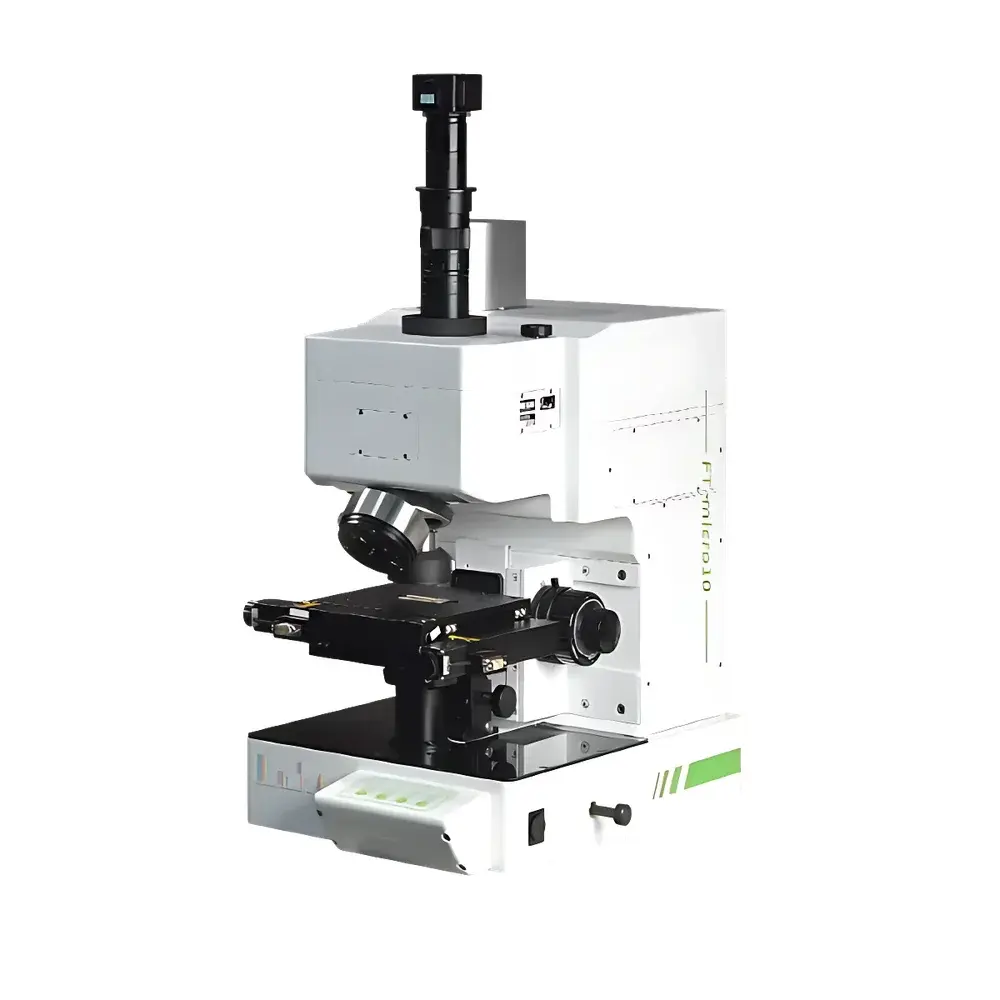
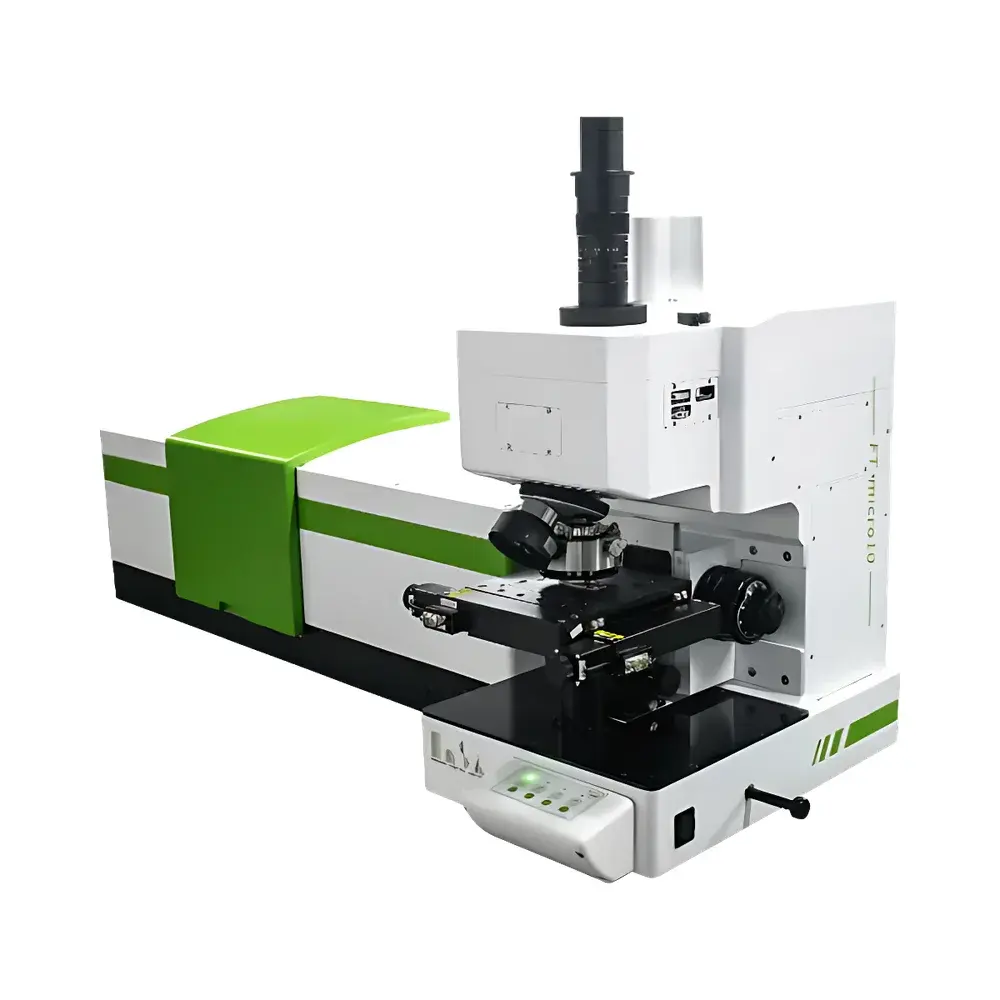
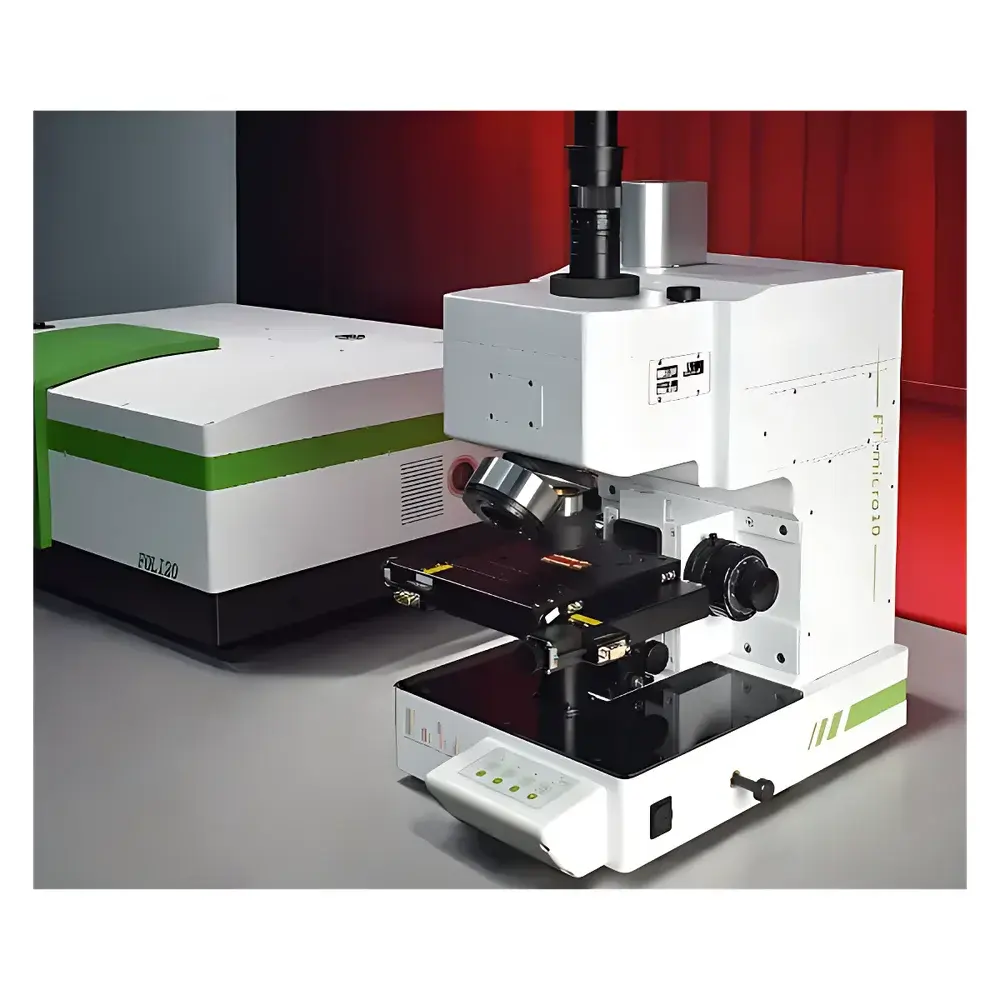
INSA Optics FTmicro10 Fourier Transform Infrared Microscope
| Brand | INSA Optics |
|---|---|
| Origin | Shanghai, China |
| Manufacturer Type | Original Equipment Manufacturer (OEM) |
| Country of Origin | China |
| Model | FTmicro10 |
| Price Range | USD 84,000 – 112,000 |
Overview
The INSA Optics FTmicro10 Fourier Transform Infrared (FTIR) Microscope is a research-grade analytical instrument engineered for high-spatial-resolution chemical imaging and microspectroscopy. It integrates a fully coaxial visible-light optical path with a precision mid-infrared (MIR) and near-infrared (NIR) spectral measurement system, enabling true “see-what-you-measure” operation. Based on Michelson interferometry, the FTmicro10 couples broadband infrared radiation from an FTIR spectrometer into a stabilized, diffraction-limited optical train optimized for microscopic sampling. The system delivers spatial resolution down to <10 µm in transmission and reflection modes—achievable through motorized knife-edge apertures and custom-designed reflective optics. Its dual-path architecture ensures zero parallax between visible observation and IR measurement coordinates, eliminating registration error critical for correlative microanalysis. Designed for laboratory environments requiring regulatory compliance and method reproducibility, the FTmicro10 meets fundamental engineering requirements for GLP-aligned workflows, including traceable alignment protocols and hardware-controlled mode switching.
Key Features
- Coaxial visible–IR optical design with zero-parallax alignment, ensuring pixel-perfect correlation between live video and spectral acquisition.
- 12-megapixel CMOS camera with dual LED illumination (transmission/reflection), supporting real-time focus-assisted targeting and digital scale calibration.
- Custom 20× reflective Cassegrain objective optimized for 7500–600 cm⁻¹ (1.3–16.7 µm), with optional ATR objective integrating a <100 µm diameter diamond or Ge crystal.
- High-stability XYZ manual stage with ≤1 µm repeatability; compatible with cryogenic cold stages, heating stages (−190 °C to +600 °C), electrochemical cells, and external beam coupling (e.g., TGA-FTIR).
- Dual-detector support: Standard liquid-nitrogen-cooled MCT detector (SNR >7000:1 peak-to-peak, 4 cm⁻¹ resolution); optional room-temperature DTGS or thermoelectrically cooled InGaAs for extended NIR (12,500–4000 cm⁻¹).
- Front-panel tactile interface for rapid, mode-agnostic switching among transmission, reflection, ATR, and emission configurations—no software dependency for basic operation.
- Integrated aperture control: Motorized knife-edge diaphragm with programmable size (5–100 µm) and orientation for directional micro-area selection.
Sample Compatibility & Compliance
The FTmicro10 accommodates solid, thin-film, particulate, and semi-transparent samples without destructive preparation. It supports standardized measurement geometries per ASTM E1252 (general IR microsampling), ASTM E2821 (ATR microanalysis), and ISO 18380 (micro-FTIR performance verification). Its mechanical stability, thermal drift compensation, and detector auto-zeroing routines ensure compliance with ISO/IEC 17025–2017 requirements for accredited testing laboratories. When configured with audit-trail-enabled software and electronic signatures, the system supports FDA 21 CFR Part 11–compliant data integrity practices. All optical components are certified RoHS-compliant, and housing meets IEC 61010-1 safety standards for laboratory instrumentation.
Software & Data Management
Control and analysis are performed via INSA’s proprietary MicroSpectra Suite v4.x—a Windows-based application supporting full spectral library search (including NIST, SDBS, and custom collections), multivariate mapping (PCA, cluster analysis), and hyperspectral image reconstruction. Raw interferograms are stored in standardized JCAMP-DX format; processed spectra adhere to ASTM E1655 conventions. The software includes built-in calibration validation tools (e.g., polystyrene film verification), automated baseline correction algorithms, and batch-processing pipelines for QA/QC workflows. Data export supports CSV, ASCII, and HDF5 formats; metadata embedding follows ISA-Tab conventions for FAIR data principles. Optional modules enable integration with LIMS systems via HL7 or RESTful API interfaces.
Applications
- Materials Science: Layer-by-layer composition analysis of polymer laminates, failure root-cause identification in delaminated composites, and crystallinity mapping in semicrystalline thermoplastics.
- Life Sciences: Spatial distribution profiling of lipids, proteins, and nucleic acids in tissue sections; detection of drug metabolites in single-cell lysates; microdomain characterization in lipid bilayers.
- Forensics & Cultural Heritage: Discrimination of ink formulations in questioned documents; identification of pigment binders in historical paintings; fiber-type classification from trace evidence.
- Environmental & Food Safety: Identification and quantification of microplastic particles (<20 µm) in water filtrates; screening for adulterants (e.g., melamine, Sudan dyes) in food matrices.
- Electronics & Quality Control: Contamination analysis on PCB surfaces; coating thickness and crosslinking uniformity assessment in display panels; residual solvent detection in photolithography resists.
- Geosciences: Fluid inclusion chemistry in mineral grains; carbonate speciation in fossil biominerals; hydrocarbon phase identification in shale kerogen.
FAQ
What spectral range does the FTmicro10 cover in standard configuration?
With the MCT detector, the system operates from 7500 to 600 cm⁻¹ (1.3–16.7 µm); with optional InGaAs, coverage extends to 12,500 cm⁻¹ (0.8 µm) for NIR microspectroscopy.
Is the system compatible with automated stage scanning for chemical imaging?
Yes—retrofitting with the optional high-precision motorized XYZ stage enables step-scan mapping at user-defined spatial increments (down to 0.5 µm), with synchronized spectral acquisition and positional metadata logging.
Can the FTmicro10 perform variable-temperature measurements?
Absolutely—the base platform accepts commercially available cryo- and thermo-stages; full thermal control integration (including temperature ramping and stabilization feedback) is supported via third-party stage drivers and MicroSpectra Suite plugins.
How is spectral calibration verified and maintained?
Calibration is validated using NIST-traceable polystyrene film (1.5 µm thickness) before each session; software-guided alignment checks ensure consistent wavenumber accuracy (±0.05 cm⁻¹) and photometric linearity across the full range.
Does the system support polarized IR measurements?
Yes—optional wire-grid polarizers are available for both visible and IR paths, enabling dichroic analysis of anisotropic materials such as stretched polymers, liquid crystals, and aligned biological fibers.





