
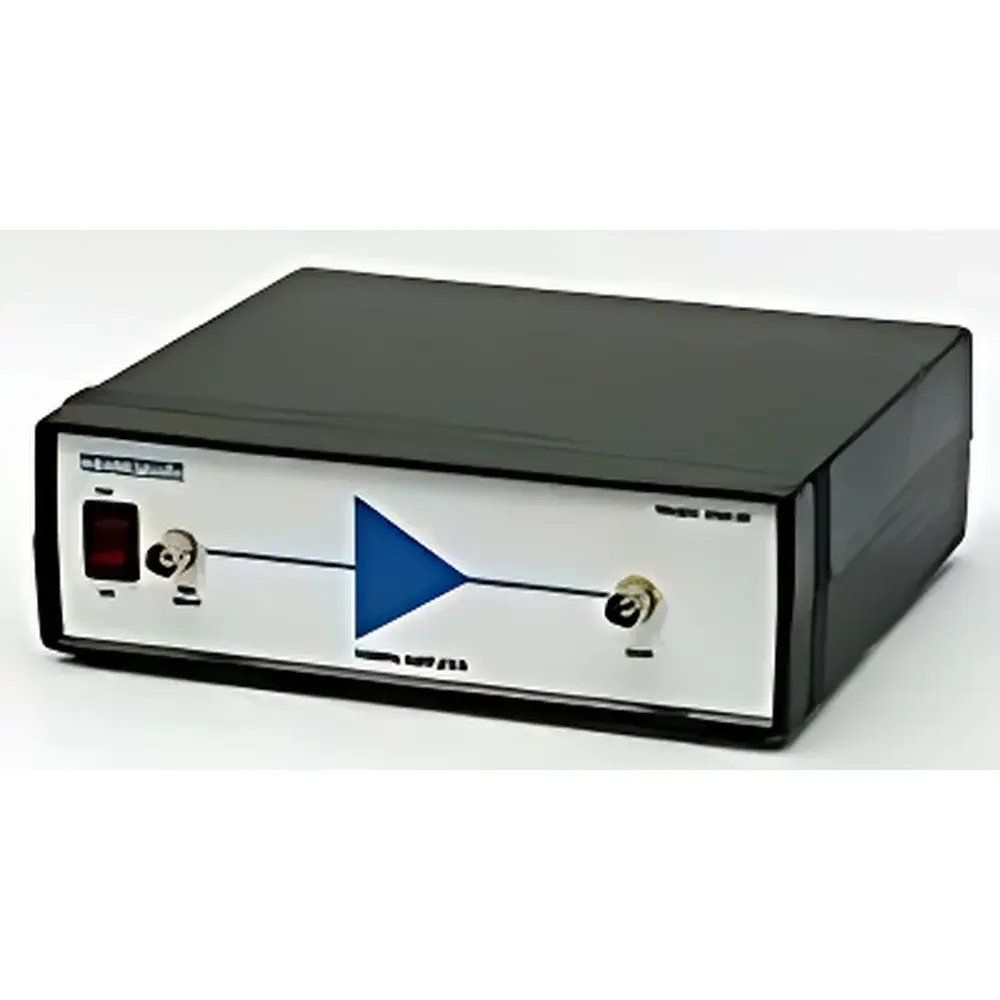
EOA Broadband High-Frequency Optical Signal Amplifier
| Origin | Canada |
|---|---|
| Manufacturer Type | Authorized Distributor |
| Origin Category | Imported |
| Model | EOA |
| Pricing | Upon Request |
| Component Category | Light Source |
Overview
The EOA Broadband High-Frequency Optical Signal Amplifier is a precision analog signal conditioning module engineered for low-noise, wide-dynamic-range amplification of weak optical detector outputs—including photodiode, PMT, and APD signals—in time-resolved and intensity-modulated optical experiments. Unlike general-purpose electronic amplifiers, the EOA employs a fully differential, DC-coupled architecture with optimized transimpedance gain stages and impedance-matched RF output buffering to preserve signal integrity across its specified bandwidth (DC to >1 GHz, typical). It operates on the principle of linear current-to-voltage conversion followed by broadband voltage gain, enabling high-fidelity amplification of fast optical transients—such as those generated in time-correlated single-photon counting (TCSPC), lock-in detection of modulated laser sources, or real-time monitoring of pulsed laser-induced fluorescence—without phase distortion or slew-rate limiting. Designed for integration into optical test benches and OEM instrumentation platforms, the EOA supports both free-space and fiber-pigtailed detector interfaces via standardized SMA or FC/PC input options.
Key Features
- Ultra-wide bandwidth: DC to ≥1 GHz (–3 dB), verified with calibrated step-response and network analyzer characterization
- Low input-referred noise floor: ≤3.5 pA/√Hz (typ. at 100 MHz), minimizing degradation of signal-to-noise ratio in photon-starved measurements
- Adjustable transimpedance gain: 103–106 V/A (switch-selectable), supporting nA- to µA-level photocurrents without external biasing
- Differential output stage with 50 Ω matched impedance, compatible with high-speed digitizers (e.g., Keysight UXR, Tektronix DPO70000SX) and RF spectrum analyzers
- Thermally stabilized front-end design with <±0.02 %/°C gain drift, ensuring measurement repeatability across ambient lab conditions (15–30 °C)
- EMI-hardened metal enclosure with grounded I/O shielding, meeting CISPR 22 Class B radiated emission limits
Sample Compatibility & Compliance
The EOA amplifier is compatible with a broad range of optical detectors used in academic and industrial photonics labs, including silicon and InGaAs photodiodes (with active areas from 0.2 mm² to 5 mm²), microchannel plate PMTs, and linear-mode avalanche photodiodes operating under reverse bias up to –120 V. Its input protection circuitry complies with IEC 61000-4-2 (ESD immunity: ±8 kV contact discharge) and IEC 61000-4-4 (EFT: ±2 kV), safeguarding against transient coupling during system integration. The unit conforms to RoHS 2011/65/EU and REACH (EC 1907/2006) material restrictions. While not certified for medical or aerospace use, its performance stability and traceable calibration protocol support GLP-compliant data acquisition workflows when paired with NIST-traceable reference photodetectors.
Software & Data Management
The EOA operates as a hardware signal conditioner and does not include embedded firmware or USB/ethernet connectivity. It is designed for seamless integration into existing data acquisition ecosystems: analog output signals are directly routed to oscilloscopes, digitizers, or lock-in amplifiers (e.g., Zurich Instruments HF2LI, Stanford Research SR830). For automated gain calibration and system-level validation, users may employ MATLAB, Python (with PyVISA or NI-DAQmx), or LabVIEW-based scripts to control external attenuators or reference light sources synchronized to the EOA’s output. Audit trails for amplifier configuration (gain setting, power-on state) are maintained manually per lab SOPs; no FDA 21 CFR Part 11 electronic signature or audit trail functionality is implemented, as the device lacks programmable memory or user-accessible storage.
Applications
- Time-resolved photoluminescence spectroscopy in semiconductor and 2D material research
- High-speed optical coherence tomography (OCT) interferometric signal recovery
- Modulated reflectance and ellipsometry systems requiring phase-preserving amplification
- Laser-induced breakdown spectroscopy (LIBS) plasma emission pulse train analysis
- Fiber-optic sensor interrogation (e.g., FBG, interferometric hydrophones) with kHz–MHz demodulation bandwidths
- Quantum optics experiments involving coincidence counting and Hanbury Brown–Twiss setups
FAQ
Is the EOA amplifier compatible with cryogenic optical setups?
Yes—the EOA has been validated for operation at temperatures down to –20 °C ambient; for sustained sub-zero environments (<–40 °C), custom thermal management and feedthrough-rated cabling are recommended.
Does the EOA provide DC offset adjustment?
No—DC offset correction must be applied externally via post-amplifier AC coupling or software baseline subtraction; the EOA maintains true DC coupling for accurate pulse area integration.
Can multiple EOA units be cascaded for higher gain?
Cascading is not recommended due to cumulative noise figure degradation and potential instability; instead, select the appropriate transimpedance gain setting for the target signal level.
What is the maximum safe input current before saturation?
Saturation occurs at input currents exceeding ±10 µA for the 105 V/A gain setting; consult the detailed datasheet for full gain-dependent linearity specifications.
Is calibration documentation provided with each unit?
Each EOA ships with a factory calibration report listing measured gain flatness, noise spectral density, and rise time at three representative frequencies (10 MHz, 100 MHz, 1 GHz), traceable to NRC Canada standards.




