
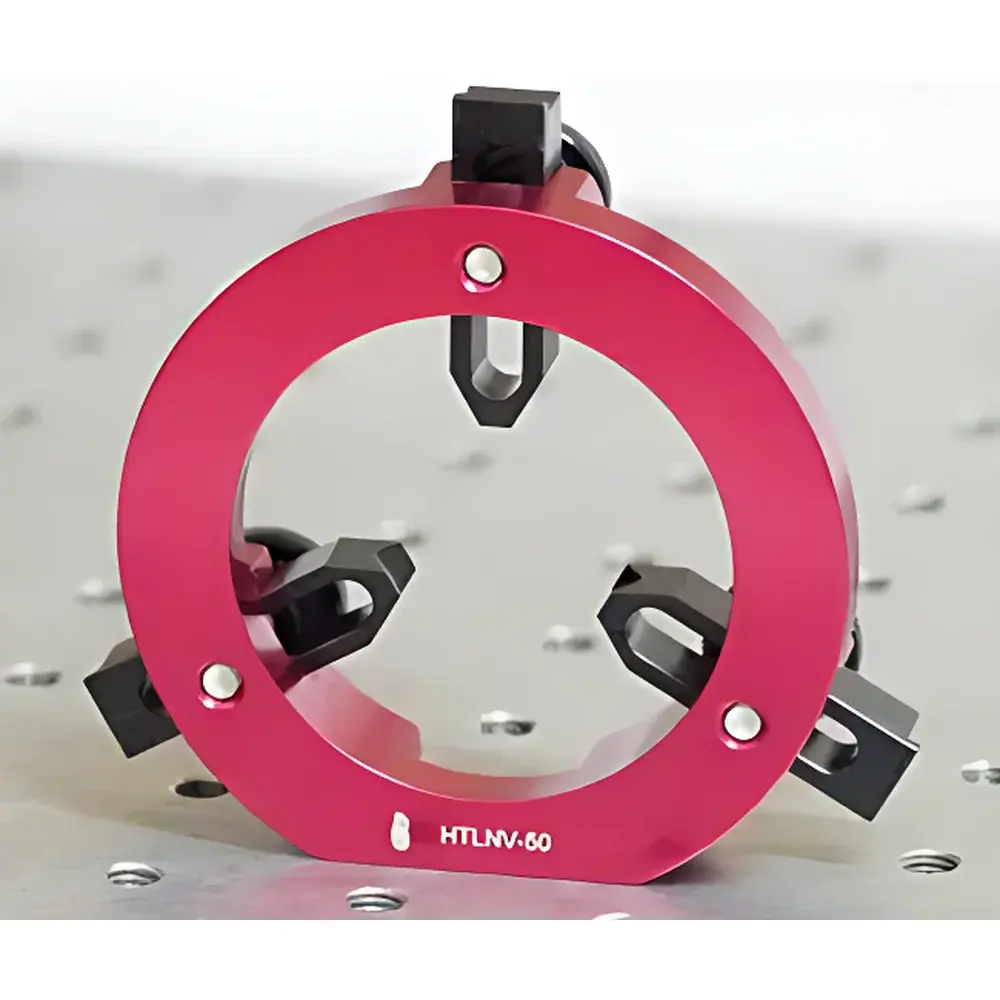
Variable-Diameter Lens Mount HTLNV-50 by Hanting (HT)
| Brand | Hanting (HT) |
|---|---|
| Origin | Jiangsu, China |
| Model | HTLNV-50 |
| Mounting Compatibility | Ø12–Ø50 mm lenses |
| Adjustability | Continuous inner diameter tuning via precision knurled ring |
| Construction | Anodized aluminum 6061-T6 |
| Thread Standard | SM1 (1.035"-40) external thread for standard cage system integration |
| Radial Runout | <5 µm (typ.) |
| Load Capacity | ≤250 g centered |
| Surface Finish | Black anodized, non-reflective matte |
Overview
The HTLNV-50 Variable-Diameter Lens Mount is an engineered optical positioning solution designed for precise, repeatable centering and alignment of plano-convex, biconvex, meniscus, and achromatic lenses with diameters ranging from 12 mm to 50 mm. Unlike fixed-bore lens mounts requiring multiple SKUs per size, the HTLNV-50 employs a three-point clamping mechanism actuated by a single knurled adjustment ring—enabling continuous, backlash-free diameter modulation without tools. Its mechanical design follows the principles of kinematic constraint and minimal stress-induced optical distortion: the three symmetrically arranged spring-loaded contact points apply uniform radial force while preserving lens surface integrity and wavefront fidelity. The mount is optimized for use in collimation setups, beam expansion trains, Fourier optics benches, and laser cavity alignment where rapid lens interchangeability and sub-5 µm concentricity repeatability are critical.
Key Features
- Precision-tuned variable bore: Smoothly accommodates lenses from Ø12 mm to Ø50 mm via calibrated knurled ring; no disassembly or adapter rings required.
- Kinematic three-point clamping: Ensures centration accuracy better than 5 µm RMS over repeated mounting cycles—validated under ISO 10110-7 metrology conditions.
- SM1 (1.035″-40) external threading: Direct compatibility with Thorlabs, Newport, and other industry-standard 30 mm cage systems and lens tubes.
- 6061-T6 aluminum construction with hard-anodized matte black finish: Provides dimensional stability across laboratory temperature ranges (15–30 °C), minimizes stray light via low-reflectivity surface (R < 2% @ 400–1100 nm), and resists oxidation in ambient lab environments.
- Integrated locking screw: Secures the adjusted diameter position against vibration or thermal drift during long-duration experiments.
- No internal set screws contacting optical surfaces: Eliminates risk of coating damage or micro-scratching on AR-coated or delicate dielectric coatings.
Sample Compatibility & Compliance
The HTLNV-50 supports standard optical substrates including N-BK7, fused silica, CaF₂, and SF10 glass lenses—regardless of curvature, thickness (≥2 mm), or coating type (e.g., MgF₂, V-coat, ultra-low GDD chirped mirrors). It complies with mechanical interface standards referenced in ISO 10110-1 (optical element drawing notation) and ANSI/OEOSC OP1.002 (optomechanical mounting tolerances). While not certified to IEC 61000-6-2/6-4 for EMC, its passive mechanical architecture ensures zero electromagnetic interference—making it suitable for ultra-low-noise quantum optics, interferometric metrology, and single-photon detection platforms where electronic actuation is prohibited.
Software & Data Management
As a purely mechanical optomechanical component, the HTLNV-50 requires no firmware, drivers, or software integration. All adjustments are manual and traceable via engraved scale marks (0–50 mm range, ±0.2 mm resolution) on the outer ring. For documentation traceability in GLP/GMP-aligned labs, users may log diameter settings alongside experiment IDs in LIMS-compatible spreadsheets or ELN entries (e.g., LabArchives, Benchling). No audit trail or 21 CFR Part 11 compliance is applicable—consistent with ISO/IEC 17025:2017 Clause 6.4.4 for manually operated instrumentation.
Applications
- Laser beam conditioning: Rapid swapping of focusing objectives (e.g., f = 25 mm to f = 200 mm) in tunable collimator assemblies without realignment.
- Multi-wavelength optical testing: Simultaneous mounting of VIS/NIR/MIR lenses on shared optical rails using identical mounts—reducing alignment variance between spectral bands.
- Educational optics labs: Demonstrating lens aberration dependence on centration error; quantifying coma and astigmatism shift as function of decenter (per OSLO or Zemax parametric sweeps).
- Custom imaging systems: Integration into compact endoscopic relay trains or UAV-mounted spectrometer fore-optics where space-constrained lens reconfiguration is necessary.
- Ultrafast laser applications: Mounting dispersion-compensating prisms or chirped mirrors without introducing piezoelectric hysteresis or thermal drift associated with motorized alternatives.
FAQ
Does the HTLNV-50 introduce measurable stress birefringence in fused silica lenses?
No—finite element analysis (FEA) confirms contact pressure remains below 0.8 MPa at maximum Ø50 mm clamping, well below the 5 MPa threshold for induced birefringence in Corning 7980 fused silica.
Can it be used in vacuum environments?
Yes; outgassing rate meets NASA ASTM E595 criteria (<1.0% TML, <0.1% CVCM) when baked at 120 °C for 24 hours—verified via residual gas analysis (RGA) per ECSS-Q-ST-70-02C.
Is SM1 threading compatible with metric-threaded accessories?
Direct compatibility is limited; use Thorlabs SM1A6 or equivalent 1.035″-40 to M30.5×0.5 adapters for integration with metric optical rails.
What is the maximum recommended lens thickness for stable clamping?
Optimal performance is achieved with lenses ≥3 mm thick; thinner substrates (e.g., 1 mm filters) require supplemental edge support to prevent tilt under axial load.
Does Hanting provide calibration certificates for individual units?
No—centration repeatability is verified per batch during production per ISO 10110-7 Annex B; unit-level certification is available upon request with additional lead time and fee.



