Azenta Brooks FluidX Tri-Code Cryogenic Storage Tubes
| Brand | Azenta Brooks FluidX |
|---|---|
| Origin | Japan |
| Model | 66-9302 |
| Capacity | 7.6 mL (24-well format), 1.9 mL / 1.5 mL / 1.0 mL / 0.5 mL / 0.26 mL (48/96-well formats) |
| Material | Virgin polypropylene (PP) |
| Sterilization | Gamma-irradiated (optional) |
| Temperature Range | -196 °C to +121 °C |
| Thread Type | External thread |
| Max. Centrifugation | 20,000 × g |
| Compliance | ISO 15189, ISO/IEC 17025, FDA 21 CFR Part 11 (software-integrated workflows), GLP/GMP-ready |
Overview
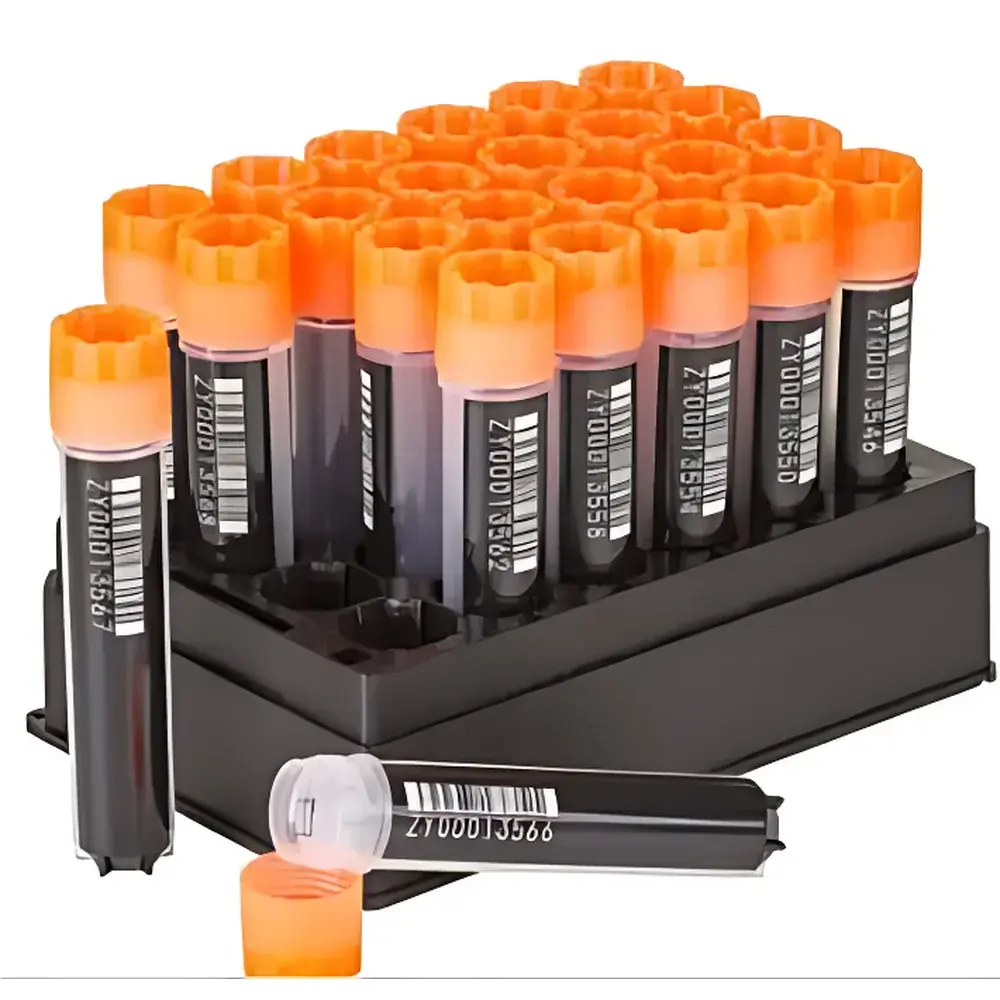
The Azenta Brooks FluidX Tri-Code Cryogenic Storage Tubes represent a foundational advancement in biobanking and compound management infrastructure—engineered to deliver permanent, audit-grade traceability across the full sample lifecycle. Each tube integrates three physically distinct, laser-etched identifiers: a high-contrast 2D QR code permanently etched into the base, a linear 1D barcode laser-marked on the sidewall, and human-readable numeric characters also laser-etched for visual verification. Critically, all three codes encode identical, cryptographically validated identifiers—verified at 100% during manufacturing—to eliminate transcription errors, misalignment risks, or database reconciliation failures. This tri-code architecture supports unambiguous chain-of-custody documentation required under ISO 20387 (biobanking), CLIA, CAP, and EU IVDR frameworks. Designed for seamless integration with automated liquid handlers, robotic storage systems (e.g., Hamilton STAR, Tecan Freedom EVO), and LIMS platforms—including Azenta’s own SampleManager and third-party solutions—the tubes operate within SBS-compliant 24-, 48-, and 96-well rack formats. Their virgin polypropylene construction ensures chemical inertness, low extractables, and mechanical stability across repeated freeze-thaw cycles down to liquid nitrogen temperatures (–196 °C), while excluding cryo-cap compatibility with direct liquid-phase immersion per ASTM F2697 guidance.
Key Features
- Triple-layer physical encoding: Base-embedded QR code, sidewall 1D barcode, and human-readable digits—all laser-etched in high-contrast black-on-white for frost- and condensation-resistant readability without tube removal from racks.
- External-thread design maximizes working volume versus internal-thread alternatives; optimized for consistent torque application in automated capping/de-capping systems.
- Non-silicone compression seal technology eliminates over-torque risk, prevents gasket extrusion, and ensures uniform sealing force across all tubes—validated via helium leak testing (<1 × 10⁻⁹ mbar·L/s).
- Monolithic PP construction (tube + cap) eliminates differential thermal expansion during cryogenic cycling, reducing micro-fracture risk and maintaining seal integrity over >100 freeze-thaw cycles.
- Dual-start thread geometry enables precise 180° rotation control—critical for robotic gripper synchronization and repeatability in high-throughput environments.
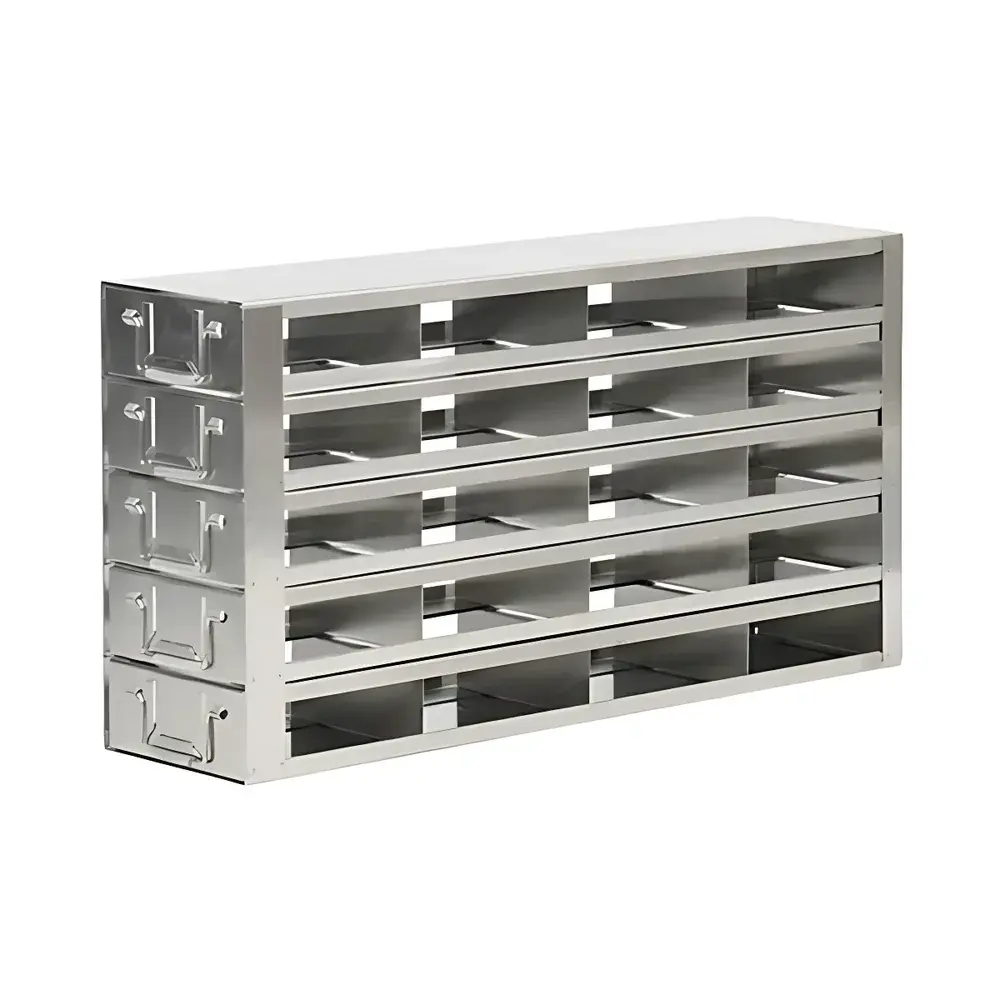
- Rack-level intelligence: TwistLock, TubeLock, and LidLock mechanisms standard across all SBS-compatible racks; enable drop-test compliance (1 m free-fall per IEC 60068-2-32), prevent tube ejection during centrifugation, and support fully automated rack orientation via simultaneous rack-and-tube QR decoding.
Sample Compatibility & Compliance
FluidX Tri-Code tubes accommodate diverse biological and chemical matrices—including genomic DNA, plasma, cell lysates, small-molecule libraries, and synthetic oligonucleotides—without adsorption or leaching concerns. All lots undergo rigorous QC: 100% optical verification of code uniqueness and scannability (per ISO/IEC 15415 and AIM DPM-1 standards), dimensional validation (±0.05 mm tolerance), and functional leak testing. The system meets ISO 15189 requirements for pre-analytical traceability and supports ALCOA+ data integrity principles when deployed with compliant LIMS or ELN software. Rack designs comply with ANSI/SBS 1–2022 specifications and integrate with camera-based readers (e.g., Azenta XTR, PerkinElmer ScanPlus) capable of decoding both tube and rack identifiers in a single imaging pass—enabling end-to-end audit trails from rack-level inventory to individual sample metadata.
Software & Data Management
While the tubes themselves are hardware components, their traceability value is realized through interoperable software ecosystems. FluidX Tri-Code identifiers natively map to Azenta SampleManager v6.x and are certified for bidirectional synchronization with LabVantage, Thermo Fisher SampleManager LIMS, and Dotmatics Bioregistry. Audit logs capture timestamped events—including rack loading, tube scanning, freeze/thaw cycle counts, and location transfers—with immutable SHA-256 hashing. When integrated with 21 CFR Part 11–compliant platforms, electronic signatures, role-based access controls, and automated audit-trail generation satisfy FDA, MHRA, and PMDA regulatory expectations. Optional encrypted QR payloads support controlled vocabulary binding (e.g., SNOMED CT, LOINC) for semantic interoperability across federated biobanks.
Applications
These tubes serve as the physical substrate for mission-critical applications demanding zero-error sample identity assurance: large-scale biobanking (UK Biobank, All of Us), pharmaceutical compound management (HTS libraries, lead optimization archives), clinical trial biospecimen repositories, forensic evidence storage, and synthetic biology strain libraries. Their compatibility with cryo-racks (9×9 and 10×10 PC formats), automated cold-storage robotics (e.g., Brooks BioStore III), and ambient-temperature compound management systems provides unified infrastructure across heterogeneous storage conditions—from –80 °C ultra-low freezers to room-temperature compound vaults.
FAQ
Are FluidX Tri-Code tubes compatible with liquid nitrogen vapor-phase storage?
Yes—they are validated for long-term storage at –196 °C in vapor-phase liquid nitrogen dewars. Direct immersion in liquid-phase nitrogen is not recommended due to potential pressure differentials during rapid warming.
Can the QR code be scanned through frost accumulation?
Yes—the high-contrast laser etching and optimized depth profile ensure reliable decoding even under 100 µm frost layers, as verified per ISO/IEC TR 29158.
Do the tubes meet USP and requirements for extractables and leachables?
All virgin PP formulations undergo USP Class VI testing and comply with ICH Q5C stability guidelines; full extractables reports available upon request.
Is batch-level sterility certification available?
Gamma irradiation (25 kGy) is offered as an optional qualification; certificates of analysis and sterilization include dose mapping reports per ISO 11137.
How is code uniqueness guaranteed across global production batches?
Each tube receives a globally unique identifier assigned via Azenta’s centralized ID registry, synchronized with GS1’s Global Trade Item Number (GTIN) framework and validated against ISO/IEC 15459-1.