
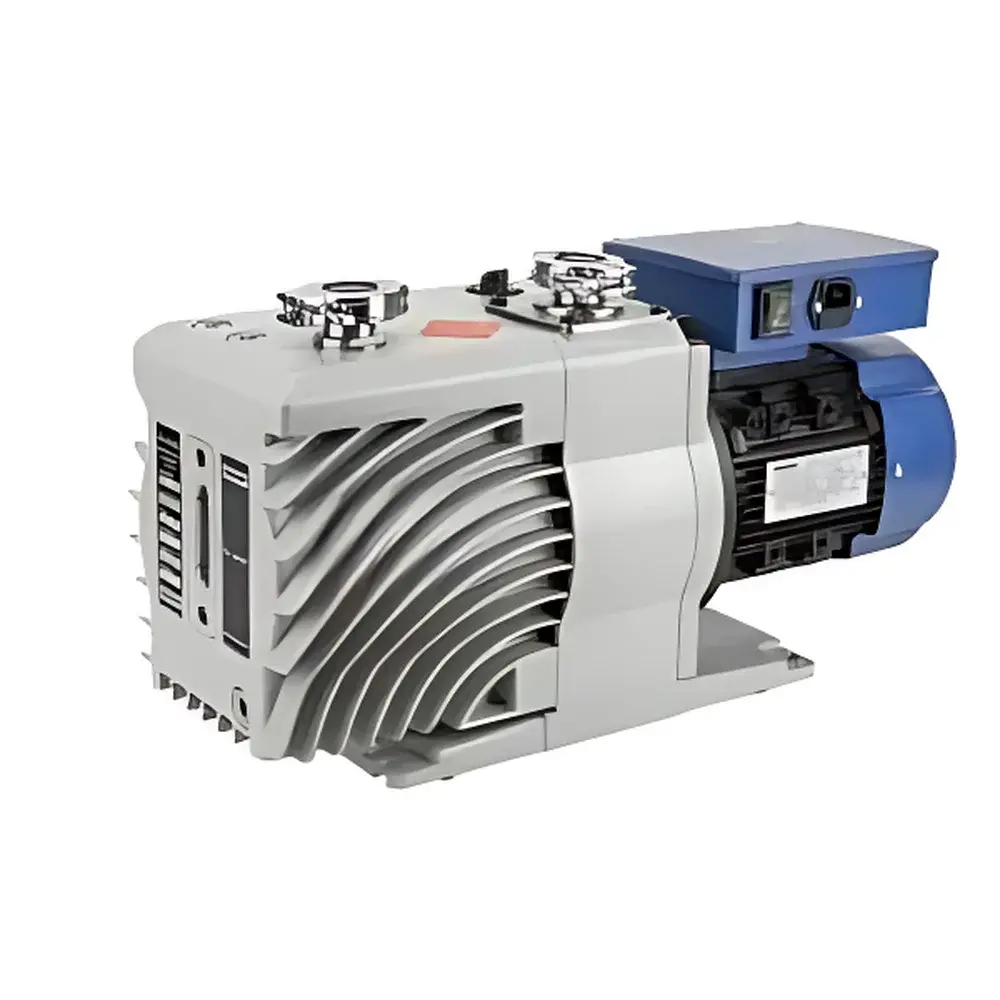
WIGGENS R-24D Dual-Stage Oil-Sealed Rotary Vane Vacuum Pump
| Brand | WIGGENS |
|---|---|
| Origin | Germany |
| Pump Type | Dual-Stage Rotary Vane |
| Ultimate Vacuum | 4 × 10⁻⁴ mbar |
| Pumping Speed | 360 L/min |
| Motor Power | 750 W |
| Motor Speed | 1400 rpm |
| Noise Level (Gas Ballast Off) | < 56 dB(A) |
| Oil Capacity | 1.9 L |
| Weight | 37 kg |
| Protection Rating | IP44 |
| Inlet Port | DN25 KF |
| Ordering Code | 900025-22 |
Overview
The WIGGENS R-24D is a dual-stage, oil-sealed rotary vane vacuum pump engineered for reliable, continuous operation in demanding laboratory and pilot-scale industrial applications. Based on the proven principles of positive displacement via rotating vanes within an eccentrically mounted rotor, the R-24D achieves high volumetric efficiency and stable ultimate vacuum performance down to 4 × 10⁻⁴ mbar. Its robust cast-iron housing, precision-ground vanes, and optimized oil circulation system ensure consistent pumping characteristics across extended duty cycles. Designed as a standalone primary vacuum source or as a forepump for high-vacuum systems—including turbomolecular pumps, diffusion pumps, and cryopumps—the R-24D meets the operational requirements of vacuum-dependent processes where reproducibility, chemical resilience, and low maintenance are critical.
Key Features
- Dual-stage architecture enables deeper base pressure and improved gas handling compared to single-stage equivalents
- Integrated gas ballast valve allows controlled admission of atmospheric air to facilitate removal of condensable vapors (e.g., water, solvents), minimizing oil contamination and extending oil service life
- Sealed IP44 induction motor with thermal overload protection ensures safe, uninterrupted operation under variable load conditions
- Low-noise design (< 56 dB(A) with gas ballast off) and compact footprint (DN25 KF inlet) support integration into space-constrained fume hoods and modular vacuum manifolds
- Corrosion-resistant internal coatings and chemically stable mineral oil formulation enhance tolerance to mild organic vapors and moisture-laden process streams
- Transparent circular oil sight gauge enables rapid visual verification of oil level and clarity without disassembly
- Anti-backstreaming check valve prevents oil migration into the vacuum chamber upon shutdown, preserving sample integrity and reducing system contamination risk
- Minimal oil mist emission due to integrated baffle and centrifugal separation—reducing ambient hydrocarbon loading in shared laboratory environments
Sample Compatibility & Compliance
The R-24D is suitable for non-explosive, non-toxic, and non-oxygen-rich gas streams typical of academic research and quality-controlled production settings. It complies with IEC 60034 (rotating electrical machines) and EN 61000-6-3 (EMC emission standards). While not intrinsically safe, its IP44-rated motor housing provides protection against solid objects ≥1 mm and splashing water—making it appropriate for general laboratory use per ISO/IEC 17025 environmental requirements. For GMP/GLP-regulated workflows involving solvent removal or lyophilization, the pump supports traceable maintenance logs and scheduled oil change protocols aligned with ASTM D2889 (standard guide for vacuum pump oil testing).
Software & Data Management
As a standalone mechanical pump, the R-24D operates without embedded firmware or digital interfaces. However, it is fully compatible with third-party vacuum monitoring systems via analog pressure transducer inputs (0–10 V or 4–20 mA) when integrated into automated vacuum control loops. Its predictable performance curve and stable flow rate allow seamless pairing with digital vacuum gauges (e.g., Pirani, capacitance manometers) and programmable logic controllers (PLCs) used in validated freeze-dryer or vacuum distillation platforms. Maintenance records—including oil replacement dates, operating hours, and gas ballast usage frequency—can be logged manually or imported into laboratory information management systems (LIMS) supporting 21 CFR Part 11 audit trails.
Applications
- Vacuum distillation and fractional evaporation of heat-sensitive compounds
- Rotary evaporation and solvent recovery in synthetic chemistry labs
- Freeze-drying (lyophilization) of pharmaceuticals and biologics
- Vacuum filtration of fine particulates in environmental and materials science
- Leak detection using helium mass spectrometry (as forepump)
- Vacuum impregnation of porous substrates in composites manufacturing
- Thin-film deposition and plasma etching support in microfabrication cleanrooms
- Encapsulation and vacuum packaging of analytical standards and reference materials
FAQ
What is the recommended oil change interval for the R-24D under continuous operation?
Under normal laboratory use (≤8 hrs/day, non-aggressive vapors), oil should be replaced every 500 operating hours or semiannually—whichever occurs first. More frequent changes are advised when processing water-saturated or halogenated solvents.
Can the R-24D be used with aggressive acids like HCl or HF vapor?
No. The R-24D is not designed for direct exposure to highly corrosive, oxidizing, or polymerizing gases. A cold trap or scrubber must be installed upstream to condense or neutralize such vapors prior to pump entry.
Is the DN25 KF inlet compatible with standard ISO-KF vacuum components?
Yes. The DN25 KF flange conforms to ISO 2861 and is mechanically and dimensionally interoperable with all commercially available KF-25 fittings, clamps, and adapters.
Does the pump require a dedicated exhaust line?
While not mandatory, routing exhaust through a vented duct or activated carbon filter is strongly recommended when handling volatile organic compounds to maintain indoor air quality and comply with local occupational exposure limits (e.g., OSHA PELs, EU Directive 2004/37/EC).
How does the gas ballast function affect ultimate vacuum performance?
Engaging the gas ballast intentionally leaks dry air into the compression chamber, lowering the partial pressure of condensables and preventing their recondensation in the oil. This trade-off elevates the attainable base pressure by approximately one order of magnitude but is essential for stable long-term operation with moist or solvent-laden loads.



