
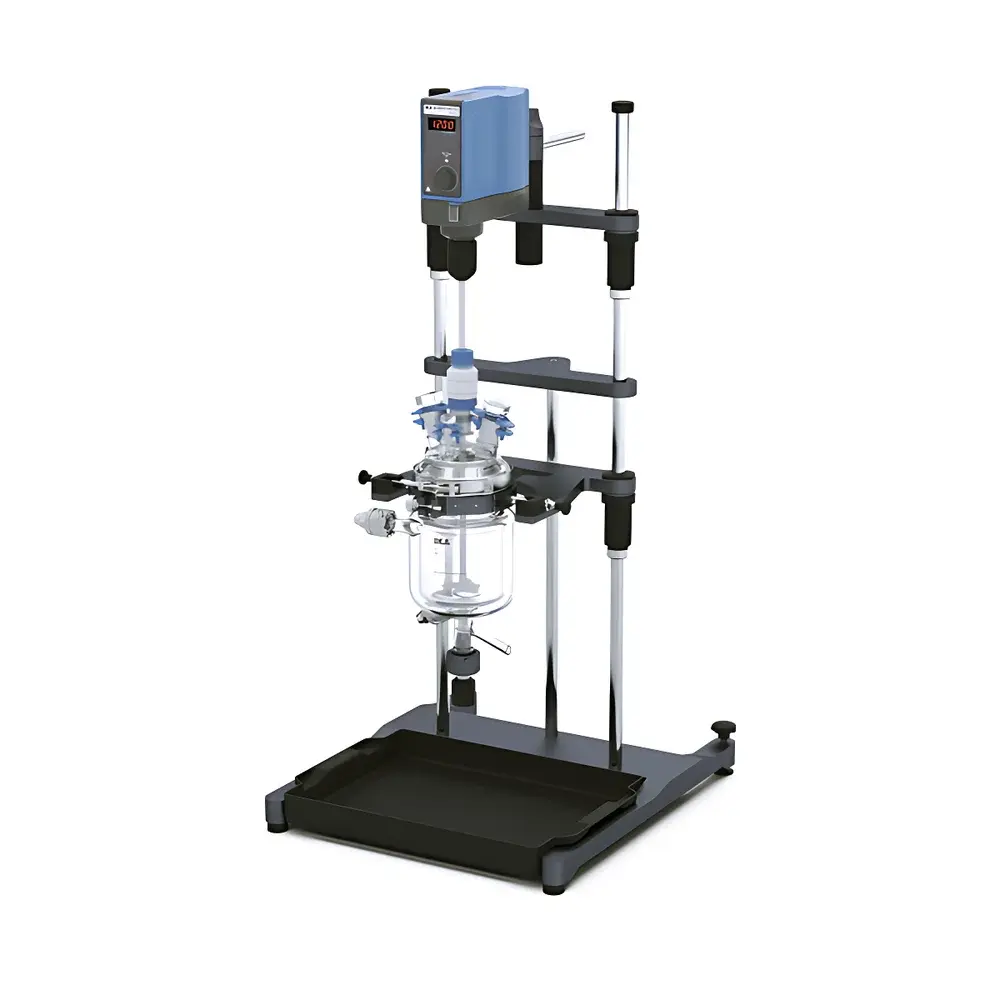
IKA EasySyn 1000 Starter Benchtop Glass Reactor System
| Brand | IKA |
|---|---|
| Origin | Germany |
| Manufacturer Type | Original Equipment Manufacturer (OEM) |
| Product Category | Imported Laboratory Reactor |
| Model | EasySyn 1000 Starter |
| Vessel Capacity | 1 L |
| Vessel Material | Borosilicate Glass 3.3 |
| Operating Temperature Range | –50 °C to +200 °C |
| Maximum Vacuum | 3 mbar |
| Working Pressure | Low-pressure (up to 2 bar gauge, per IKA specification) |
| Stirring Torque | 60 N·cm |
| Flange Standard | DN 100 |
| Port Configuration | 1 × NS 29/32 (central), 2 × NS 29/32 (lateral), 1 × NS 14/23 |
| Sealing Material | FEP-coated O-ring |
| Valve Material | PTFE-lined bottom discharge valve |
| Stirrer Material | PTFE-coated helical impeller |
| Ambient Operating Conditions | 5–40 °C, ≤80% RH, ≤2000 m altitude |
Overview
The IKA EasySyn 1000 Starter is a fully integrated, benchtop-scale glass reactor system engineered for reproducible and scalable organic and aqueous synthesis under controlled temperature, pressure, and vacuum conditions. Designed around Couette-type mixing geometry and jacketed thermal management, the system enables precise reaction parameter control—from exothermic catalytic hydrogenations to low-temperature lithiation or high-boiling-point solvent refluxes. Its modular architecture supports seamless transition from discovery-phase screening to pilot-scale process development, aligning with Quality by Design (QbD) principles in pharmaceutical and fine chemical R&D. The reactor operates within a validated thermal envelope of –50 °C to +200 °C using external circulators, and achieves ultimate vacuum down to 3 mbar via chemically resistant sealing interfaces—critical for moisture-sensitive Grignard reactions, solvent removal, or distillation under reduced pressure.
Key Features
- DN 100 standardized flange interface with FEP-coated O-ring seal ensures long-term chemical resistance against strong acids, bases, halogenated solvents, and organometallic reagents.
- Ergonomic height-adjustable support frame (500 × 950 × 580 mm) accommodates diverse user anthropometry and lab bench configurations; tool-free vessel mounting/dismounting minimizes handling risk.
- 1 L double-jacketed borosilicate glass 3.3 vessel (DIN ISO 3585) certified for thermal shock resistance and hydrolytic stability—compatible with cryogenic quenching and steam sterilization protocols.
- Spring-loaded PTFE-lined bottom discharge valve prevents mechanical stress-induced fracture during vacuum or pressure cycling; leak-tight operation verified per ISO 15848-1 (low-emission valve standard).
- IKA EUROSTAR 60 digital overhead stirrer delivers up to 60 N·cm torque with closed-loop speed regulation (0.1–300 rpm), integrated RS232/USB interface for remote command and audit trail logging.
- Multi-port lid configuration (1× NS 29/32 central port, 2× NS 29/32 side ports, 1× NS 14/23 auxiliary port) supports simultaneous insertion of PT100 temperature probes, condensers, addition funnels, gas inlets, and pH electrodes without adapter stacking.
Sample Compatibility & Compliance
The EasySyn 1000 Starter is compatible with corrosive, viscous, heterogeneous, and air/moisture-sensitive reaction mixtures—including lithium aluminum hydride reductions, palladium-catalyzed cross-couplings, and anhydrous polymerizations. All wetted parts comply with USP Class VI and FDA 21 CFR 177.2430 (PTFE/FEP) and DIN 7080 (borosilicate glass). The system meets CE marking requirements under Machinery Directive 2006/42/EC and Pressure Equipment Directive 2014/68/EU (PED Category I). When operated with IKA’s certified Labworldsoft® automation suite, full 21 CFR Part 11 compliance—including electronic signatures, audit trails, and role-based access—is achievable for GLP/GMP-regulated environments.
Software & Data Management
While the Starter configuration includes standalone analog/digital controls, it is natively interoperable with IKA Labworldsoft®—a validated laboratory automation platform supporting synchronized acquisition of stirring speed, temperature setpoints, vacuum level, and time-stamped event logs. Data export formats include CSV, PDF reports, and XML for LIMS integration. Optional Ethernet-enabled controllers enable remote monitoring via secure HTTPS, with configurable alarm thresholds and automatic shutdown on thermal runaway or vacuum loss—supporting ALCOA+ data integrity principles.
Applications
- Process safety evaluation of highly exothermic nitration or diazotization reactions under controlled heat removal.
- Development of continuous-flow precursors using batch-to-continuous translation workflows.
- Crystallization kinetics studies with in situ FBRM or PVM probe integration through NS 29/32 ports.
- Synthesis of metal–organic frameworks (MOFs) requiring strict oxygen/moisture exclusion and extended aging at elevated temperature.
- Enzymatic transesterification under mild vacuum to shift equilibrium toward biodiesel yield maximization.
- Academic teaching labs: demonstration of Le Chatelier’s principle, Arrhenius kinetics, and mass transfer limitations in multiphase systems.
FAQ
Is the EasySyn 1000 Starter suitable for pressurized reactions?
Yes—when equipped with optional pressure-rated lids and safety burst discs, it supports operation up to 2 bar(g) per PED Category I classification. Standard configuration is rated for vacuum and atmospheric use.
Can the system be integrated with third-party temperature controllers or vacuum pumps?
Yes—via 0–10 V analog I/O or Modbus RTU, though full functional validation (e.g., interlock logic, emergency stop coordination) requires IKA-certified components.
What maintenance intervals are recommended for the stirring shaft seal?
Under continuous operation at 3 mbar vacuum and 150 °C, inspect FEP lip seal integrity every 500 operating hours; replacement kits are available as spare part #RW-SEAL-EASYSYN1000.
Does the system support automated addition via syringe pumps?
Yes—NS 29/32 ports accept standard GL45-compatible feed lines; IKA offers programmable dosing modules (RSD series) with flow accuracy ±1.5% of full scale.
Is calibration documentation provided with the unit?
Each system ships with factory calibration certificates for temperature sensor (±0.2 °C traceable to DKD), torque sensor (±1.0% FS), and vacuum transducer (±1% of reading), compliant with ISO/IEC 17025.



