
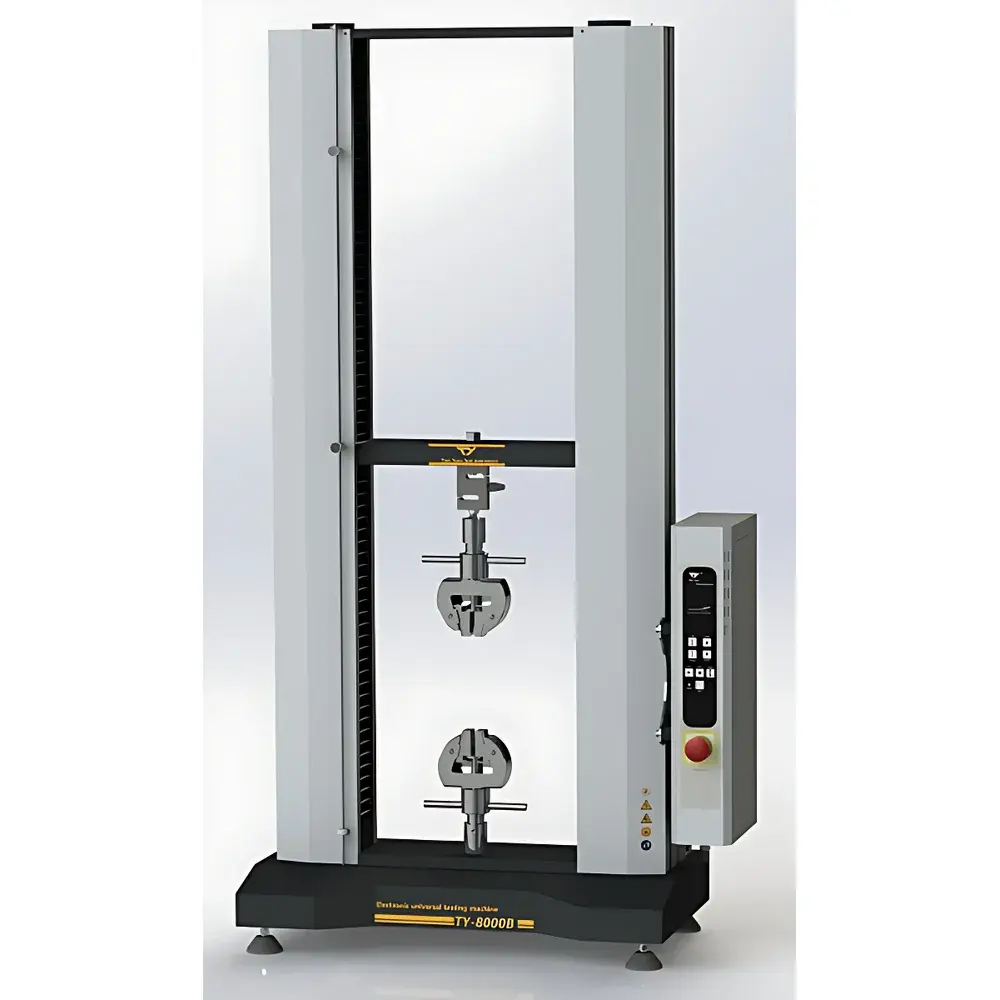
TianYuan TY8000-B Series Electronic Universal Tensile Testing Machine
| Brand | TianYuan |
|---|---|
| Origin | Jiangsu, China |
| Manufacturer Type | Manufacturer |
| Regional Category | Domestic |
| Model | TY8000-B |
| Price Range | USD 2,800 – 7,000 |
| Instrument Type | Electronic Tensile Testing Machine |
| Maximum Test Load | 5 kN |
| Force Measurement Range | 1–100% of Full Scale (FS) |
| Force Accuracy | ≤ ±0.5% FS |
| Maximum Travel | 900 mm |
| Displacement Resolution | 0.01 mm |
| Speed Range | 1–500 mm/min |
| Speed Accuracy | ≤ ±0.8% |
| Load Resolution | 1/60,000 FS |
| Effective Width | 360 mm |
| Dimensions (W×D×H) | 720 × 440 × 1550 mm |
| Weight | 180 kg |
| Power Supply | 220 V AC, 50 Hz |
Overview
The TianYuan TY8000-B Series Electronic Universal Tensile Testing Machine is a precision-engineered electromechanical system designed for static mechanical property characterization under uniaxial loading conditions. It operates on the principle of controlled displacement actuation via a high-efficiency servo-motor-driven ball screw mechanism, enabling precise force application and real-time position feedback. The machine conforms to fundamental mechanics-of-materials testing paradigms—applying standardized tensile, compressive, flexural, shear, tear, peel, and puncture loads to specimens while measuring load, displacement, and strain responses. Its architecture supports full compliance with ISO 6892-1 (metallic materials), ASTM D638 (plastics), ASTM D412 (rubber), ISO 37 (vulcanized rubber), and GB/T 228.1 (Chinese metallic tensile standard), making it suitable for QC laboratories, R&D centers, and third-party certification facilities operating under GLP or ISO/IEC 17025 frameworks.
Key Features
- High-fidelity closed-loop control architecture integrating DSP + MCU digital signal processing for synchronized force and displacement regulation
- Stepper-servo hybrid motor system with pulse-width modulation (PWM) drive, delivering stable torque output across the full speed range (1–500 mm/min)
- Preloaded precision ground ball screw transmission (Taiwan TBI) ensuring axial rigidity, minimal backlash, and long-term repeatability
- Dual-channel analog-to-digital acquisition system with 1/60,000 load resolution and ≤ ±0.5% FS force accuracy per ISO 7500-1 Class 0.5
- Real-time dynamic curve plotting including Load vs. Displacement, Load vs. Time, Stress vs. Strain, and Load vs. Extensometer Extension
- Modular software interface supporting multi-curve overlay, automatic yield point detection, modulus calculation (tangent/secant), and post-test reanalysis
- Comprehensive data export capability in native Excel (.xlsx) format with customizable report templates compliant with internal QA documentation requirements
Sample Compatibility & Compliance
The TY8000-B accommodates a broad spectrum of specimen geometries and material classes—including metallic alloys, thermoplastics, elastomers, composites, textiles, adhesives, and thin films—via interchangeable grips and fixtures. Standard configuration includes one set of wedge-action tensile grips; optional accessories include compression platens, bending jigs, pneumatic clamps, and bi-axial extensometers meeting GB/T 12160 Class 1 specifications. All mechanical and electrical subsystems are validated against GB/T 2611 (General Technical Requirements for Testing Machines) and GB/T 16491 (Electronic Universal Testing Machines). Calibration traceability aligns with national metrological standards, and system-level verification satisfies ISO 17025 clause 6.5.2 for measurement uncertainty estimation. Routine operation supports audit readiness for FDA 21 CFR Part 11-compliant environments when paired with electronic signature-enabled software modules.
Software & Data Management
The proprietary TianYuan test software provides a Windows-based GUI with intuitive workflow navigation, multi-user role assignment (operator, supervisor, administrator), and built-in audit trail logging. Test methods can be preconfigured per ASTM D638 Method I or ISO 527-2, with auto-parameter inheritance for batch testing. Raw data streams are stored in encrypted binary files with timestamped metadata, while processed results are archived in structured Excel workbooks containing calculated parameters (e.g., tensile strength, elongation at break, Young’s modulus, yield offset, Poisson’s ratio). Version-controlled software updates are provided free of charge during the warranty period, and historical data remains fully compatible across revisions. Exported reports include instrument ID, operator ID, environmental conditions (optional sensor integration), calibration certificate reference, and statistical summaries for n ≥ 3 replicate tests.
Applications
This system serves as a primary tool for mechanical property validation in polymer formulation labs (e.g., assessing cure-state dependency in silicone elastomers), tire compound development (measuring tensile set and hysteresis), medical device component qualification (suture tensile strength per ISO 10993-12), packaging film integrity testing (peel strength per ASTM F904), and aerospace composite laminate screening (interlaminar shear per ASTM D2344). Its 5 kN capacity and 900 mm travel enable full-stroke testing of extruded profiles and molded parts without sectioning. In academic settings, it supports undergraduate materials science curricula and graduate-level fracture mechanics studies where reproducible load-displacement hysteresis loops are required.
FAQ
What international standards does the TY8000-B support out-of-the-box?
It includes preloaded test templates for ASTM D638, ASTM D412, ISO 37, ISO 6892-1, GB/T 228.1, and DIN 53504, with editable parameter sets for custom protocol development.
Is the system compatible with external extensometers?
Yes—both clip-on and non-contact video extensometers meeting ISO 9513 Class 1 accuracy can be integrated via analog voltage input or digital USB interface.
Does the software meet regulatory requirements for electronic records?
The latest firmware version supports ALCOA+ principles (Attributable, Legible, Contemporaneous, Original, Accurate) and enables 21 CFR Part 11-compliant user authentication and electronic signatures when deployed on domain-joined Windows systems.
What maintenance intervals are recommended?
Lubrication of the ball screw assembly every 6 months and annual recalibration of the load cell and displacement encoder are advised per GB/T 16825 guidelines.
Can test data be imported into LIMS or MES platforms?
Yes—CSV and XML export formats are supported, and REST API integration is available upon request for enterprise-level laboratory informatics deployment.



