
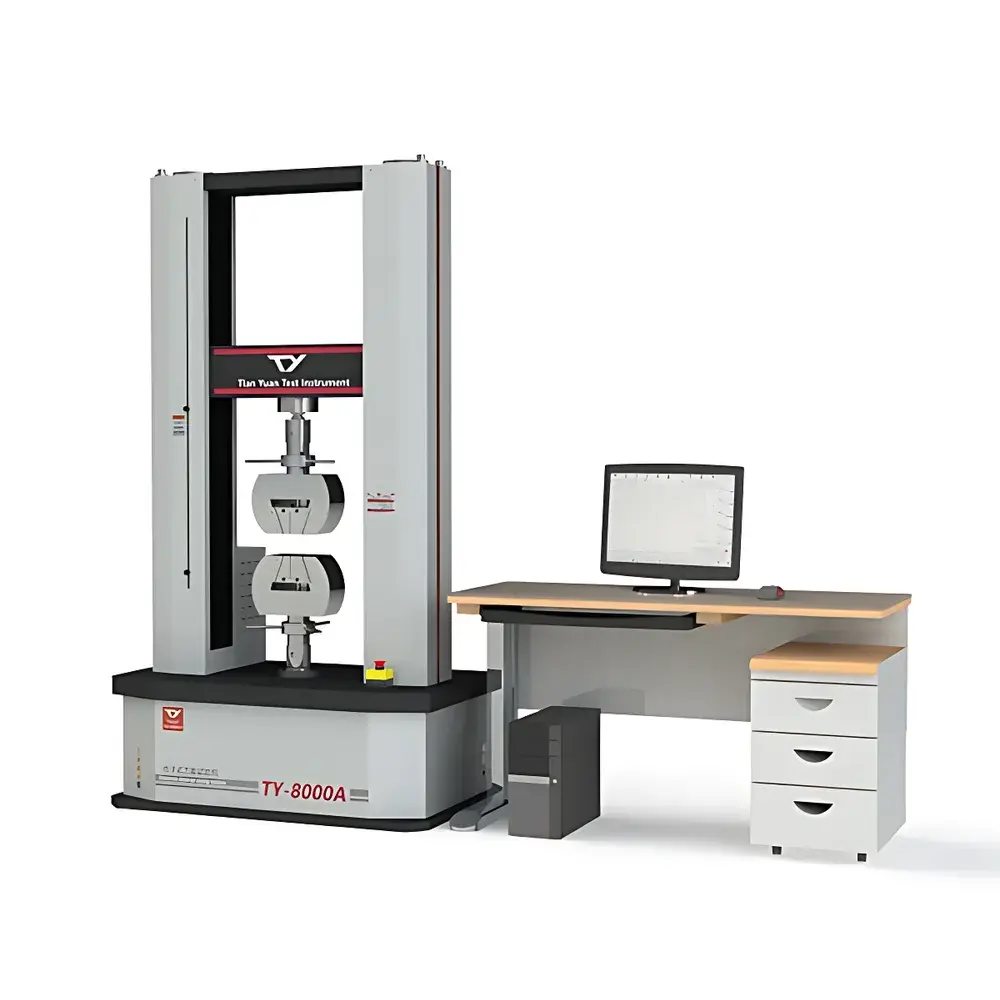
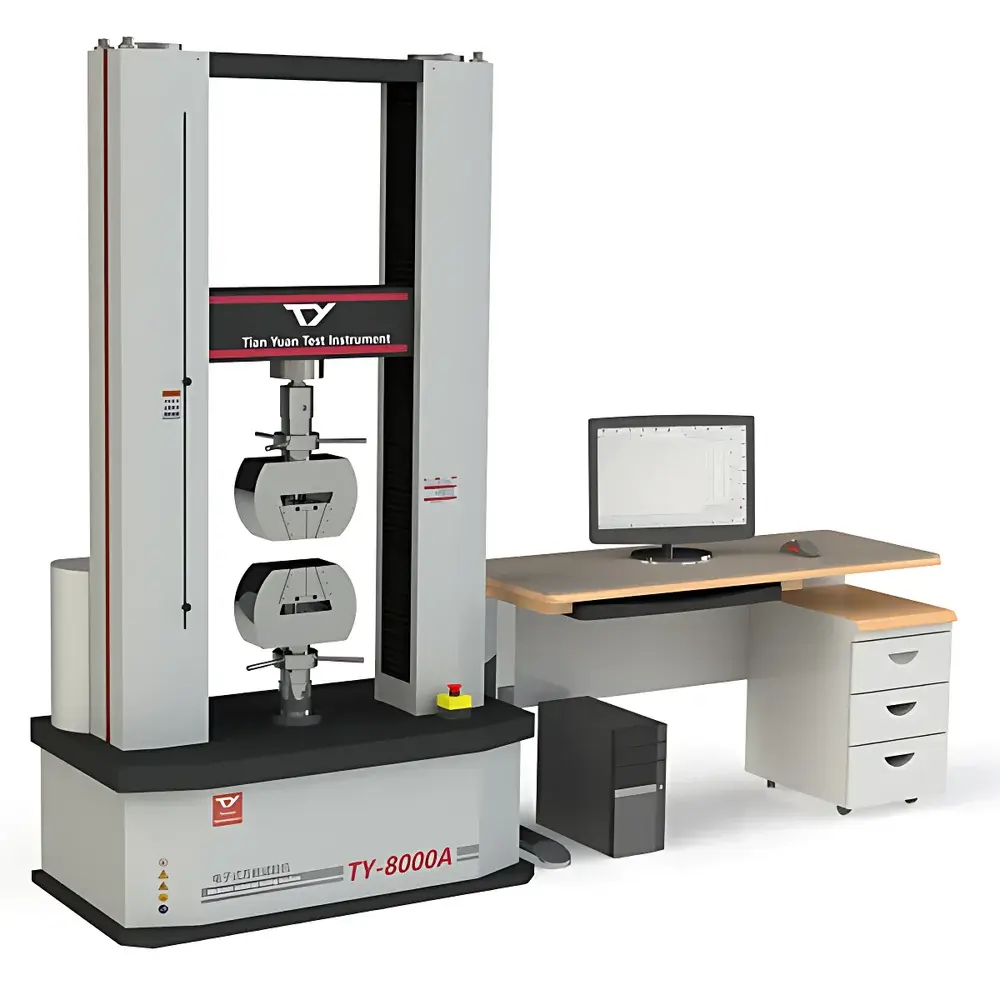
TianYuan TY8000-A 300 kN Electromechanical Universal Testing Machine
| Brand | TianYuan |
|---|---|
| Origin | Jiangsu, China |
| Manufacturer Type | Direct Manufacturer |
| Instrument Type | Electromechanical Universal Testing Machine |
| Model | TY8000-A 300 kN |
| Drive System | Servo Motor with Planetary Gearbox |
| Control Architecture | DSP + MCU Triple-Closed-Loop Digital Control |
| Load Capacity | 300 kN |
| Accuracy Class | 0.5 |
| Force Resolution | 1/500,000 FS |
| Force Measurement Range | 0.4–100% FS |
| Deformation Measurement Range | 0.2–100% FS |
| Force Rate Control Range | 0.01–5% FS/s |
| Deformation Rate Control Range | 0.02–5% FS/s |
| Crosshead Travel (excl. fixtures) | 1200 mm |
| Effective Width | 600 mm |
| Test Speed Range | 0.001–460 mm/min |
| Speed Accuracy | ≤ ±0.3% |
| Displacement Resolution | 0.001 mm |
| Sampling Rate (optional) | up to 1000 Hz |
| Power Supply | 380 V ±10%, 3.1 kW |
| Dimensions (W×D×H) | 1200 × 660 × 2210 mm |
| Weight | 1500 kg |
| Compliant Standards | GB/T 16491–1996, ISO 34, ISO 37, ISO 178, ISO 527, ASTM equivalents (200+ built-in test methods) |
Overview
The TianYuan TY8000-A 300 kN Electromechanical Universal Testing Machine is a high-precision, servo-driven static mechanical testing system engineered for rigorous tensile, compression, flexural, shear, peel, and tear characterization of both metallic and polymeric materials. Operating on the principle of controlled displacement and force feedback via a triple-closed-loop digital control architecture (force, displacement, and strain), the system delivers metrologically traceable mechanical property data in accordance with international standards including ISO, ASTM, and GB. Its modular mechanical design—featuring a rigid load frame, planetary gearbox-coupled ball screw drive, and high-stiffness load cell—ensures minimal deflection under maximum load, enabling reliable measurement of modulus, yield strength, ultimate tensile strength, elongation at break, compressive stress–strain response, and cyclic deformation behavior across thermoplastics, thermosets, composites, elastomers, and structural metals.
Key Features
- Servo motor actuation (Panasonic) integrated with a high-precision planetary gearbox (LIMING, Taiwan) for zero-backlash motion transmission, high torque density, and long-term maintenance-free operation.
- DSP + MCU-based triple-closed-loop digital controller enabling simultaneous real-time regulation of force, displacement, and strain—critical for advanced test protocols such as low-cycle fatigue, creep, stress relaxation, and multi-step ramp-hold sequences.
- Ultra-high-resolution data acquisition: standard 100 Hz sampling, optionally upgradable to 1000 Hz for dynamic event capture and high-speed transient analysis.
- Force transducer calibrated to 0.5-class accuracy (per ISO 7500-1), with full-scale resolution of 1/500,000 and measurement range from 0.4% to 100% FS—supporting precise quantification of both low-force polymer deformation and high-load structural metal yielding.
- Graphical software interface supporting real-time overlay of up to five synchronized curves: Load vs. Displacement, Load vs. Time, Displacement vs. Time, Stress vs. Strain, and Load vs. Extensometer Extension.
- Post-test graphical reanalysis module allowing curve smoothing, peak detection, modulus calculation (tangent, secant, chord), yield point identification (0.2% offset), and custom region-of-interest extraction without raw data reacquisition.
Sample Compatibility & Compliance
The TY8000-A accommodates standardized specimens per ISO 527 (plastics – tensile properties), ISO 178 (flexural properties), ISO 34 (peel resistance), ISO 37 (tensile stress–strain of vulcanized rubber), and ASTM D638/D790/D1876. It supports interchangeable fixture systems—including wedge-action tensile grips, compression platens, 3-/4-point bending fixtures, peel jigs, and pneumatic clamps—for specimen widths up to 600 mm and thicknesses compatible with common polymer sheet, film, pipe, profile, and metallic bar stock. All test methods are pre-configured within the embedded software library (200+ standards), with automated parameter initialization, pass/fail thresholding, and audit-ready reporting aligned with GLP and GMP documentation requirements. The system meets GB/T 16491–1996 (Chinese national standard for UTM performance verification) and supports FDA 21 CFR Part 11-compliant electronic signatures and audit trails when deployed in regulated QC environments.
Software & Data Management
The proprietary TianYuan TestMaster™ software provides ISO/IEC 17025-aligned test sequence definition, method validation, and result traceability. Each test session automatically logs operator ID, environmental conditions (if interfaced with external sensors), calibration status, fixture configuration, and raw time-series data with microsecond timestamping. Reports export natively to Excel (.xlsx) with embedded charts, statistical summaries (mean, SD, CV%), and customizable templates compliant with internal SOPs or external accreditation bodies. All data files are stored in an encrypted, version-controlled repository with role-based access control. Software updates and method patches are delivered via secure HTTPS channel with SHA-256 integrity verification.
Applications
- Quantitative evaluation of tensile modulus, yield strength, and fracture toughness in engineering thermoplastics (e.g., PEEK, PEI, PA66-GF30) and biopolymers (PLA, PHA).
- Compression testing of foams, elastomeric seals, and structural composites per ISO 844 and ASTM D1621.
- Flexural property determination (modulus, stress at yield) of plastic profiles and laminates using 3-point bending per ISO 178.
- Peel and tear resistance assessment of adhesive tapes, laminated films, and medical packaging per ISO 8510 and ASTM D903.
- Mechanical qualification of orthopedic implant materials (Ti-6Al-4V, CoCr alloys) under quasi-static loading per ISO 5832-3 and ASTM F1717.
- Teaching and research applications in university materials science labs requiring reproducible, standards-based mechanical property instruction.
FAQ
What is the maximum allowable specimen height for compression testing?
The effective crosshead travel is 1200 mm (excluding fixture height); maximum specimen height depends on selected compression platens and alignment requirements—typically up to 800 mm for standard configurations.
Does the system support extensometer integration?
Yes—both clip-on and non-contact video extensometers can be interfaced via analog or digital I/O ports; strain measurement range is 0.2–100% FS with optional high-resolution encoder coupling.
Is calibration traceable to national metrology institutes?
All load cells are factory-calibrated against NIST-traceable reference standards; full calibration certificates (including uncertainty budgets per ISO/IEC 17025) are supplied with each unit.
Can test methods be exported and shared across multiple machines?
Test method files (.tmf) are portable across TY8000-series instruments and retain all parameters, limits, and report formatting—enabling lab-wide consistency and inter-site comparability.
What safety certifications does the machine carry?
The system complies with CE marking requirements (EN ISO 12100, EN 61000-6-2/6-4) and meets UL 61010-1 for electrical safety in laboratory environments.



