
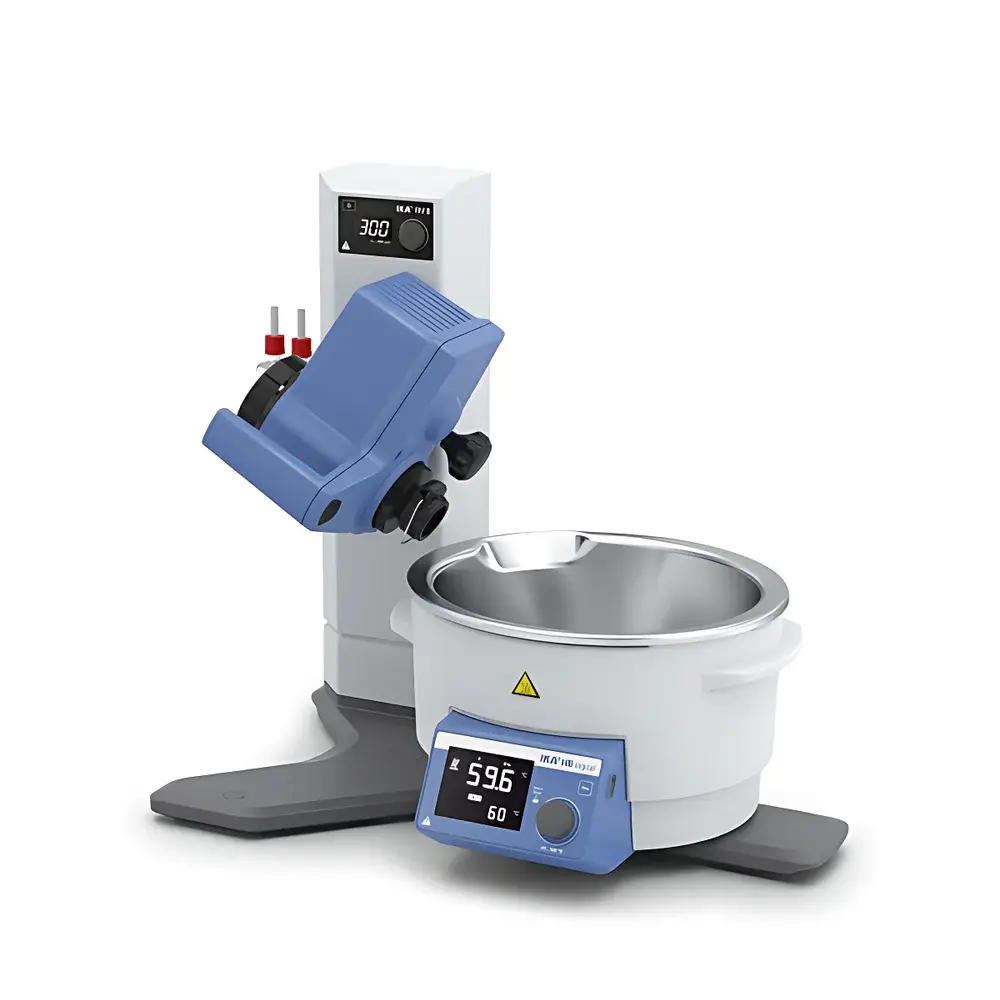
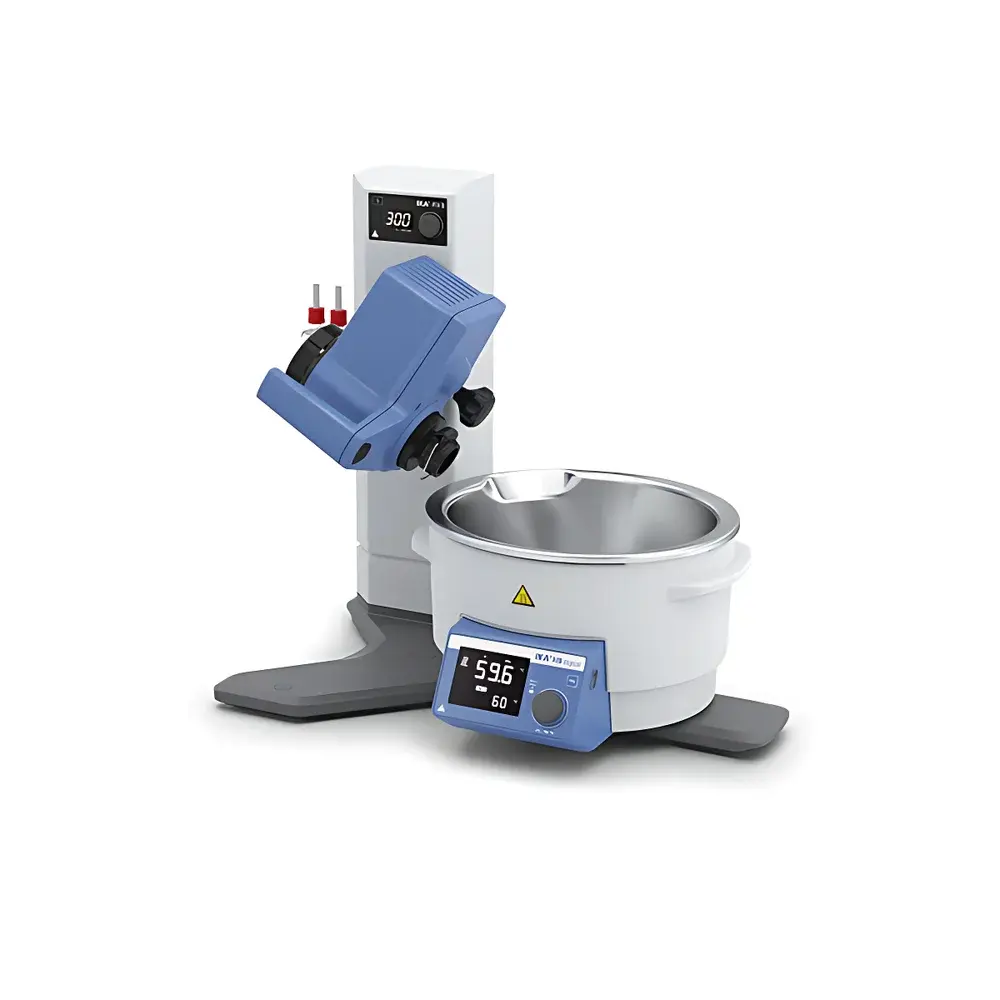
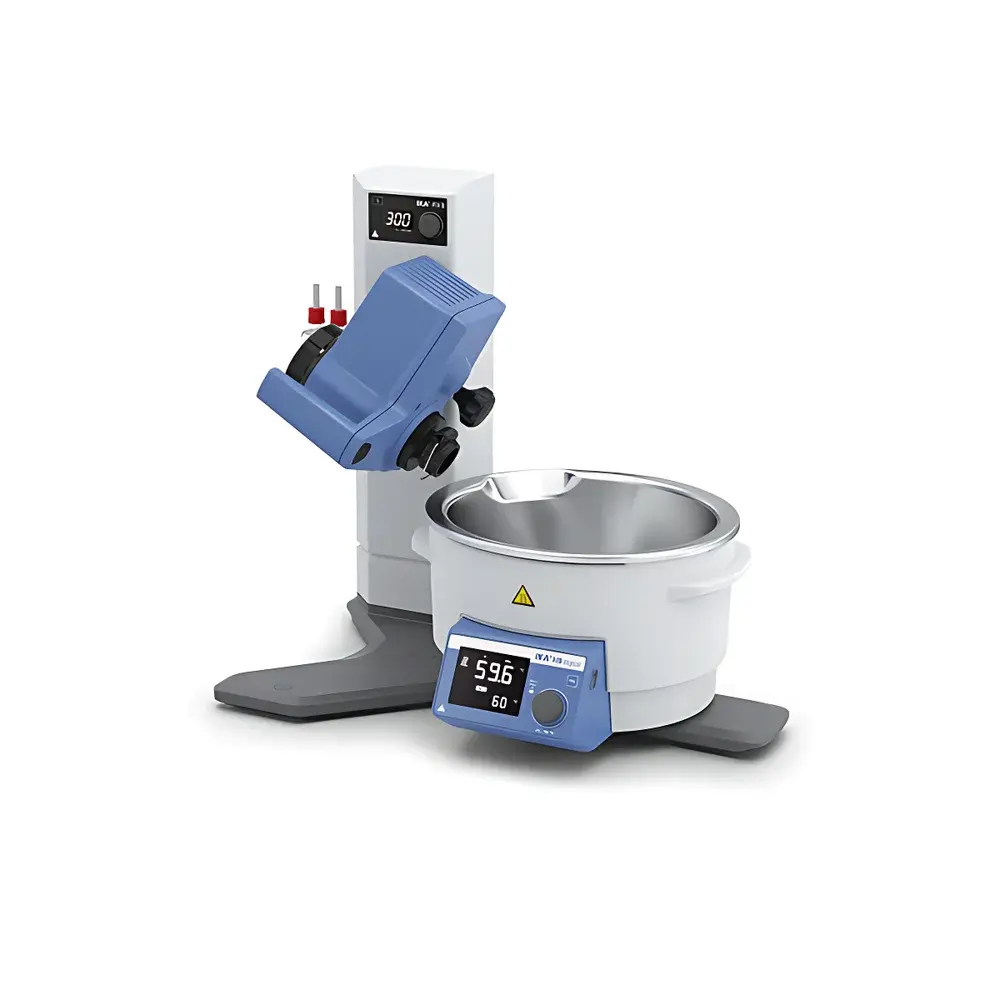
IKA RV 8 FLEX Rotary Evaporator
| Brand | IKA |
|---|---|
| Origin | Germany |
| Manufacturer | IKA-Werke GmbH & Co. KG |
| Type | Imported |
| Model | RV 8 FLEX |
| Capacity | 3 L |
| Ultimate Vacuum | 1 mbar |
| Rotational Speed Range | 5–300 rpm |
| Temperature Control Range | Ambient to 180 °C |
| Temperature Accuracy | ±1 °C |
| Cooling Surface Area | 1500 cm² |
Overview
The IKA RV 8 FLEX Rotary Evaporator is an engineered solution for efficient, reproducible solvent removal and concentration under reduced pressure in research, quality control, and pilot-scale laboratories. Based on the fundamental principle of rotary evaporation—where simultaneous rotation, heating, and vacuum application lower the boiling point of solvents while enhancing surface area and mass transfer—the RV 8 FLEX delivers precise process control across diverse sample matrices. Designed and manufactured in Staufen, Germany, it integrates robust mechanical architecture with intelligent safety logic and modular thermal management, enabling operation from ambient temperature up to 180 °C with ±1 °C stability across the full range. Its 3 L evaporation capacity supports scalable workflows, while the 1 mbar ultimate vacuum capability ensures compatibility with low-volatility solvents and heat-sensitive compounds.
Key Features
- Brushless DC motor drive offering quiet, maintenance-free operation with extended service life and consistent torque delivery across the full 5–300 rpm speed range; digital RPM display enables real-time monitoring and repeatability.
- Ergonomic dual-side lift handle equipped with capacitive proximity sensors and mechanical lock keys—enabling safe, one-handed elevation or descent over a 120 mm travel stroke; fixed 60 mm safety gap at bottom limit prevents condenser–bath collision.
- Adjustable head tilt (0–45°) facilitates optimal alignment between evaporating flask and condenser, improving condensation efficiency and reducing bumping risk during volatile solvent removal.
- Triple-layer vertical condenser with fully jacketed coolant channels provides ≥1500 cm² effective cooling surface; optimized geometry ensures uniform thermal distribution and high condensate recovery rates.
- Integrated vacuum buffer flask minimizes backstreaming and protects connected vacuum pumps from solvent vapors and particulates—critical for long-term pump reliability and compliance with ISO 8573-1 air purity standards.
- Heating bath features elliptical base geometry for rapid thermal equilibration and maximized usable volume; operates as both water and oil bath (no accessory required); 1300 W heating power enables fast ramp-up without overshoot.
- Automatic lift-on-power-loss function raises the evaporation flask above the heating bath within <1.5 seconds, preventing thermal degradation, bumping, or sample contamination during unexpected outages.
- Dual-lock verification system on the vapor tube—mechanical and visual (red indicator)—ensures secure assembly before operation, meeting IEC 61010-1 safety requirements for laboratory equipment.
Sample Compatibility & Compliance
The RV 8 FLEX accommodates standard ground-glass jointed glassware (ISO K 29/32 and K 35/40), including 1 L and 3 L evaporation flasks and matching receiving flasks. Its PTFE-sealed joints resist corrosion from aggressive solvents (e.g., chlorinated hydrocarbons, strong acids/bases), supporting applications compliant with ASTM D129, USP , and EP 2.4.24. The unit conforms to CE marking directives (2014/30/EU EMC, 2014/35/EU LVD), RoHS 2011/65/EU, and carries full IKA factory certification per ISO 9001:2015 manufacturing controls. Safety temperature limits (50–190 °C) are user-configurable to align with GLP/GMP thermal validation protocols.
Software & Data Management
While the RV 8 FLEX operates as a standalone instrument with analog-digital hybrid controls (no embedded PC or cloud connectivity), its digital temperature and RPM displays support manual logbook documentation aligned with 21 CFR Part 11 Annex 11 principles. All setpoints, runtime durations, and observed parameters can be recorded externally using validated electronic lab notebooks (ELNs) or LIMS-integrated workflows. IKA’s optional LabWorldSoft™ (v5.0+) enables remote monitoring and parameter logging via RS232/USB interface—supporting audit trails, user access levels, and export to CSV/PDF for regulatory submissions.
Applications
- Solvent removal and concentration of natural product extracts (e.g., botanical oils, alkaloid fractions) under gentle thermal conditions.
- Post-synthesis workup in organic and medicinal chemistry labs—removal of THF, dichloromethane, ethyl acetate, and toluene without decomposition.
- Concentration of HPLC fractions prior to lyophilization or NMR analysis.
- Removal of residual solvents from polymer solutions and nanoparticle dispersions (e.g., PLGA, liposomes).
- Preparative purification in food science (flavor compound isolation) and environmental testing (PAH, PCB extraction concentrates).
FAQ
Does the RV 8 FLEX support external vacuum controller integration?
Yes—via 0–10 V analog input and digital RS232 port; compatible with IKA VAC Star® controllers for programmable vacuum ramps and endpoint detection.
Can the heating bath be used independently of the rotary mechanism?
Yes—the bath operates as a standalone thermostatic bath with independent temperature control, suitable for water/oil baths, dissolution testing, or enzymatic reactions.
What glassware configurations are supported beyond the standard 1 L kit?
The system accepts all IKA RV series glassware up to 4 L via optional extension sleeves and adapter collars (e.g., RV 10.2, RV 10.3 kits); no modification to the mainframe is required.
Is firmware upgradability supported?
Firmware updates are performed by authorized IKA service engineers using certified diagnostic tools; version history and update logs are maintained per ISO/IEC 17025 calibration records.
How is traceability ensured during routine operation?
Each unit ships with a factory-issued calibration certificate (temperature and rotation), valid for 12 months; periodic verification follows DIN EN ISO/IEC 17025 guidelines using NIST-traceable reference standards.



