
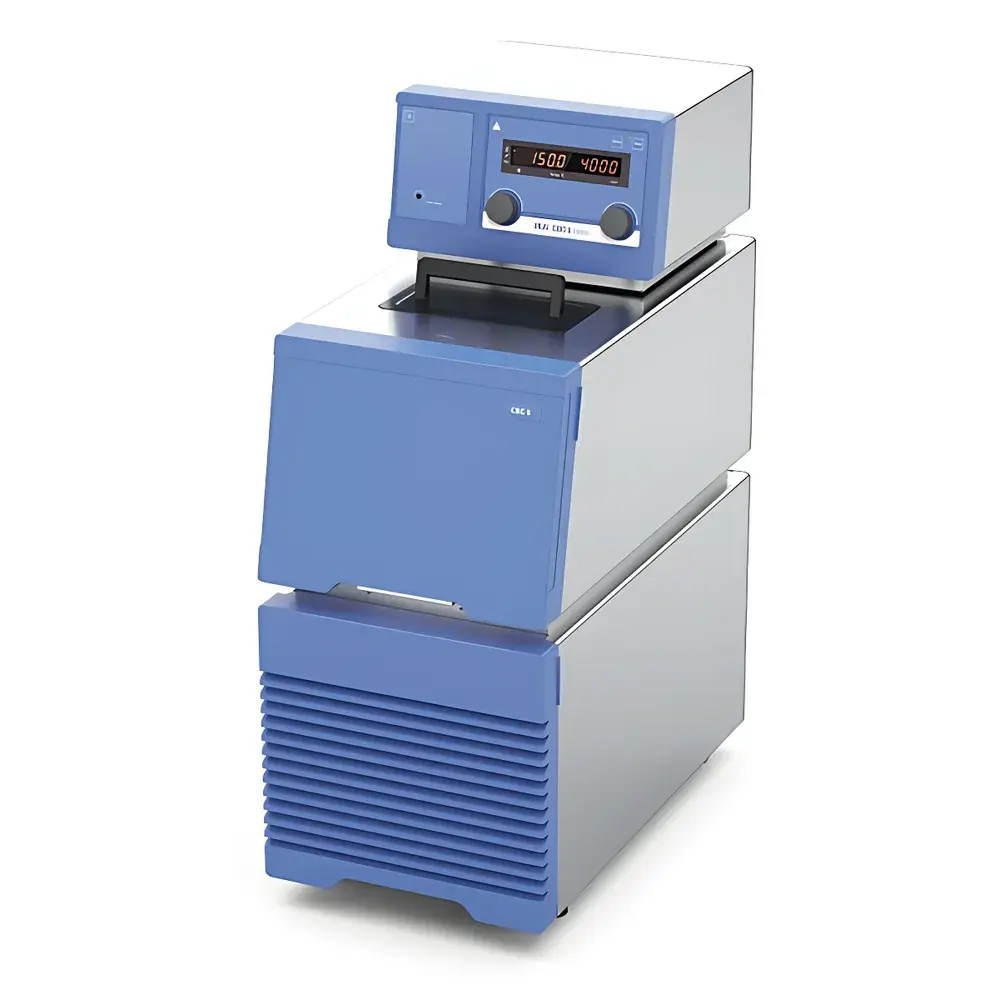
IKA CBC 5 basic Circulating Chiller/Heater
| Brand | IKA |
|---|---|
| Origin | Germany |
| Manufacturer | IKA-Werke GmbH & Co. KG |
| Type | CBC 5 basic |
| Instrument Category | Circulating Bath (Water/Oil) |
| Circulation Mode | Internal & External |
| Temperature Control | Refrigeration & Heating |
| Bath Volume | 7 L |
| Temperature Range | −25 °C to +200 °C |
| Temperature Stability | ±0.02 °C (@ +70 °C, DIN 12876) |
| Input Power | 3000 W |
| Supply Voltage | 230 V AC, 50/60 Hz |
| Cooling Capacity | 400 W (@ 20 °C) |
| Heating Power | 2500 W |
| Pump Flow Rate | up to 31 L/min (0 bar backpressure) |
| Max. Pressure | 0.61 bar |
| Safety Class | DIN 12876 Class III (FL) |
| Refrigerant | R134a |
| Net Weight | 39.5 kg |
| Dimensions (W × D × H) | 275 × 690 × 490 mm |
| Protection Rating | IP21 |
| Interface | RS232 & USB |
| External Sensor Support | PT100 input |
Overview
The IKA CBC 5 basic is a high-performance, dual-mode circulating chiller/heater engineered for precise temperature control in demanding laboratory applications requiring both cooling and heating capabilities. Based on Peltier-assisted refrigeration combined with resistive heating and a robust pressure/suction pump system, it delivers stable thermal management across an exceptionally wide operating range—from −25 °C to +200 °C—making it suitable for applications involving low-temperature reaction control, high-temperature solvent reflux, or dynamic temperature ramping in external systems such as jacketed reactors, viscometers, or spectroscopic cells. Its design complies fully with DIN 12876 Part 3 for safety classification of laboratory equipment (Class III, FL designation), ensuring safe operation with flammable liquids and elevated temperatures. The unit features vacuum-insulated bath construction to minimize heat loss during cooling and reduce thermal inertia during heating cycles, contributing to rapid thermal response and superior long-term stability.
Key Features
- Wide operational temperature span: −25 °C to +200 °C, enabled by integrated compressor-based refrigeration (R134a) and high-wattage resistive heating (2500 W)
- High-flow, variable-speed pressure/suction pump (0–31 L/min; max. 0.61 bar pressure) optimized for external circulation loops with minimal head loss
- Temperature stability of ±0.02 °C at +70 °C (per DIN 12876), achieved via dual-sensor control architecture: primary PT100 working sensor + redundant PT1000 safety sensor
- Dual-display LED interface showing real-time bath temperature, pump speed, and safety status—calibration-traceable with user-accessible offset adjustment
- Comprehensive safety system including adjustable high/low temperature cut-off (0–260 °C), audible/visual alarms, automatic shutdown on sensor fault or overtemperature, and mechanical emergency drain valve
- Standard digital interfaces (RS232 and USB) supporting integration with lab automation platforms and remote monitoring via IKA’s labworldsoft® software suite
- IP21-rated enclosure and Class III FL certification per DIN 12876 for use with flammable media in controlled laboratory environments
Sample Compatibility & Compliance
The CBC 5 basic accommodates aqueous, ethylene glycol–water, silicone oil, and other thermally stable heat transfer fluids compatible with its stainless steel bath and fluoropolymer-sealed pump components. Its 7 L bath volume supports immersion of large probes or multiple sensors while maintaining homogeneous thermal distribution. The unit conforms to key international standards including DIN 12876-3 (safety classification for laboratory thermostats), EN 61000-6-3 (EMC emissions), EN 61000-6-2 (immunity), and EN 61010-1 (safety requirements for electrical equipment). It meets essential requirements for GLP-compliant environments when paired with audit-trail-capable software (e.g., labworldsoft® with 21 CFR Part 11 mode enabled) and supports calibration documentation per ISO/IEC 17025 traceability frameworks.
Software & Data Management
Digital communication is supported natively via RS232 and USB ports, enabling bidirectional parameter exchange—including setpoint control, real-time temperature/pump data streaming, alarm status reporting, and firmware updates. When connected to labworldsoft®, the CBC 5 basic provides full logging capability: time-stamped temperature profiles, pump duty cycles, event-triggered alerts (e.g., “temp deviation >0.1 °C”), and automated export to CSV or PDF. The software supports multi-device synchronization, batch protocol scripting, and electronic signature workflows compliant with FDA 21 CFR Part 11 Annex 11 expectations. All internal memory retains critical operational logs even during power interruption, and external PT100 probe inputs allow closed-loop control of process temperature at the point of use—not just bath temperature.
Applications
- Temperature control of external analytical instruments: HPLC column ovens, UV-Vis spectrophotometer cuvette holders, FTIR sample compartments
- Process simulation in chemical synthesis: exothermic reaction quenching, cryogenic Grignard initiation, distillation condenser cooling
- Materials testing: rheometer temperature ramps, DSC reference calibration, polymer melt index conditioning
- Biotechnology: fermenter jacket temperature regulation, enzyme activity assays across physiological and supra-physiological ranges
- Quality control laboratories: viscosity measurement standardization (ASTM D445), refractive index calibration (ISO 2859), thermal stability screening (USP <1031>)
FAQ
What is the minimum and maximum fluid volume the bath can operate with?
The recommended operating volume is 5–7 L. Operation below 5 L may compromise pump priming and temperature uniformity; exceeding 7 L risks overflow and reduced thermal responsiveness.
Can the CBC 5 basic be used with silicone oil or other high-boiling-point media?
Yes—provided the fluid’s flash point exceeds 200 °C and it remains chemically inert toward stainless steel (AISI 304 bath) and EPDM/FKM seals. Verify compatibility with IKA’s fluid recommendation list before extended use.
Is the unit suitable for GMP-regulated environments?
When operated with labworldsoft® in 21 CFR Part 11 mode (electronic signatures, audit trail, role-based access), and maintained under documented calibration and preventive maintenance schedules, it fulfills core instrumentation requirements for GMP-compliant QC labs.
How does the dual-sensor safety architecture function?
The primary PT100 sensor governs active temperature control, while the independent PT1000 safety sensor continuously monitors bath temperature. If deviation exceeds user-defined thresholds—or if either sensor fails—the system triggers immediate shutdown and visual/audible alarm.
Does the pump support dry-run protection?
No—dry running will damage the pump. Always ensure adequate fluid level (>5 L) and verify circulation path integrity prior to startup. The unit includes no intrinsic dry-run detection; this must be managed externally via flow switches or interlocks.



