ASD N2 Sense Online Trace Nitrogen Analyzer for Argon and Helium
| Brand | ASD |
|---|---|
| Origin | Canada |
| Model | N2 Sense |
| Detection Limit | 0.5 ppb |
| Repeatability | <1% |
| Detector Type | Enhanced Plasma Discharge (EPD) |
| Column Temperature Range | Ambient +4 °C to 450 °C |
| Carrier Gas Requirement | High-Purity Gas |
| Output | 4–20 mA, Ethernet, RS-232, MQTT |
| Data Storage | 12-month onboard logging |
| Dimensions | 133 × 202 × 330 mm (19″ rack-mountable) |
| Power | 24 VDC, 40 W |
| Operating Temperature | 5–40 °C |
| Sample Flow Rate | 5–200 mL/min |
| Inlet Pressure | 3–25 PSIG |
| Response Time | <10 s (90% step change at 75 mL/min) |
| Drift | <0.5% FS |
| Measurement Ranges | 0–1 ppm, 0–10 ppm, 0–100 ppm, up to 1% N₂ in Ar/He |
Overview
The ASD N2 Sense Online Trace Nitrogen Analyzer is a dedicated industrial gas chromatograph engineered for continuous, real-time quantification of nitrogen impurities at sub-part-per-trillion levels in high-purity argon and helium process streams. Unlike conventional thermal conductivity (TCD) or paramagnetic analyzers, the N2 Sense employs Enhanced Plasma Discharge (EPD) detection—a robust, non-destructive spectroscopic technique leveraging controlled low-energy plasma excitation combined with differential optical signal processing. This architecture eliminates spectral interference from matrix gases (Ar, He), enabling selective N₂ measurement without chemical conversion or catalytic reactors. The instrument operates on the principle of electron-impact-induced nitrogen molecular emission, where differential photodetector arrays reject background continuum and Rayleigh-scattered light—ensuring baseline stability and immunity to pressure or flow fluctuations common in cryogenic air separation and semiconductor-grade gas distribution systems.
Key Features
- Sub-ppb detection limit: 0.5 ppb (enhanced mode), validated per ISO 10723:2012 Annex C for trace gas calibration traceability
- Differential spectral compensation: Dual-channel optical path with active reference subtraction suppresses matrix-induced drift and lamp aging effects
- Patented zero-leakage mass flow controller: Integrated thermal-based laminar flow regulation maintains ±0.5% volumetric accuracy across 5–200 mL/min range, independent of inlet pressure (3–25 PSIG)
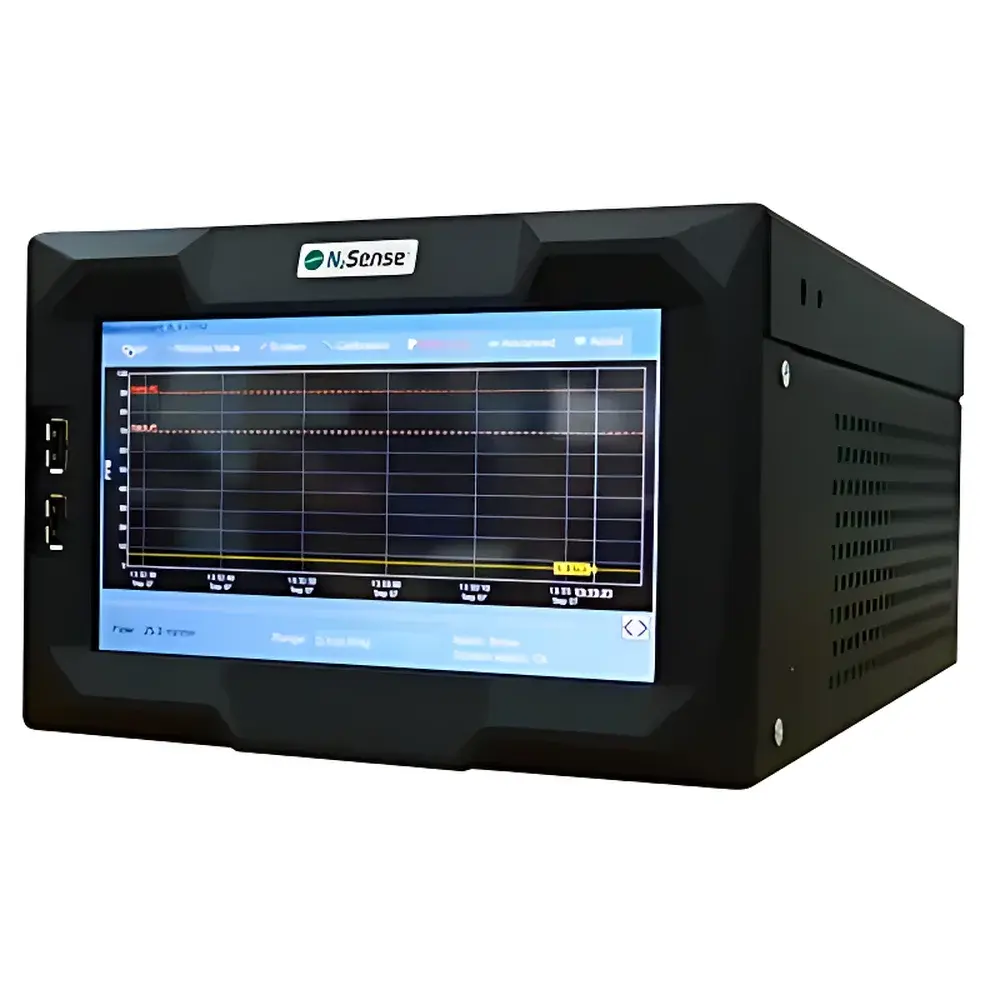
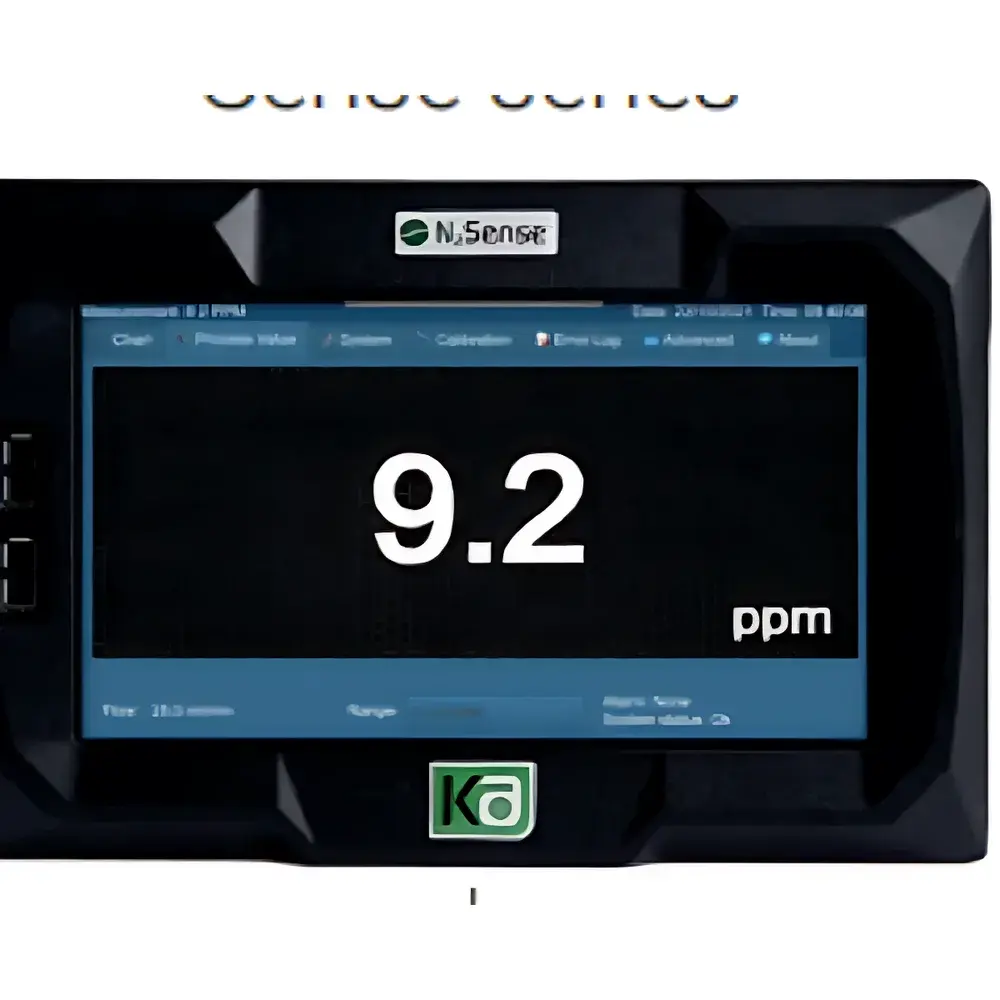
- Industrial HMI: 7-inch capacitive touchscreen with SIL2-compliant UI, supporting multilingual operator prompts and audit-ready event logging
- Embedded data stewardship: Onboard 16 GB flash memory stores 12 months of second-resolution chromatograms, alarm states, calibration logs, and system diagnostics—compliant with FDA 21 CFR Part 11 electronic record requirements
- Compact 19″ rack form factor (133 × 202 × 330 mm): Designed for panel integration in Class 1 Div 2 hazardous locations; meets IEC 61000-6-2/6-4 EMC standards
Sample Compatibility & Compliance
The N2 Sense is optimized exclusively for binary mixtures of high-purity argon or helium containing nitrogen as the sole analyte of interest. It accepts standard industrial gas connections via 1/8″ LipLOK™ fittings—compatible with Swagelok®, Parker A-LOK®, and equivalent instrumentation-grade compression fittings. Calibration is performed using certified N₂-in-Ar or N₂-in-He standards traceable to NIST SRM 2629a, with dual-point (zero/span) protocol supporting ASTM D6866-22 verification. The analyzer conforms to ISO 8573-1:2010 Class 1 compressed air purity specifications for inert gas applications and satisfies SEMI F57-0301 requirements for ultra-high-purity (UHP) gas monitoring in front-end semiconductor fabrication.
Software & Data Management
Firmware v4.2 includes embedded MQTT client support for secure TLS 1.2 communication with cloud-based SCADA platforms (e.g., Ignition, Siemens MindSphere). Local HMI provides real-time chromatogram overlay, trend analysis over user-defined intervals (1 min to 30 days), and configurable alarm thresholds with latching/non-latching behavior. All I/O events—including relay state changes, calibration triggers, and detector voltage anomalies—are timestamped with microsecond precision and stored with SHA-256 hash integrity. Remote firmware updates are authenticated via X.509 certificate chain validation. Audit trail export complies with GLP/GMP Annex 11 requirements, including operator ID, action type, timestamp, and pre/post-value deltas.
Applications
- Air separation units (ASUs): Monitoring nitrogen breakthrough in argon side-stream purification columns
- Helium liquefaction plants: Verifying N₂ removal efficiency downstream of cryogenic adsorption beds
- Specialty gas production: Final QC release testing for electronic-grade argon (Grade 5.7, ISO 8573-1 Class 1) and helium (Grade 6.0)
- Semiconductor fab gas cabinets: Continuous monitoring of purge gas lines feeding ALD/CVD tools
- Research gloveboxes: Quantifying nitrogen ingress during long-term inert atmosphere maintenance
- Leak detection support: Correlating N₂ rise rates with helium leak test results in vacuum-integrated systems
FAQ
What calibration gases are required for routine operation?
Certified N₂-in-Ar or N₂-in-He standards at two concentrations: one near zero (≤10 ppb) and one within 70–90% of selected measurement range (e.g., 700 ppb for 1 ppm range). Standards must be NIST-traceable with uncertainty ≤15% k=2.
Does the N2 Sense require carrier gas conditioning?
Yes. A dedicated high-purity (≥99.9999%) argon or helium supply is mandatory for EPD plasma stabilization. Moisture and hydrocarbon content must be ≤0.1 ppmv, verified per ISO 8573-6 Class 1.
Can the instrument operate unattended for extended periods?
Yes. With scheduled auto-zero cycles and remote diagnostic telemetry, mean time between maintenance (MTBM) exceeds 6 months under continuous operation per IEC 61508 SIL2 operational profile.
Is the detector sensitive to oxygen or moisture contamination?
No. The EPD cell is inherently insensitive to O₂ and H₂O due to non-reactive plasma excitation physics. However, prolonged exposure to >1 ppm moisture may degrade column lifetime and requires upstream desiccant filtration.
How is measurement uncertainty quantified?
Total expanded uncertainty (k=2) is ≤±2.5% of reading for concentrations ≥10 ppb, derived from detector noise, flow control error, calibration standard uncertainty, and temperature coefficient contributions per GUM (JCGM 100:2008).
Related Products