
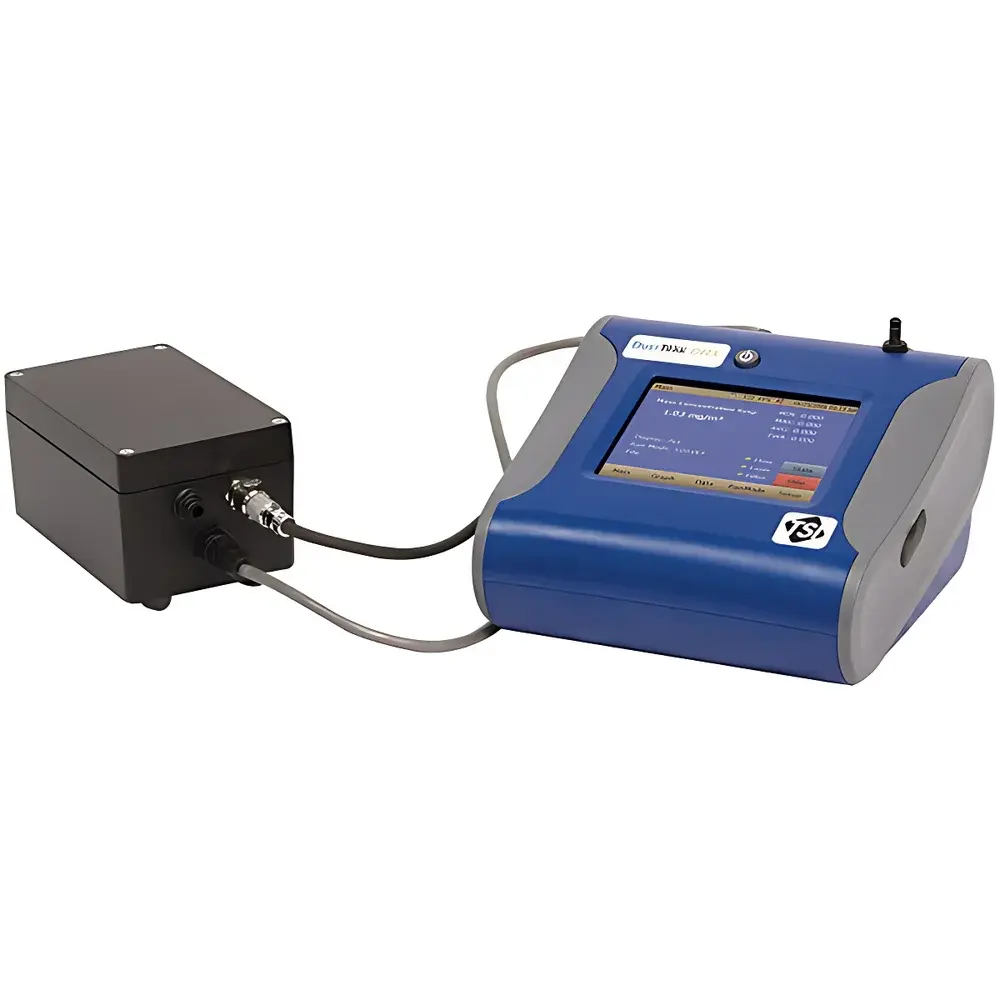
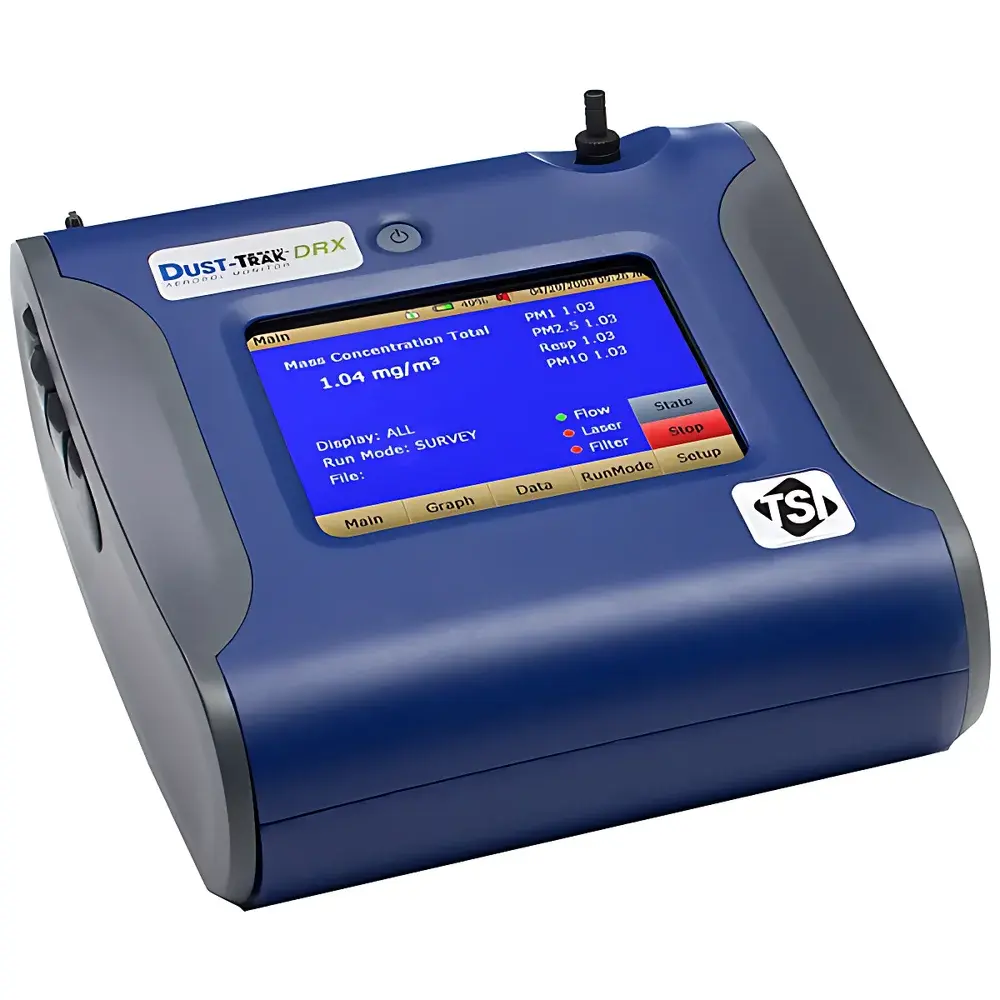
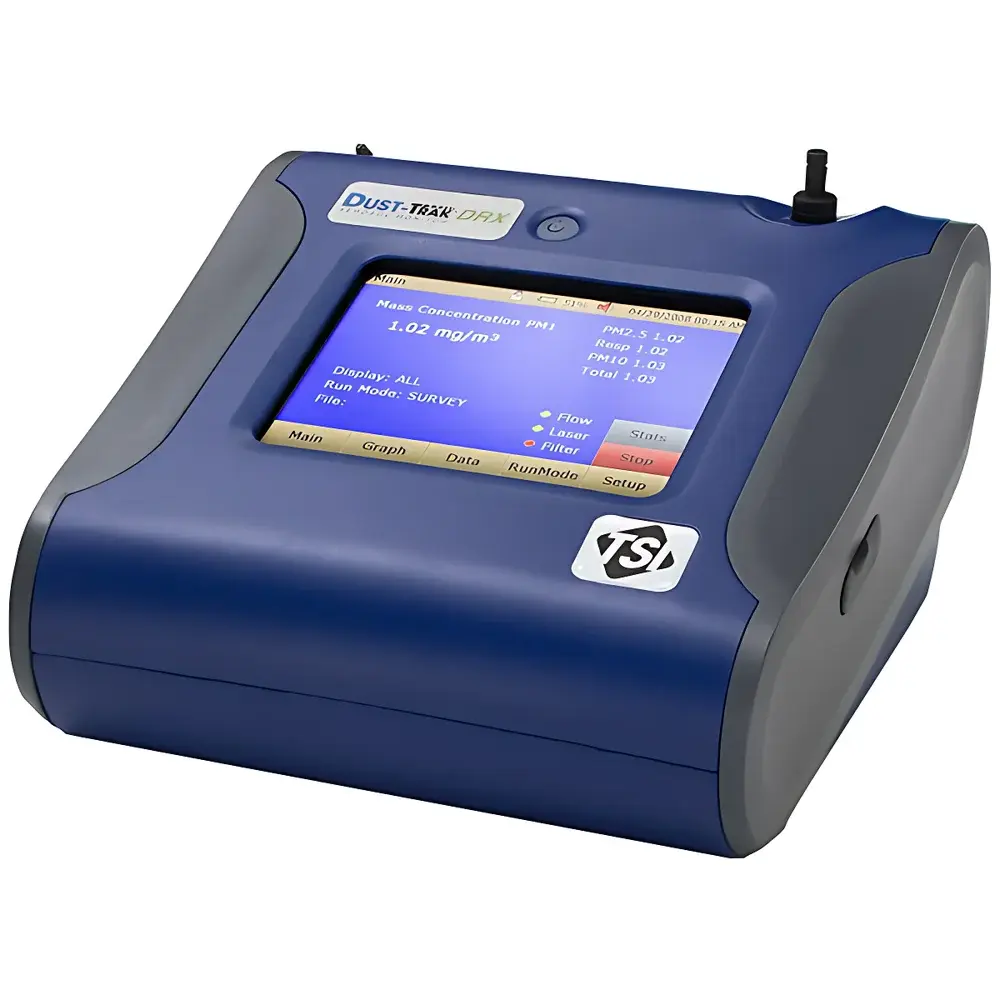
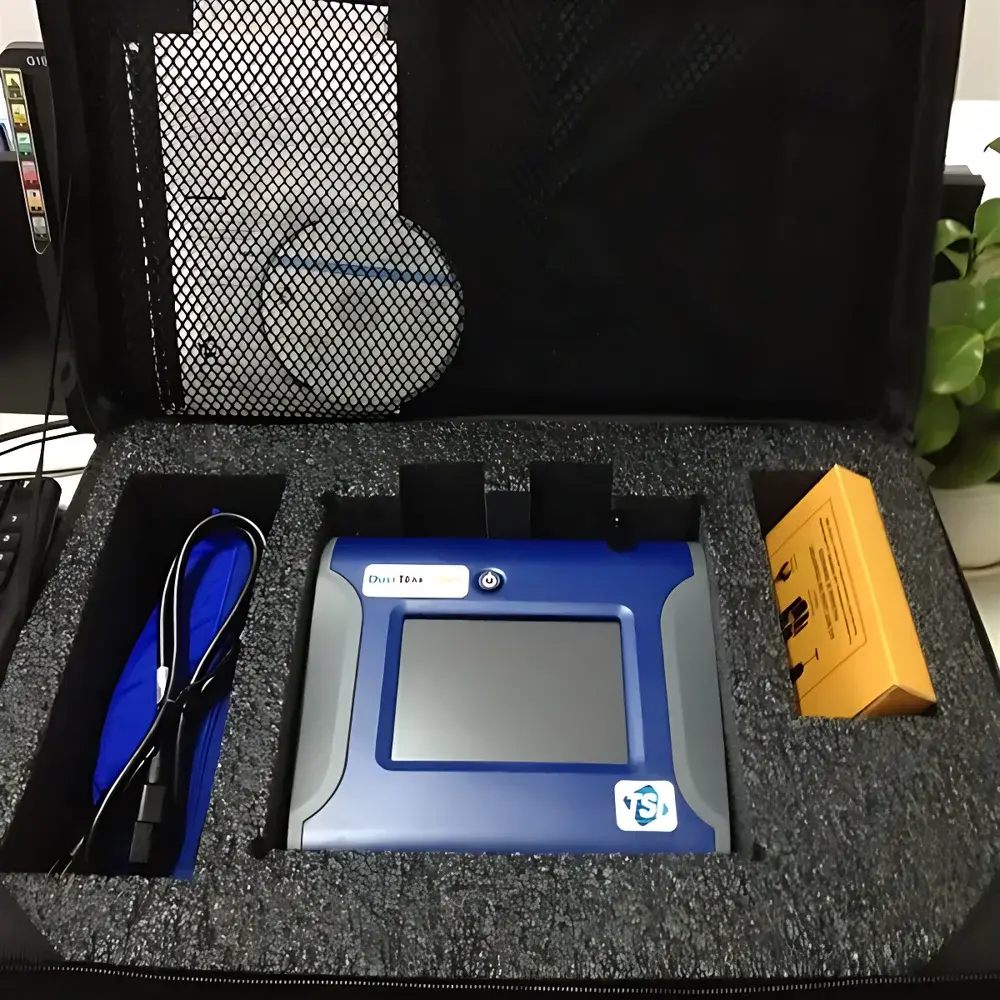
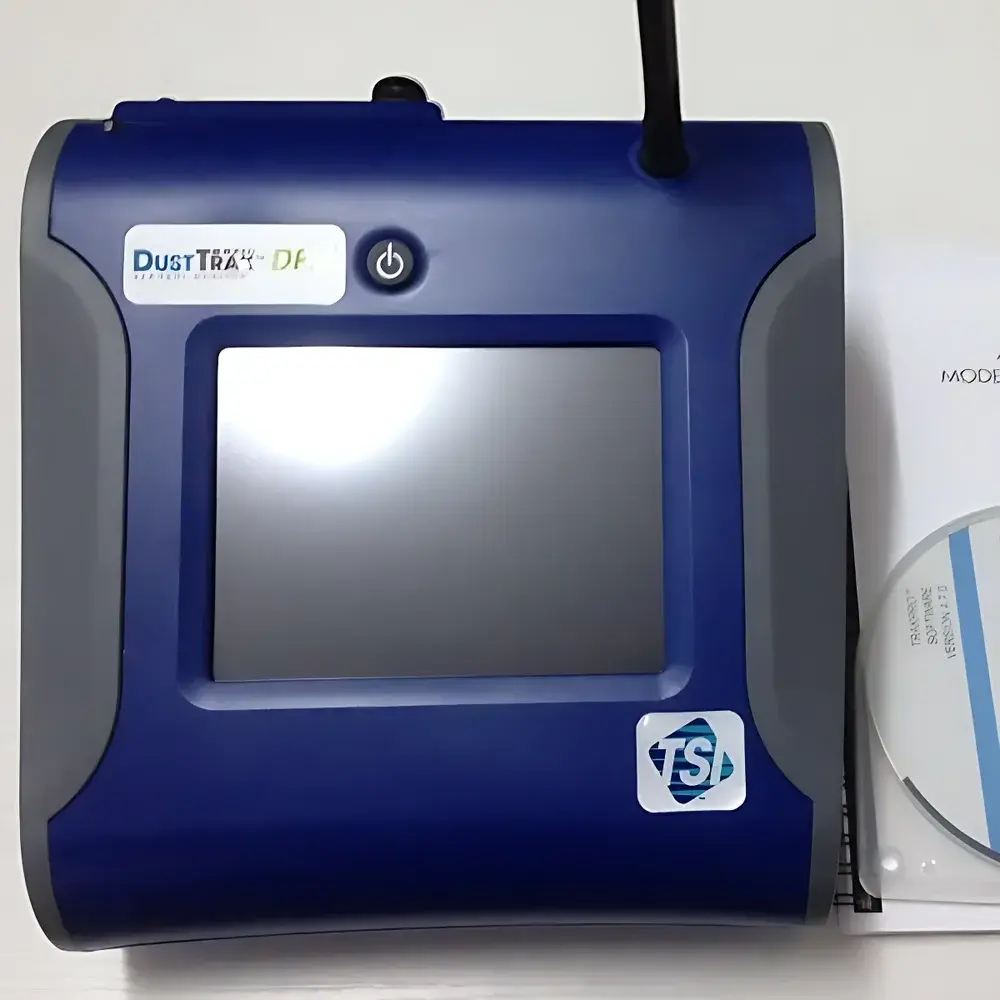
TSI DustTrak DRX Model 8533EP Aerosol Monitor
| Brand | TSI |
|---|---|
| Origin | USA |
| Model | 8533EP |
| Instrument Type | Real-time Aerosol Mass Concentration Monitor |
| Detection Principle | 90° Light Scattering (Laser Photometry) |
| Mass Concentration Range | 0.001–150 mg/m³ |
| Simultaneous Size-Fractionated Outputs | PM₁, PM₂.₅, Respirable (PM₄), PM₁₀, and Total PM (<15 µm) |
| Flow Rate | 3.0 L/min (±5% accuracy, internally controlled) |
| Optical System | Sheath-Air Isolated Laser Cavity |
| Display | 5.7″ VGA Color Touchscreen |
| Data Storage | 5 MB internal memory (>60,000 data points |
| Operating Temperature | 0–50 °C |
| Storage Temperature | −20–60 °C |
| Relative Humidity | 0–95% RH (non-condensing) |
| Time Constant | User-selectable (1–60 s) |
| Resolution | ±0.1% of reading or 0.001 mg/m³ (whichever is greater) |
| Zero Stability | ±0.002 mg/m³ over 24 h |
| Particle Size Range | 0.1–15 µm |
| Power | Rechargeable Li-ion battery (2.0 kg w/1 battery |
| Connectivity | USB, Ethernet (8533EP only), USB mass storage support |
| Analog Output | User-selectable 0–5 V or 2–20 mA |
| Alarm Output | Relay (non-latching MOSFET) or audible buzzer |
| Filter Holder | Replaceable 37 mm filter cassette (user-supplied) |
| Compliance | Designed for use in occupational health monitoring per OSHA, NIOSH, and ISO 7708 air sampling protocols |
Overview
The TSI DustTrak DRX Model 8533EP is a real-time, gravimetrically referenced aerosol mass concentration monitor engineered for continuous environmental and occupational exposure assessment. It employs calibrated 90° light scattering photometry with integrated sheath-air optics isolation—ensuring long-term optical stability and minimizing contamination-induced drift in demanding field conditions. Unlike single-size-fraction instruments, the 8533EP simultaneously quantifies five mass-based aerosol fractions—PM₁, PM₂.₅, respirable (PM₄), PM₁₀, and total particulate mass (<15 µm)—using proprietary Mie-scattering algorithms validated against reference gravimetric methods. Its fixed 3.0 L/min volumetric flow rate is actively regulated by an internal mass flow controller, eliminating reliance on external rotameters or pressure-compensated pumps. The instrument is purpose-built for unattended 24/7 operation in construction sites, industrial perimeters, ambient air quality networks, and indoor workplace environments where regulatory compliance, reproducible trending, and traceable calibration are mandatory.
Key Features
- Simultaneous real-time output of five size-selective mass concentrations: PM₁, PM₂.₅, respirable (PM₄), PM₁₀, and total PM (<15 µm)
- Sheath-air optical isolation system prevents particle deposition on laser and detector surfaces—reducing maintenance frequency and enhancing measurement continuity
- 5.7″ VGA color touchscreen interface with intuitive icon-driven navigation and context-sensitive soft keys
- User-programmable time constant (1–60 s) for dynamic response optimization across varying aerosol generation rates
- Internal 5 MB flash memory stores >60,000 timestamped records (including all five fractions, flow, temperature, humidity, and status flags)
- Rechargeable lithium-ion battery system with dual-battery configuration option for extended field deployment
- Onboard analog output (0–5 V or 2–20 mA) and relay alarm output with user-defined setpoints and 5% deadband
- Integrated flow, laser, and filter status indicators displayed in real time on the main screen
- Filter service counter with configurable maintenance alerts to support preventive servicing schedules
- Pause/resume sampling functionality without data loss or timebase interruption
Sample Compatibility & Compliance
The 8533EP is compatible with standard 37 mm diameter mixed-cellulose ester (MCE), polyvinyl chloride (PVC), or quartz fiber filters for concurrent gravimetric validation. Its aerosol inlet meets ISO 7708:1995 specifications for inhalable, thoracic, and respirable convention definitions—enabling direct correlation with occupational exposure limits (OELs) established by ACGIH®, OSHA, and EU-OSHA. The instrument’s optical calibration is traceable to NIST-traceable polystyrene latex (PSL) spheres and verified using ISO 12103-1 A1 test dust. While not certified as a Class I, Division 1 hazardous location device, its robust IP54-rated enclosure ensures reliable operation in dusty, high-humidity outdoor settings—including construction zones, demolition sites, and landfill perimeter monitoring stations.
Software & Data Management
Data acquisition, visualization, and reporting are managed via TSI’s TRAKPRO™ Data Analysis Software (v6.0+), a Windows-based application compliant with FDA 21 CFR Part 11 requirements for electronic records and signatures when configured with audit trail, user access controls, and electronic signature modules. TRAKPRO™ enables batch import of .csv or native .tdt files, synchronized multi-instrument timeline overlays, statistical summaries (min/max/mean/stdev), and automated report generation in PDF or Excel formats. All raw sensor outputs—including individual channel voltages, temperature-compensated scatter signals, and flow diagnostics—are retained in the native file structure to support retrospective reprocessing and uncertainty analysis. Firmware updates are delivered via secure HTTPS download and applied through USB or Ethernet connection.
Applications
- Continuous perimeter air monitoring at construction, mining, and remediation sites per EPA Method PS-1 and local air district requirements
- Indoor air quality (IAQ) assessments in schools, hospitals, and office buildings to evaluate HVAC filtration efficiency and source emission control
- Occupational hygiene surveys for silica, coal dust, welding fume, and biomass combustion aerosols in accordance with NIOSH Method 0600 and ISO 7213
- Validation of engineering controls (e.g., local exhaust ventilation, water suppression systems) through pre- and post-intervention time-series analysis
- Mobile monitoring campaigns using vehicle-mounted or tripod-deployed configurations with optional GPS synchronization
- Research-grade aerosol characterization in atmospheric science laboratories requiring multi-fraction resolution and long-term stability
FAQ
Does the 8533EP require annual factory recalibration?
No—TSI recommends verification against a NIST-traceable reference aerosol generator or gravimetric filter sample every 6–12 months depending on usage intensity and regulatory program requirements. Field zero checks using the optional Zero Module are advised prior to each critical measurement campaign.
Can the 8533EP be used for regulatory compliance reporting?
Yes—when operated per TSI’s documented procedures and paired with gravimetric backup sampling, it satisfies data quality objectives outlined in EPA OTM-11, ISO 16000-25, and EU Directive 2008/50/EC Annex XII for indicative monitoring.
Is the analog output suitable for integration into a SCADA system?
Yes—the user-configurable 0–5 V or 2–20 mA output provides linear scaling across the full 0.001–150 mg/m³ range and includes hardware-level short-circuit protection and noise filtering.
How is temperature compensation implemented?
A precision thermistor continuously monitors internal optical chamber temperature; compensation coefficients are applied in real time to scatter voltage signals using empirically derived polynomial functions stored in firmware.
What filter media are recommended for co-located gravimetric validation?
37 mm PVC filters (e.g., SKC #225-03) for general dust, or quartz fiber filters (e.g., Pallflex Tissuquartz QAT-UP) for high-temperature or volatile organic compound (VOC)-rich aerosols—both compliant with ISO 7708 and NIOSH 0500/0600 methodologies.
Related Products







