
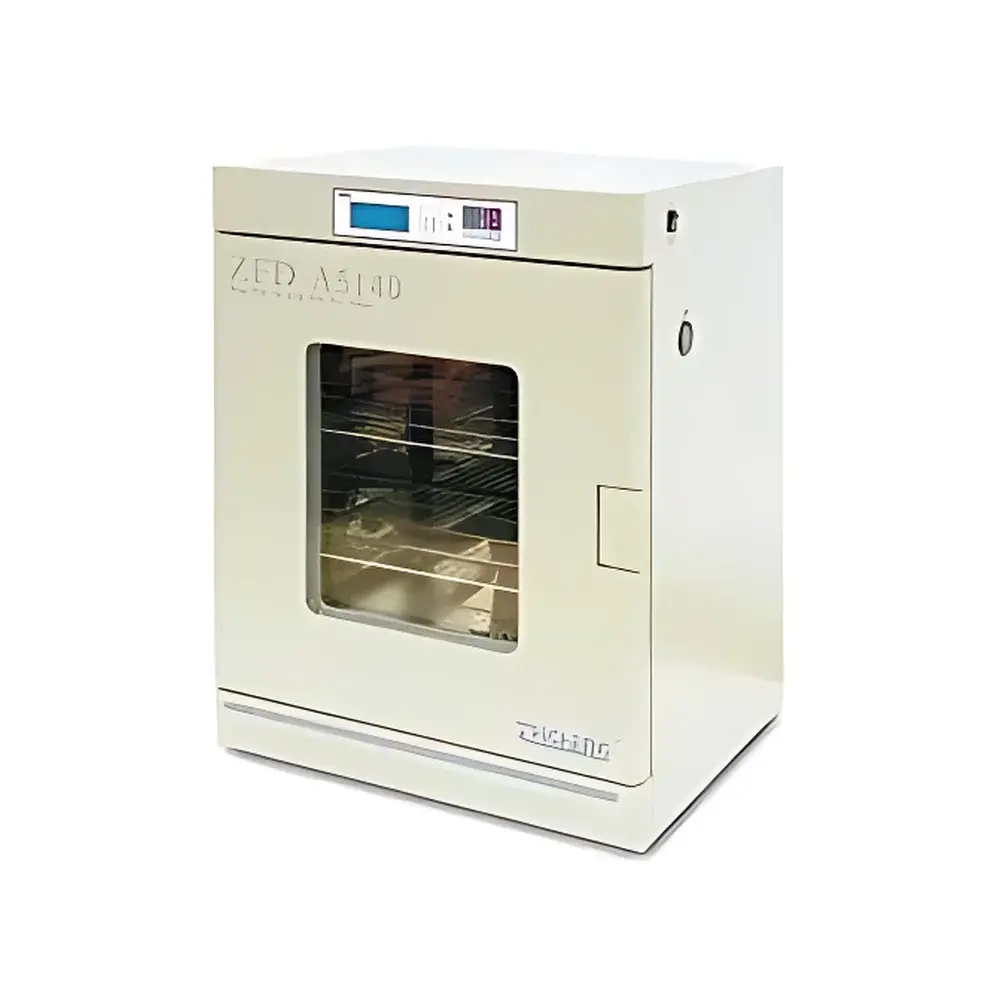
Zhixin ZXFD-A5040 Ten-Stage Programmable Forced-Convection Oven with Bottom Heating
| Origin | Shanghai, China |
|---|---|
| Manufacturer Type | Authorized Distributor |
| Origin Category | Domestic (China) |
| Model | ZXFD-A5040 |
| Quotation | Available Upon Request |
| Capacity | 40 L |
| Temperature Range | Ambient +5°C to 200°C |
| Temperature Resolution | 0.1°C |
| Temperature Uniformity | ≤ ±2.5% (at max operating temperature) |
| Temperature Fluctuation | ≤ ±1°C |
| Programming | 10 segments / up to 18 steps per program |
| Segment Duration | 1–999 minutes per step |
| Control Method | Fuzzy Logic Algorithm |
| Display | LCD |
| Airflow Direction | Vertical forced convection from bottom |
| Internal Chamber Dimensions (W×D×H) | 345 × 300 × 385 mm |
| External Dimensions (W×D×H) | 535 × 430 × 765 mm |
| Net Weight | 45 kg |
| Power Supply | AC 220 V, 50/60 Hz |
| Rated Power | 700 W |
| Standard Interfaces | RS-232 serial port, embedded thermal printer |
| Safety Protections | Independent overtemperature cut-off (adjustable 30–80°C), independent overheat prevention device, leakage current protection, overcurrent trip, power failure alarm, sensor fault detection, upper/lower limit temperature alarms, self-diagnostic system |
| Interior Material | Mirror-finish stainless steel |
| Shelf Quantity | 2 standard (up to 4 optional) |
| Door | Double-layer tempered glass with outer surface compliant with EN 61000-3-2 and EN 60598 safety standards |
Overview
The Zhixin ZXFD-A5040 Ten-Stage Programmable Forced-Convection Oven with Bottom Heating is a precision-engineered laboratory oven designed for applications requiring precise thermal control, reproducible dry-heat sterilization, and programmable thermal profiling. Unlike conventional static ovens, the ZXFD-A5040 employs vertical forced convection generated from a bottom-mounted heating and blower assembly, ensuring uniform airflow distribution across the entire chamber volume. This configuration minimizes thermal stratification and supports consistent heat transfer kinetics—critical for microbiological decontamination (e.g., dry-heat sterilization of glassware per ISO 17665-1 and USP ), thermal denaturation studies, moisture removal in hygroscopic samples, and pre-conditioning of materials prior to analytical testing. Its operational range (ambient +5°C to 200°C), combined with 0.1°C resolution and ≤±1°C temperature fluctuation, enables reliable execution of GLP- and GMP-aligned protocols where thermal stability directly impacts assay validity.
Key Features
- Fuzzy logic-based temperature control algorithm ensures rapid stabilization and minimal overshoot during segment transitions in multi-step programs.
- 10-segment programmable interface supporting up to 18 discrete steps per program; each step allows independent setpoint, duration (1–999 min), and ramp/hold behavior.
- Bottom-heated vertical airflow architecture—optimized via computational fluid dynamics modeling—delivers uniform temperature distribution (≤±2.5% at 200°C) without turbulent hot spots or cold zones.
- Triple-layer safety architecture: (1) adjustable independent overtemperature limiter (30–80°C), (2) fixed overheat prevention device, and (3) separate leakage current and overcurrent circuit breakers compliant with IEC 61010-1.
- Full self-diagnostic suite including sensor fault detection, power interruption recovery with parameter retention, and real-time upper/lower limit deviation alerts.
- RS-232 serial interface enables integration into centralized lab data management systems; embedded thermal printer provides immediate hard-copy audit trail of temperature logs and program execution status.
- Mirror-polished 304 stainless steel interior with electropolished shelves and double-glazed tempered observation door meets ISO 14644-1 Class 8 cleanroom compatibility requirements for low particulate emission.
Sample Compatibility & Compliance
The ZXFD-A5040 accommodates standard laboratory glassware (e.g., Petri dishes, test tubes, volumetric flasks), ceramic substrates, polymer films, and metal components up to 40 L total volume. Its bottom-heating design eliminates top-surface condensation risks during extended drying cycles and avoids thermal shadowing on vertically oriented samples. The unit complies with electromagnetic compatibility (EMC) standards EN 61326-1 and electrical safety standard EN 61010-1. For regulated environments, its parameter memory, password-protected settings, timestamped event logging, and RS-232 traceability support FDA 21 CFR Part 11 compliance when paired with validated data acquisition software. It is routinely deployed in laboratories adhering to ISO/IEC 17025, CLIA, and GLP frameworks for sterilization validation, residual moisture analysis (per ASTM E1064), and thermal stability assessment of pharmaceutical excipients.
Software & Data Management
While the ZXFD-A5040 operates autonomously via its front-panel LCD interface, its RS-232 port supports bidirectional communication with third-party SCADA or LIMS platforms using ASCII-based command protocols. Users may export time-stamped temperature profiles, program execution timestamps, and alarm event logs in CSV format. The embedded thermal printer outputs real-time chamber temperature traces synchronized with active program segments—providing an immediate, tamper-evident record suitable for internal QA audits or regulatory submissions. All user-modifiable parameters—including calibration offsets, segment schedules, and safety thresholds—are stored in non-volatile memory with battery-backed retention, ensuring continuity after power loss or scheduled maintenance shutdowns.
Applications
- Dry-heat sterilization of glass and metal instruments (validated per ISO 17665-1 for 160°C/120 min or 170°C/60 min cycles).
- Thermal denaturation and cross-linking studies of proteins, nucleic acids, and synthetic polymers.
- Moisture content reduction in soil, pharmaceutical powders, and botanical extracts prior to gravimetric or Karl Fischer titration.
- Pre-drying of filter membranes, chromatography columns, and sensor substrates under controlled thermal ramps.
- Accelerated aging tests for electronic components and construction materials per ASTM D3045 and ISO 4892-2.
- Baking and curing of coatings, adhesives, and composite laminates in R&D and quality control labs.
- Heat fixation of cytological specimens and histological slides prior to staining procedures.
FAQ
What is the difference between ZXFD and ZXRD series ovens?
The ZXFD series features bottom-mounted heating elements and vertical upward airflow, optimized for uniform heating of stacked or vertically placed samples. The ZXRD series uses rear-mounted heaters with horizontal recirculating airflow—better suited for shallow, wide-format trays.
Can the ZXFD-A5040 be validated for ISO 13485 medical device manufacturing?
Yes—its programmable repeatability, temperature uniformity data, and full event logging capability meet core requirements for equipment qualification (IQ/OQ/PQ) under ISO 13485:2016 Annex A. Validation documentation templates are available upon request.
Is the RS-232 interface compatible with LabVIEW and Python-based automation?
Yes—the interface uses standard ASCII commands with configurable baud rate (9600 default), parity, and stop bits. Protocol documentation and sample scripts for LabVIEW and PySerial are provided with the instrument.
Does the unit support remote monitoring over Ethernet or Wi-Fi?
No native Ethernet/Wi-Fi module is integrated; however, third-party RS-232-to-Ethernet converters (e.g., Moxa NPort series) have been successfully deployed in multi-unit lab networks.
What calibration certificates are supplied with delivery?
Each unit ships with a factory calibration report traceable to NIM (National Institute of Metrology, China), covering temperature accuracy at three points (50°C, 100°C, 180°C) across the working range.





