
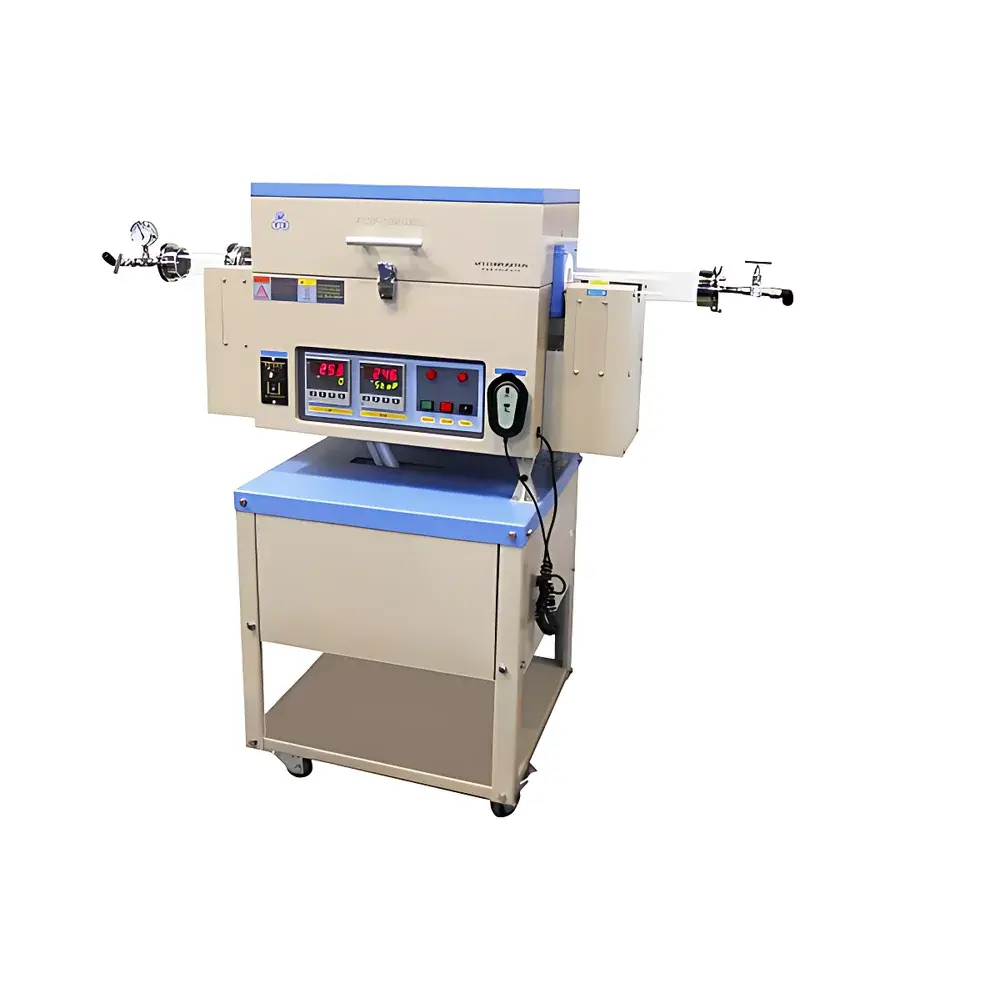
OTF-1200X-4-R-II Dual-Zone Tilting Rotating Tube Furnace
| Brand | Hefei Kejing |
|---|---|
| Origin | Anhui, China |
| Model | OTF-1200X-4-R-II |
| Type | Horizontal Dual-Zone Tube Furnace |
| Max Temperature | 1200°C |
| Temp Control Accuracy | ±1°C |
| Max Power | 4 kW |
| Heating Rate (to max temp) | 10°C/min |
| Internal Dimensions | 100 mm O.D. × 1200 mm L |
| Rotation Speed | 0–10 RPM (adjustable) |
| Tilt Angle | Left 0–30°, Right 0–15° |
| Vacuum Level | 1×10⁻² torr |
| Continuous Operating Temp | 1100°C |
| Heating Zone Length | 400 mm (2×200 mm zones) |
| Uniform Temp Zone | 150 mm (±1°C) |
| Voltage | 208–240 V AC, Single Phase |
| Circuit Breaker Requirement | 30 A |
| Net Weight | 100 kg |
| Overall Dimensions | 1300 × 600 × 1200 mm |
| Compliance | CE certified |
Overview
The OTF-1200X-4-R-II is a CE-certified, dual-zone horizontal tube furnace engineered for controlled thermal processing under dynamic mechanical conditions. Its core architecture integrates precise temperature zoning, programmable rotational motion, and adjustable axial tilt—enabling homogeneous thermal treatment of solid-state materials during reactive sintering, solid-phase mixing, and compositional homogenization. Unlike static furnaces, this system employs Couette-type rotation of the quartz reaction tube (100 mm O.D. × 1200 mm L) to induce continuous particle reorientation and interfacial renewal, significantly improving mass transfer kinetics in powder-based synthesis. The two independently controlled heating zones (each 200 mm long) provide a stable 150 mm uniform-temperature region (±1°C), critical for reproducible solid-state reactions such as lithium transition metal oxide synthesis (e.g., LiFePO₄, LiMnNiO₄). Constructed with high-purity alumina fiber insulation and a proprietary 1750°C-rated reflective alumina coating on the inner chamber surface, the furnace minimizes radial thermal gradients and ensures energy-efficient operation up to 1200°C (≤1 h) or sustained use at 1100°C.
Key Features
- Dual independent PID temperature controllers—each supporting 30-segment ramp-soak programs, enabling complex multi-step thermal profiles across both zones
- DC motor-driven quartz tube rotation (0–10 RPM, continuously adjustable) with integrated rotary feedthroughs and sealed gas-tight connections
- Mechanically actuated tilting mechanism: left-side tilt range 0–30°, right-side 0–15°, facilitating gravity-assisted powder flow and preventing material segregation
- Optimized gas handling system: inlet via 1/4″ Swagelok® compression fitting (φ6.35 mm), outlet via 12 mm barbed port; compatible with inert, reducing, or oxidizing atmospheres
- Double-walled steel housing with forced-air cooling ducts—maintains external surface temperature below 50°C during full-load operation
- Four internal baffles welded into the quartz tube to enhance radial mixing efficiency and reduce axial channeling during rotation
- Stainless steel flanges with integrated stainless steel needle valves and rotating gas seals—designed for leak-tight operation down to 1×10⁻² torr
Sample Compatibility & Compliance
The OTF-1200X-4-R-II accommodates powdered, granular, or pelletized inorganic compounds—including cathode precursors, ceramic oxides, and alloy powders—within its 100 mm O.D. fused quartz tube. The absence of metallic heating elements inside the tube ensures minimal contamination risk, making it suitable for high-purity battery material synthesis per ISO 12944-6 and ASTM D7824 guidelines. All electrical components rated above 24 V comply with UL 61010-1, MET 61010-1, and CSA C22.2 No. 61010-1 safety standards. CE marking confirms conformity with EU Machinery Directive 2006/42/EC and Electromagnetic Compatibility Directive 2014/30/EU. Optional third-party certification (TÜV Rheinland or CSA Group) is available upon customer-requested assessment and associated fee coverage.
Software & Data Management
Temperature programming and real-time monitoring are performed via front-panel touchscreen interface with non-volatile memory storage for ≥100 user-defined protocols. While no PC-based software is bundled, the furnace supports RS485 Modbus RTU communication for integration into centralized lab automation platforms (e.g., LabVIEW, Ignition SCADA). All temperature logs—including setpoint, actual reading, zone power output, and alarm status—are timestamped and stored internally for ≥30 days. Audit trail functionality meets GLP-compliant data integrity requirements when operated in conjunction with validated electronic lab notebooks (ELNs) or LIMS systems adhering to FDA 21 CFR Part 11 principles.
Applications
- Solid-state synthesis of layered oxide and polyanionic cathode materials for Li-ion batteries
- Controlled oxidation/reduction of transition metal precursors under flowing gas atmospheres
- Thermal annealing of thin-film coated substrates mounted on rotating carriers
- Multi-stage calcination of mixed-metal carbonates or hydroxides with sequential decomposition steps
- Homogenization of dopant-distributed ceramic powders prior to hot pressing or spark plasma sintering
- Low-pressure thermal treatment of air-sensitive compounds under dynamic inert purge
FAQ
What is the maximum recommended continuous operating temperature?
Continuous operation is rated at 1100°C; short-term exposure up to 1200°C is permissible for durations ≤60 minutes.
Can the furnace be used under vacuum without compromising rotation integrity?
Yes—the rotating feedthroughs and flange seals maintain integrity down to 1×10⁻² torr; however, vacuum-compatible grease must be applied to the rotary seal interface before initial use.
Is the quartz tube custom-shaped, and can it be replaced with alternative materials?
The supplied tube is a custom-fused quartz design with reduced-diameter ends (60 mm O.D.) for法兰 sealing; alternatives such as alumina or silicon carbide tubes may be installed but require recalibration of thermal mass and rotation torque limits.
Does the system support inert gas purging during rotation and heating?
Yes—gas flow is maintained through sealed rotary unions; recommended flow rates: 50–200 sccm for optimal atmosphere exchange without inducing turbulence-induced particle loss.
What maintenance intervals are advised for long-term reliability?
Inspect baffle weld integrity and quartz tube surface erosion every 200 operational hours; replace rotary seal grease every 500 hours; verify thermocouple calibration annually per ISO/IEC 17025 traceable procedures.



