
Hopocolor HPALTS-800 Aviation Lighting Distribution Test System
| Brand | Hopocolor |
|---|---|
| Model | HPALTS-800 |
| Origin | Zhejiang, China |
| Manufacturer Type | Direct Manufacturer |
| Category | Domestic |
| Price | USD 27,500 (FOB) |
| Luminous Intensity Range | 0.1–100,000 cd |
| Luminous Intensity Accuracy | ≤±2% (under standard conditions) |
| Angular Resolution | 0.1° |
| Angular Repeatability | <0.1° |
| Cumulative Angular Error | <0.2° |
| Horizontal Rotation Range | −180° to +180° |
| Vertical Rotation Range | −90° to +90° |
| Horizontal Scan Speed | 0.5 / 1 / 2 °/s |
| Vertical Scan Speed | 0.5 / 1 / 2 °/s |
| Centering Alignment Accuracy | <0.1° (calibratable to <0.05°) |
| Ambient Light Rejection | Enabled |
| Test Distance | ≤10 m (1 m for edge lights) |
| Compliance | ICAO Annex 14, FAA AC 150/5340-30H, FAA Order 8260.19D |
| Power Output | 350 W |
| Current Measurement Accuracy | <±0.1 A |
| Current Stability | <3% |
| Input Voltage | 110–230 VAC |
| Max Load Capacity | 18 kg |
| Report Generation | Automated, GLP-compliant PDF/CSV export |
Overview
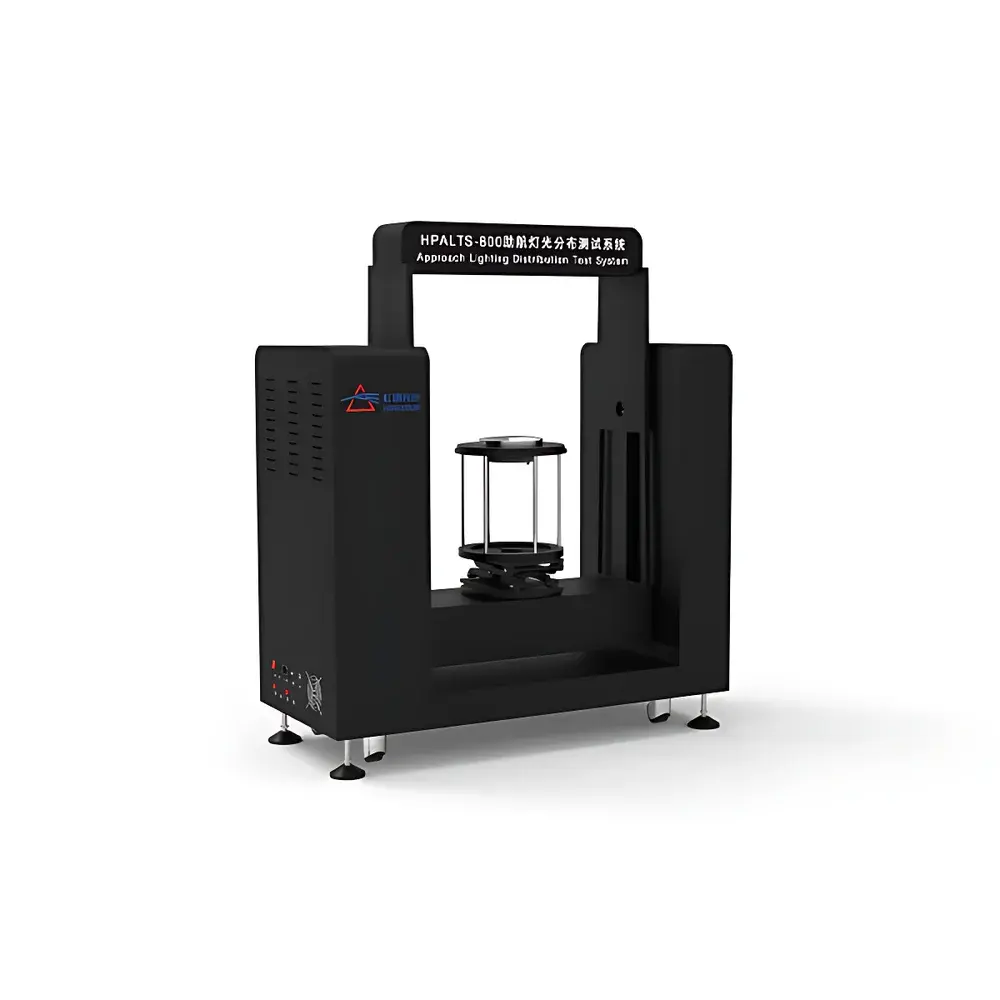
The Hopocolor HPALTS-800 Aviation Lighting Distribution Test System is a precision-engineered optical measurement platform designed specifically for quantitative verification of airport visual aid lighting systems in accordance with international civil aviation regulatory frameworks. It operates on the principle of goniophotometric measurement—capturing spatial luminous intensity distribution (LID) via synchronized high-resolution angular positioning and calibrated photometric detection. The system integrates a motorized dual-axis goniometer with a thermally stabilized silicon photodiode-based luminance sensor, spectrally corrected to CIE 1931 V(λ) response, enabling traceable measurement of candela (cd) values across the full operational range of aviation obstruction lights, runway edge lights, taxiway centerline lights, approach lighting systems (ALS), and precision approach path indicator (PAPI) units. Unlike generic photometers, the HPALTS-800 implements real-time ambient light compensation algorithms and adaptive exposure control, allowing field-deployable operation under variable daylight or nocturnal conditions—eliminating dependence on dark-room environments while maintaining metrological integrity.
Key Features
- Motorized dual-axis goniometric stage with sub-arcminute repeatability (<0.1°) and cumulative angular error <0.2° over full travel (−180° to +180° horizontal; −90° to +90° vertical)
- High-dynamic-range photometric sensor calibrated against NIM-traceable standards, covering 0.1–100,000 cd with ≤±2% uncertainty at reference conditions (per CIE S 025/E:2015)
- Integrated spectral measurement module compliant with CIE 15:2018, reporting correlated color temperature (CCT) and general color rendering index (CRI Ra) per ICAO Annex 14 Vol. I Chapter 5 requirements
- Automated scanning protocols aligned with FAA AC 150/5340-30H Section 4.3.2 and ICAO Annex 14 Table II-1—supporting predefined test trajectories for Type A (runway), Type B (taxiway), and Type C (approach) fixtures
- Real-time flicker analysis (frequency, modulation depth) per IEC TR 61000-3-3 Ed. 3.0 and FAA Order 8260.19D Appendix B
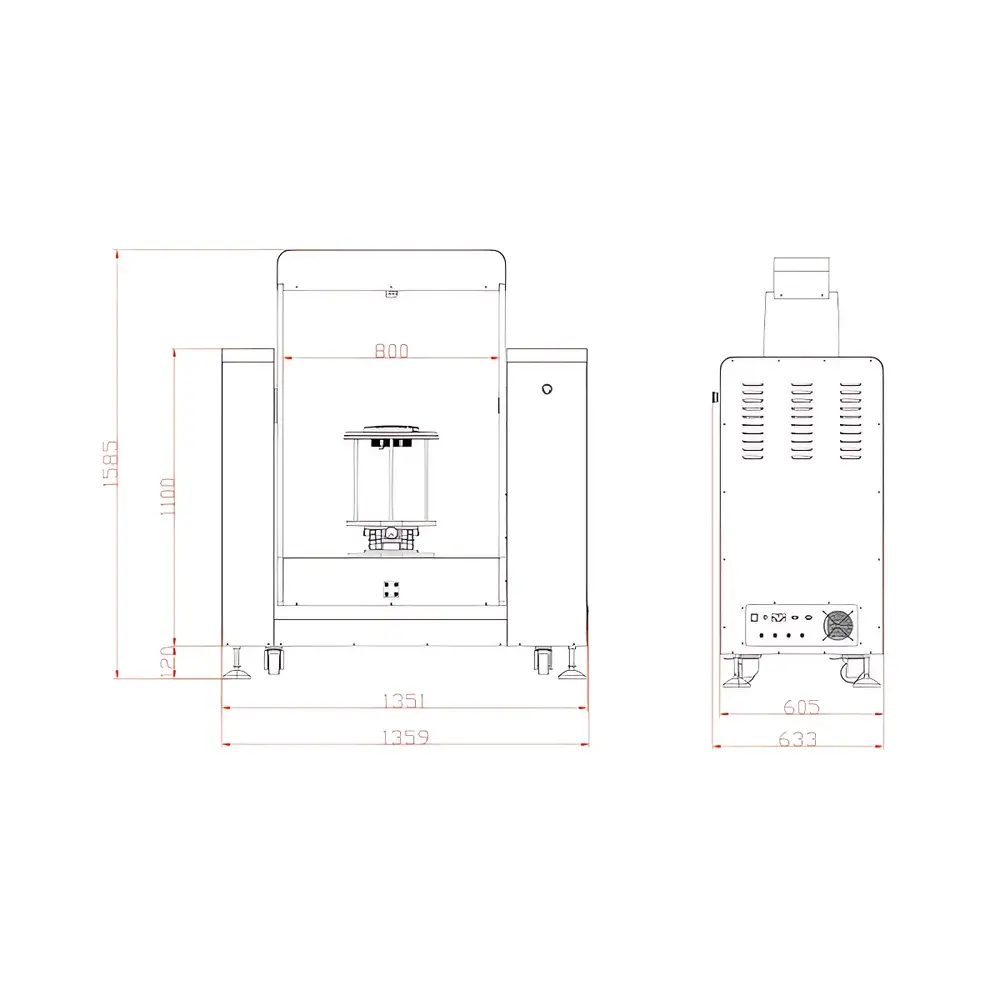
- Modular mechanical architecture: lightweight main unit (≤12 kg) and detachable probe head (≤3.5 kg), rated IP54 for outdoor use on tarmacs and aprons
- Onboard power regulation (110–230 VAC input, 350 W max output) with current monitoring (<±0.1 A accuracy) for dimming curve validation per ICAO Annex 14 §5.3.4
Sample Compatibility & Compliance
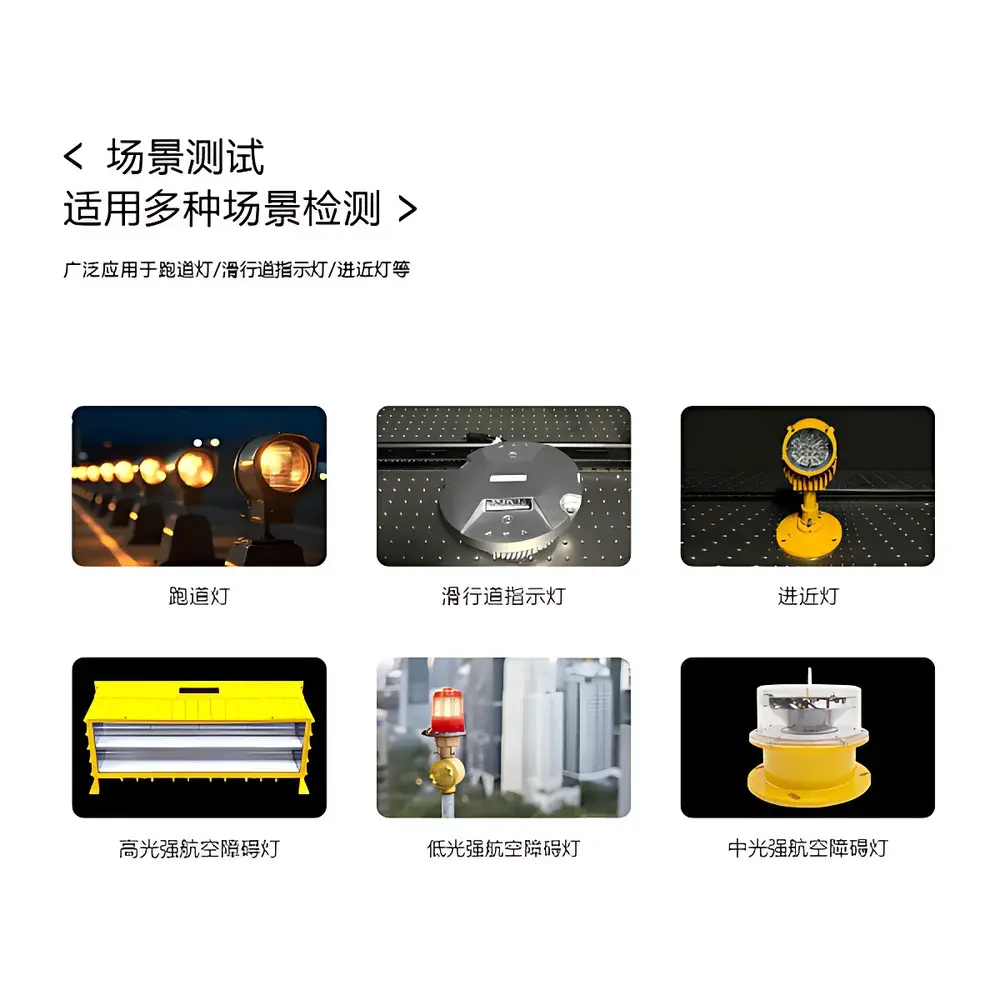
The HPALTS-800 supports full-spectrum testing of all ICAO-defined aerodrome lighting categories—including elevated omnidirectional lamps (e.g., runway end identifier lights), recessed in-pavement units (e.g., taxiway centerline lights), and directional fixtures (e.g., PAPI, REIL). Its mechanical design accommodates mounting configurations per ICAO Annex 14 Figure 5-1 and FAA AC 150/5340-30H Figure 4-1. All measurement procedures and report templates conform to the metrological traceability hierarchy defined in ISO/IEC 17025:2017, with calibration certificates issued by CNAS-accredited laboratories. Data outputs satisfy audit requirements for GLP/GMP-aligned maintenance records and are compatible with FAA Form 7460-1 submission workflows. The system’s firmware embeds mandatory test logic checks—for example, automatic rejection of measurements failing ICAO Annex 14 Table II-1 minimum intensity thresholds at specified observation angles—ensuring regulatory defensibility.
Software & Data Management
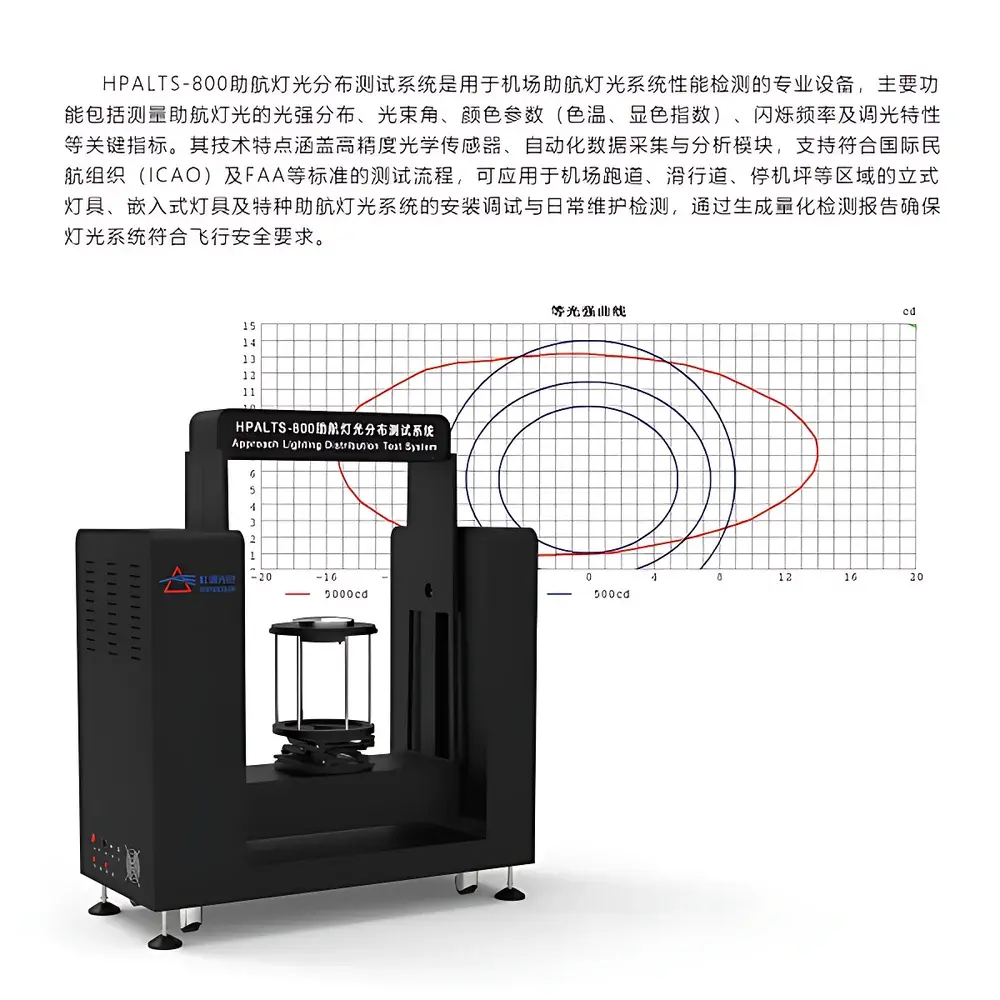
Hopocolor LightTest Suite v3.2 (Windows 10/11 x64) provides full instrument control, real-time visualization of polar luminous intensity diagrams (LID), and automated compliance flagging. The software implements 21 CFR Part 11-compliant user access tiers (Administrator, Technician, Viewer), electronic signature capture, and immutable audit trails for all calibration events, measurement sessions, and report exports. Raw datasets are stored in HDF5 format with embedded metadata (timestamp, operator ID, GPS coordinates, ambient illuminance, fixture serial number). Export options include IESNA LM-63-19, EULUMDAT (*.ldt), and PDF reports pre-formatted to match ICAO Annex 14 Annex D and FAA AC 150/5340-30H Appendix C requirements—including pass/fail annotations, deviation heatmaps, and comparative trend analysis across multiple maintenance cycles.
Applications
- Pre-commissioning verification of newly installed runway edge lighting systems prior to operational handover
- Routine performance audits of existing taxiway centerline lights under GLP-mandated 6-month inspection intervals
- Flicker diagnostics during LED retrofit projects to validate driver stability per FAA AC 150/5340-30H §4.5.2
- Commissioning support for Category III instrument landing system (ILS) approach lighting, including alignment verification of sequenced flashers
- Root-cause analysis of noncompliant light distributions—e.g., identifying reflector deformation, lens soiling, or LED binning drift via longitudinal LID comparison
- Third-party certification testing for lighting manufacturers seeking EASA ETSO-C145a or FAA TSO-C145a approval
FAQ
What regulatory standards does the HPALTS-800 natively support?
The system implements built-in test sequences and pass/fail logic for ICAO Annex 14 (Vol. I, 8th Ed.), FAA AC 150/5340-30H (2022), FAA Order 8260.19D (2023), and EASA AMC 20-22 (2021).
Can it measure lights under direct sunlight?
Yes—the optical subsystem incorporates active ambient light subtraction using dual-channel referencing and temporal noise filtering, validated per ICAO Annex 14 §5.2.3.2 for daytime operation up to 10,000 lux.
Is on-site calibration possible without returning the unit to the factory?
Field calibration is supported via NIST-traceable reference lamps (sold separately) and Hopocolor Calibration Kit CK-800, enabling full goniometric and photometric recalibration per ISO/CIE 12837:2017 in under 45 minutes.
Does the system store historical measurement data locally?
Yes—internal SSD (64 GB) retains ≥10,000 full LID datasets with timestamped metadata; auto-sync to network drives or cloud repositories (AWS S3, Azure Blob) is configurable.
What is the maximum weight of a fixture that can be mounted directly on the goniometer?
The rotating stage supports fixtures up to 18 kg with center-of-gravity offset ≤150 mm from axis—sufficient for most PAPI housings and large obstruction light assemblies.




