
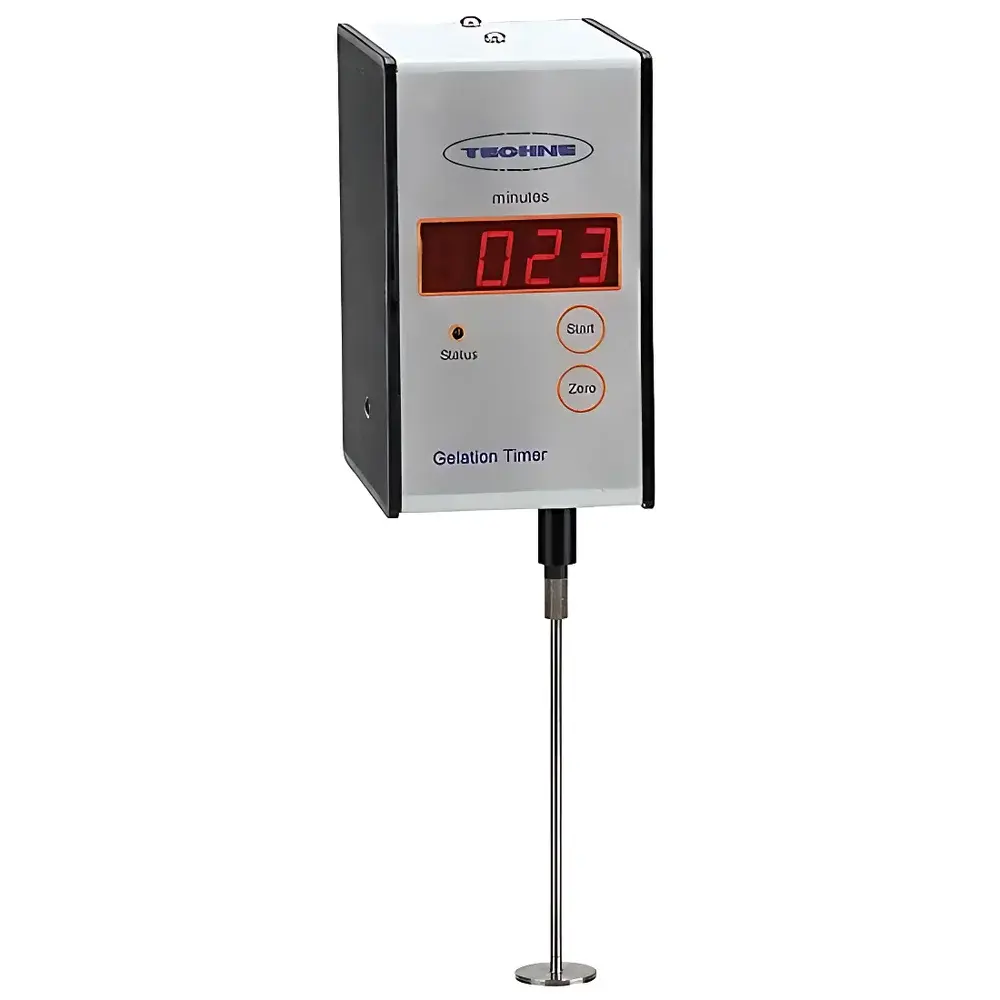
Techne GT-5 Digital Gel Timer
| Brand | Techne |
|---|---|
| Origin | United Kingdom |
| Model | GT-5 |
| Viscosity Range | 1–10 (arbitrary units, non-Newtonian transition regime) |
| Timing Resolution | 1 min |
| Max Timing Duration | 9999 min |
| Motor Speed | 1 rpm |
| Compliance | BS 3532:1990, BS 2782-8:835C:1980 |
| Display | LED digital counter |
| Power Supply | 230 V, 50 Hz |
| Power Consumption | 5 W |
| Dimensions (L×W×H) | 94 × 69 × 119 mm |
| Net Weight | 7.7 kg |
| Calibration | Traceable certificate provided |
Overview
The Techne GT-5 Digital Gel Timer is a dedicated mechanical gelation endpoint detector engineered for reproducible, standardized measurement of gel time in thermosetting resins and crosslinking polymer systems. Unlike rotational viscometers or rheometers that infer gel point from viscosity inflection or storage modulus crossover, the GT-5 operates on a fundamental mechanical principle: it detects the onset of solid-like mechanical integrity—the moment at which the evolving polymer network acquires sufficient elastic rigidity to support a defined compressive load without macroscopic flow. This corresponds closely to the Flory–Stockmayer theoretical gel point, where the average functionality-weighted conversion reaches the critical threshold for infinite network formation. The instrument employs a gravity-loaded stainless-steel plunger connected via a calibrated compression linkage to a low-speed motor-driven lift mechanism. As gelation progresses, increasing elastic resistance prevents full retraction of the plunger; at the critical point, axial force transmitted through the sample compresses the linkage, actuating an electrical switch that halts the motor and freezes the elapsed time on the LED counter. This method eliminates reliance on arbitrary viscosity thresholds and provides a physically grounded, process-relevant endpoint directly tied to structural percolation.
Key Features
- Digital timing resolution of 1 minute, with maximum measurable duration of 9999 minutes—suitable for slow-curing systems including phenolic, furan, and latent-cure epoxy formulations.
- Fixed 1 rpm upward drive speed ensures consistent mechanical stimulus across repeated measurements, minimizing shear-induced artifacts during early-stage network development.
- Traceable calibration certificate supplied as standard, supporting laboratory quality assurance protocols under ISO/IEC 17025 and internal GLP documentation requirements.
- Bright, high-contrast LED display enables clear readout in ambient laboratory lighting conditions without parallax error.
- Automatic endpoint detection with simultaneous audible beep and visual LED indicator—eliminates operator-dependent judgment and improves inter-operator reproducibility.
- Modular stainless-steel plungers (16 mm, 19 mm, and 22 mm diameters available) allow optimization for sample viscosity range and container geometry; all are fully detachable for solvent cleaning or replacement.
- Compact benchtop footprint (94 × 69 × 119 mm) and low power draw (5 W) enable integration into fume hoods, environmental chambers, or distillation stations without thermal or electrical load concerns.
Sample Compatibility & Compliance
The GT-5 is validated for use with liquid resin systems requiring gel time assessment prior to molding, casting, or impregnation processes. It accommodates sample volumes of approximately 100 mL in containers with internal diameter ≥38 mm—compatible with standard ASTM D2471 and BS 2782-8:835C sample cups. The instrument meets the normative requirements of BS 3532:1990 (Methods of test for unsaturated polyester resins) and BS 2782-8:835C:1980, ensuring regulatory acceptability for quality control in composites manufacturing, adhesive formulation, and foundry binder development. It is routinely applied to unsaturated polyesters, epoxies, urea-formaldehyde, resorcinol-formaldehyde, and melamine-formaldehyde systems. While not a rheometer, its mechanical endpoint correlates strongly with G′ = G″ crossover measured by dynamic oscillatory testing—particularly when plunger geometry is selected per Hills’ empirical correlation (J. Soc. Cosmet. Chem., 1962).
Software & Data Management
The GT-5 operates as a standalone hardware endpoint detector with no embedded firmware or data export capability. Timing data is displayed and retained solely on the integrated LED counter until manually reset. For laboratories requiring electronic recordkeeping, the instrument is compatible with external timed-event loggers or USB-connected data acquisition interfaces (e.g., National Instruments USB-6000 series with custom LabVIEW VI). When used within regulated environments governed by FDA 21 CFR Part 11 or EU Annex 11, manual transcription of results into validated LIMS or ELN platforms must be accompanied by contemporaneous operator signature, date/time stamp, and instrument identification (serial number + calibration status). Optional accessories—including disposable plungers (F1794) and cup packs (F7846)—support audit-ready traceability for batch release testing.
Applications
- Quality control of incoming resin batches in composite prepreg and wind turbine blade manufacturing.
- Formulation screening during R&D of curatives, accelerators, and inhibitors for thermoset systems.
- Process validation of cure cycles in autoclave and oven-based polymer processing lines.
- Educational demonstration of sol-gel transitions in polymer chemistry laboratories.
- Stability monitoring of shelf-life-limited adhesives and encapsulants under accelerated aging conditions.
FAQ
What physical parameter does the GT-5 actually measure?
It measures the time required for a thermosetting system to develop sufficient elastic modulus to resist gravitational deformation of a defined mass—i.e., the mechanical gel point—not viscosity or flow rate.
Can the GT-5 be used for Newtonian liquids or low-molecular-weight monomers?
No. It is designed exclusively for reactive systems undergoing covalent crosslinking; it yields no meaningful result for non-reactive or physically gelling systems (e.g., agarose, gelatin).
Is temperature control integrated into the GT-5?
No. Ambient or externally controlled bath temperature must be maintained separately; the instrument itself contains no heating or cooling elements.
How frequently should calibration verification be performed?
Per ISO/IEC 17025, verify timing accuracy annually using a certified stopwatch; verify mechanical linkage response quarterly using reference gels with documented gel times.
Does the GT-5 comply with ASTM D2471?
It satisfies the operational intent of ASTM D2471 (Standard Test Method for Gel Time of Thermosetting Resins), though the standard permits multiple apparatus types—GT-5 conforms to the “mechanical plunger” variant described in Annex A1.
Related Products



