
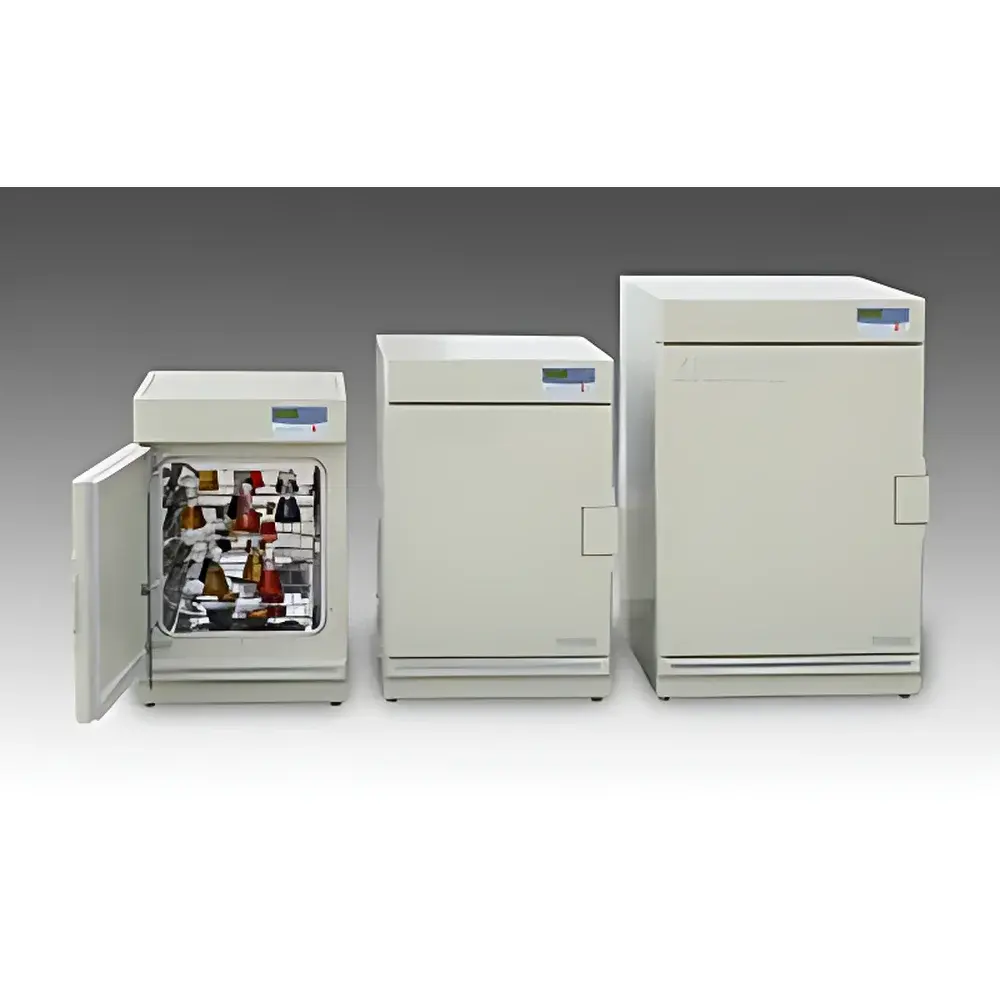
ZWY-114 Multi-Function Decolorizing Shaker
| Origin | Shanghai, China |
|---|---|
| Manufacturer Type | Authorized Distributor |
| Origin Category | Domestic (China) |
| Model | ZWY-114 |
| Pricing | Available Upon Request |
| Control Method | PID Microprocessor-Based Environmental Scan Controller |
| Display | Backlit LCD |
| Air Circulation | Natural Convection |
| Oscillation Mode | Orbital |
| Ambient Temperature Range | 5–50 °C |
| Orbital Speed Range | 30–250 rpm |
| Speed Accuracy | ±1 rpm |
| Orbital Diameter (Amplitude) | Φ30 mm |
| Max Load Capacity (incl. clamps) | 7.5 kg |
| Temperature Control Range | RT +5 to 80 °C |
| Timer Range | 0–500 h |
| Shelf Dimensions | 350 × 350 mm |
| Number of Platforms | 1 |
| Net Weight | 27.2 kg |
| Gross Weight | 45 kg |
| External Dimensions | 460 × 350 × 250 mm |
| Packing Dimensions | 580 × 470 × 355 mm |
| Power Consumption | 425 W |
| Input Power | AC 220 V, 50/60 Hz |
| Additional Functions | Auto Start/Stop, Elapsed Time Monitoring, Parameter Memory & Encryption, Power-Failure Recovery |
Overview
The ZWY-114 Multi-Function Decolorizing Shaker is a compact, benchtop orbital shaker engineered for precise, low-shear agitation in life science laboratories—specifically optimized for post-electrophoresis processing workflows. Designed for integration into temperature-controlled environments—including refrigerated rooms, cold rooms, and incubators—the instrument operates reliably across ambient conditions from 5 °C to 50 °C while maintaining stable thermal regulation up to 80 °C on the platform. Its core motion mechanism employs a balanced orbital drive system with a fixed amplitude of Φ30 mm, delivering uniform circular motion ideal for gentle yet effective mixing of gels, membranes, and blotting substrates without mechanical stress or sample displacement. The unit utilizes a brushless DC motor architecture, ensuring consistent torque delivery, silent operation, and maintenance-free longevity exceeding 20,000 hours of continuous service. All operational parameters—including speed, temperature, and timer—are governed by a dedicated PID microprocessor controller featuring environmental scan logic that continuously monitors and compensates for load-induced drift or ambient fluctuations.
Key Features
- Orbital oscillation mode with precisely calibrated Φ30 mm amplitude—optimized for uniform gel staining, destaining, and hybridization protocols
- Backlit LCD interface displaying real-time setpoints and measured values for speed (30–250 rpm, ±1 rpm accuracy), temperature (RT+5 to 80 °C), and remaining time
- Power-failure recovery function: automatically resumes pre-interruption settings upon AC restoration—critical for unattended overnight runs
- Parameter encryption lock prevents unauthorized modification of critical assay conditions—supporting GLP-compliant documentation practices
- Extended timer capability up to 500 hours with audible and visual end-of-run alert—enabling multi-day electrophoretic membrane processing
- Robust aluminum alloy platform (350 × 350 mm) rated for 7.5 kg total load—including universal clamps, gel trays, and hybridization bottles
- Thermally insulated housing with natural convection cooling—eliminates need for forced-air vents or external exhaust routing
- Compliance-ready firmware architecture supporting audit trail generation for FDA 21 CFR Part 11–aligned validation protocols
Sample Compatibility & Compliance
The ZWY-114 accommodates standard electrophoresis formats including mini-gel cassettes (e.g., Bio-Rad Mini-PROTEAN), large-format slab gels (up to 20 × 20 cm), nitrocellulose and PVDF membranes, X-ray film holders, and hybridization tubes (15–50 mL). Its orbital motion profile meets ASTM D4064-21 requirements for uniform agitation in analytical staining procedures. The device conforms to IEC 61010-1:2010 safety standards for laboratory electrical equipment and carries CE marking under the Low Voltage Directive (2014/35/EU) and EMC Directive (2014/30/EU). For regulated environments, its parameter memory and encryption functions align with ALCOA+ data integrity principles, facilitating traceability during ISO 17025 or CLIA-certified method validation.
Software & Data Management
While the ZWY-114 operates as a standalone instrument with embedded firmware, its control architecture supports external logging via RS-232 serial interface (optional adapter). Logged data includes timestamped speed, temperature, and runtime—exportable in CSV format for integration into LIMS or ELN platforms. Firmware versioning and configuration history are retained in non-volatile memory, enabling full revision tracking per GLP Annex 11 guidelines. No proprietary software installation is required; all user interaction occurs through the front-panel interface, minimizing cybersecurity exposure in network-restricted lab zones.
Applications
- Coomassie Blue and silver nitrate gel fixation, staining, and destaining
- Radiographic film development (autoradiography), including developer, fixer, and wash steps
- Western and Southern blot processing: pre-hybridization blocking, probe hybridization, and post-hybridization stringency washes
- Antibody incubation and antigen-antibody binding kinetics studies on membrane supports
- Cell suspension maintenance during low-temperature transfection or cryopreservation preparation
- Long-duration nucleic acid hybridization assays requiring thermal stability and motion consistency
FAQ
Can the ZWY-114 be operated inside a 4 °C cold room?
Yes—the unit is rated for ambient operation between 5 °C and 50 °C and features condensation-resistant electronics and sealed motor housing.
Is temperature calibration traceable to NIST standards?
The integrated Pt100 sensor is factory-calibrated; users may perform field verification using a certified reference thermometer per ISO/IEC 17025 Clause 6.5.
Does the shaker support multiple platforms or stackable configurations?
No—the ZWY-114 is configured with a single 350 × 350 mm platform; multi-tier stacking is not supported due to structural and thermal design constraints.
What clamp options are available for irregularly shaped vessels?
Standard accessories include universal spring-loaded clamps, gel tray holders, and bottle racks compatible with 15–50 mL cylindrical containers; custom fixtures can be fabricated per ISO 9001 engineering drawings.
How is firmware updated?
Firmware updates are performed via USB-to-serial adapter and manufacturer-provided utility—updates require authorized service technician access per cybersecurity policy.



