La3Ga5SiO14 (LGS) Piezoelectric Crystal Wafers –合肥科晶 | Dia 76.2 mm / 100 mm, Thickness 0.35–0.5 mm, Ra ≤ 1 nm
| Brand | Hefei Kejing |
|---|---|
| Origin | Anhui, China |
| Model | La₃Ga₅SiO₁₄ (LGS) |
| Crystal Orientation | xyl/48.5°/26.7° or (0°, 22°, 90°) |
| Diameter | 76.2 mm or 100 mm |
| Thickness | 0.35–0.5 mm |
| Primary Flat Length | 15 mm (for Ø3″), 32 mm (for Ø4″) |
| Secondary Flat Length | 8 mm (for Ø3″), 18 mm (for Ø4″) |
| Surface Roughness | Ra ≤ 1 nm |
| Polishing | Single-side or double-side polished |
| Packaging | Class 1000 cleanroom + Class 100 clean bag |
Overview
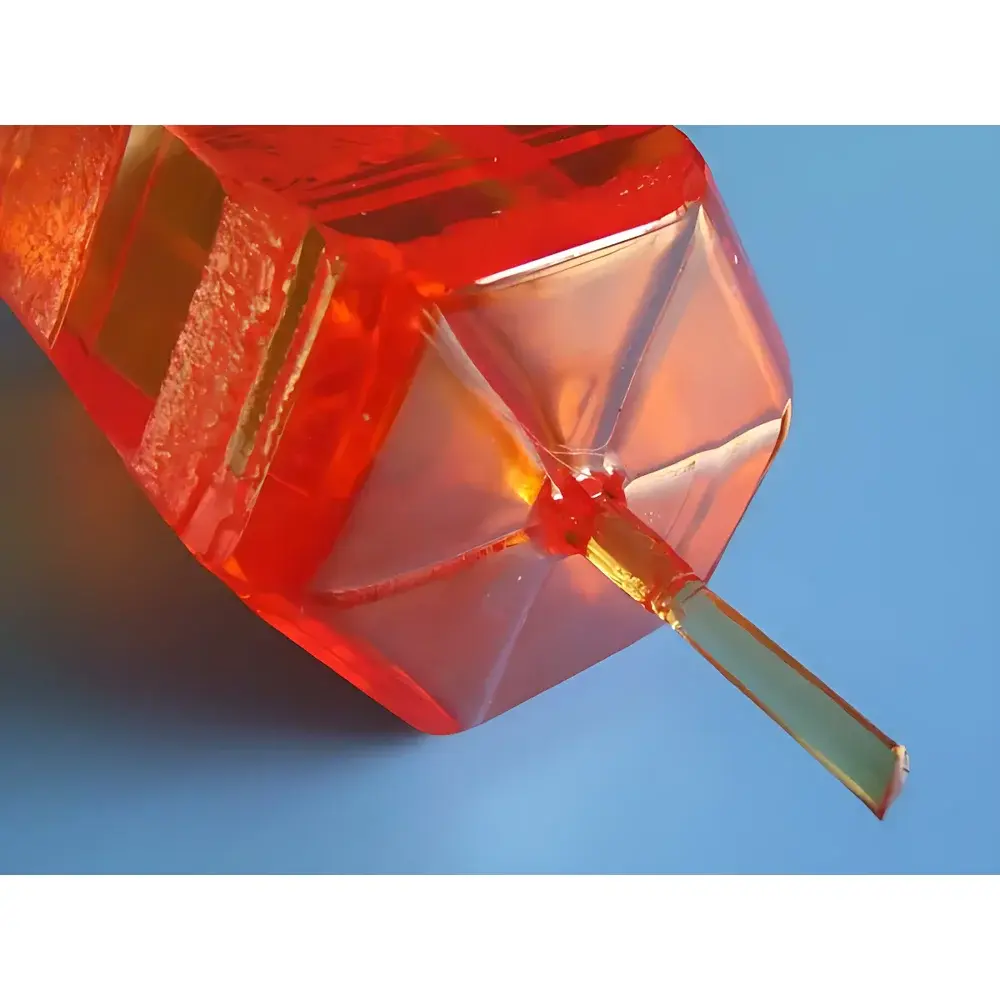
La3Ga5SiO14 (LGS) is a single-crystal piezoelectric material widely employed in high-stability resonant sensors, temperature-compensated quartz crystal microbalances (TC-QCM), SAW/BAW filters, and precision frequency control devices operating across extended temperature ranges (−40 °C to +850 °C). Unlike conventional quartz or lithium niobate, LGS exhibits near-zero temperature coefficient of frequency (TCF) along specific crystallographic orientations—enabling ultra-stable resonant behavior without active thermal regulation. This property arises from its trigonal crystal structure (space group R32) and anisotropic elastic-thermal coupling, making it especially suitable for harsh-environment sensing, aerospace-grade timing modules, and vacuum-compatible mass-sensing platforms. These wafers are grown via Czochralski method, followed by precision orientation verification using X-ray diffraction (XRD) Laue back-reflection, ensuring angular tolerance ≤ ±0.2° relative to specified Euler angles.
Key Features
- High-purity, low-dislocation-density LGS monocrystals with stoichiometric La3Ga5SiO14 composition verified by ICP-MS and EDX
- Precisely defined cut orientations: standard options include xyl/48.5°/26.7° (commonly used for zero-TCF shear-horizontal modes) and (0°, 22°, 90°) for optimized electromechanical coupling in thickness-shear resonance
- Ultra-smooth surfaces: Ra ≤ 1 nm achieved via chemical-mechanical polishing (CMP), compatible with thin-film metallization (Au, Pt, Al) without interfacial defect nucleation
- Dual polishing options: single-side polished (SSP) for substrate-integrated device fabrication; double-side polished (DSP) for symmetric resonator architectures requiring matched acoustic impedance
- Tight dimensional control: diameter tolerance ±0.1 mm; thickness uniformity ±2 µm across full aperture; parallelism < 10 arcsec
- Traceable metrology: each wafer supplied with individual certificate of conformance including XRD orientation report, surface profilometry scan, and optical flatness interferogram (λ/10 @ 633 nm)
Sample Compatibility & Compliance
These LGS wafers are fully compatible with standard microfabrication processes—including e-beam evaporation, sputtering, lift-off lithography, and dry etching (ICP-RIE using Cl2/BCl3 chemistries). Their low dielectric loss (tan δ < 2×10⁻⁵ at 1 MHz) and high resistivity (>1012 Ω·cm) ensure minimal parasitic leakage during RF excitation. All wafers undergo rigorous outgassing qualification per ASTM E595 for total mass loss (TML) < 0.5% and collected volatile condensable materials (CVCM) < 0.05%, certifying suitability for UHV (<10−9 Torr) and space-qualified instrumentation. Packaging complies with ISO Class 5 (Fed. Std. 209E Class 100) cleanroom protocols and meets IPC-J-STD-033 moisture sensitivity level (MSL) 1 requirements.
Software & Data Management
While LGS wafers themselves are passive components, their integration into resonant systems typically interfaces with industry-standard instrumentation software suites—including Keysight PathWave ADS for SAW filter modeling, COMSOL Multiphysics® for coupled-field piezoelectric simulations (using built-in LGS material libraries), and LabVIEW-based QCM data acquisition platforms supporting real-time resonance tracking (e.g., frequency shift Δf, dissipation factor D). Traceable calibration records—including orientation matrix files (.mat), surface map datasets (.xyz), and spectral reflectance reports—are delivered in vendor-neutral ASCII and HDF5 formats, enabling seamless import into LIMS environments compliant with 21 CFR Part 11 audit trail requirements.
Applications
- High-temperature resonant pressure and viscosity sensors for turbine engine monitoring
- Gas-phase and liquid-phase QCM biosensors operating above 200 °C in catalytic reaction studies
- Miniaturized BAW resonators for 5G/6G RF front-end filtering with improved thermal stability vs. AlN
- Reference standards in national metrology institutes for primary frequency calibration beyond quartz limits
- Substrate material for epitaxial growth of ferroelectric oxides (e.g., BiFeO3) where lattice matching minimizes interfacial strain
- Vacuum-deposited thin-film resonators for in-situ thin-film stress and phase transition analysis during ALD/CVD processing
FAQ
What is the typical Q-factor achievable with LGS resonators at 10 MHz?
Measured unloaded Q-values range from 1.2×10⁵ to 2.5×10⁵ depending on electrode design, mounting configuration, and ambient pressure—significantly higher than AT-cut quartz under equivalent conditions.
Can these wafers be bonded directly to silicon wafers using anodic bonding?
No—anodic bonding is not feasible due to LGS’s non-alkali composition and low sodium ion mobility. Alternative approaches include Au–Au thermocompression bonding or polymer-based adhesive lamination with controlled CTE matching.
Do you provide custom Euler angle cuts outside the two standard orientations?
Yes—custom cuts are available upon request with minimum order quantity of 5 wafers and lead time of 8–12 weeks, subject to orientation feasibility validation via orientation simulation and XRD verification.
Is post-polish annealing performed, and if so, under what atmosphere?
All double-side polished wafers undergo vacuum annealing at 900 °C for 2 hours in 10−5 Pa to relieve polishing-induced subsurface damage and stabilize surface stoichiometry.
Are these wafers suitable for use in FDA-regulated medical device manufacturing?
Yes—material traceability, cleanroom packaging, and compliance with ASTM E595 and ISO 14644-1 make them suitable for Class II/III device supply chains; full documentation packages (including CoA, CoC, and RoHS/REACH statements) are provided upon order fulfillment.