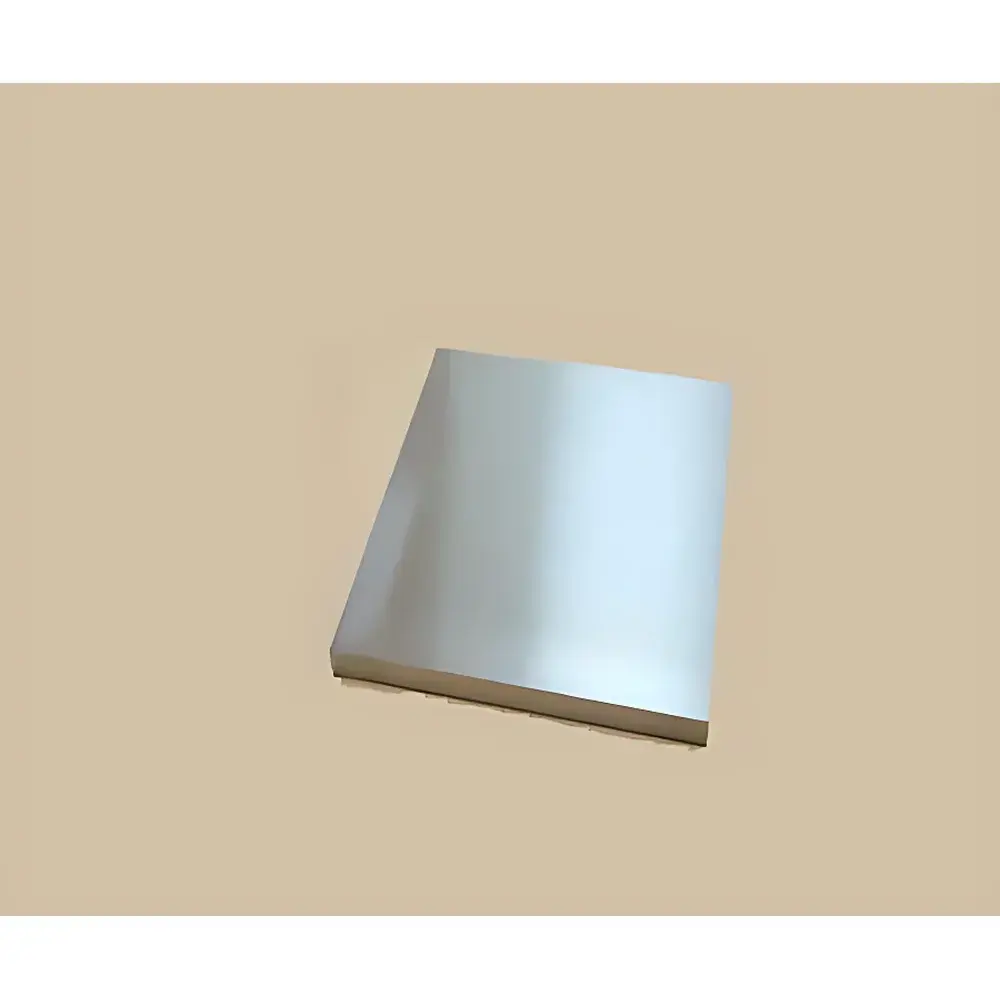
Vanadium (V) Metal Foil片 – Hefei Kejing Standard Grade
| Brand | Hefei Kejing |
|---|---|
| Origin | Anhui, China |
| Model | V Foil |
| Dimensions | 10 × 10 × 1.0 mm |
| Packaging | Vacuum-sealed in Class 100 cleanroom bag, stored under inert atmosphere or high-vacuum conditions |
| Handling Requirement | Air-sensitive |
Overview
Vanadium (V) metal foil is a high-purity elemental thin sheet material widely employed in advanced materials research, thin-film deposition, sputtering target fabrication, and fundamental solid-state physics studies. This standard-grade vanadium foil—manufactured and quality-controlled by Hefei Kejing Materials Technology Co., Ltd.—is produced via precision rolling and annealing under controlled inert atmosphere to ensure structural homogeneity, surface integrity, and minimal oxide layer formation. As a transition metal with a body-centered cubic (BCC) crystal structure, vanadium exhibits excellent ductility, moderate electrical resistivity (~20 µΩ·cm at 20 °C), and strong affinity for oxygen, necessitating strict handling protocols. Its applications span physical vapor deposition (PVD), magnetron sputtering, thermal evaporation source material, and as a calibration standard in X-ray photoelectron spectroscopy (XPS) and Auger electron spectroscopy (AES).
Key Features
- High-purity vanadium (minimum 99.8% V, trace impurities quantified by GDMS and ICP-MS)
- Precisely dimensioned at 10.0 × 10.0 × 1.0 mm (±0.05 mm tolerance on length/width, ±0.03 mm on thickness)
- Surface roughness Ra < 0.2 µm (as-measured by contact profilometry)
- Double-encapsulated vacuum packaging: primary sealing in Class 100 cleanroom environment, secondary barrier against moisture and O2 permeation
- Supplied with certificate of analysis (CoA) including elemental composition, dimensional verification, and handling instructions
- Compatible with standard glovebox transfer protocols (O2/H2O < 0.1 ppm)
Sample Compatibility & Compliance
This vanadium foil meets the baseline material requirements for use in ISO/IEC 17025-accredited laboratories conducting thin-film metrology, surface science characterization, and vacuum-based thin-film synthesis. While not certified to ASTM F2624 (Standard Specification for Vanadium Metal for Surgical Implants) or ASTM B381 (Standard Specification for Vanadium and Vanadium Alloys), its purity profile and dimensional consistency align with common R&D specifications for academic and industrial thin-film labs. Storage compliance follows IEST-RP-CC024.2 (Cleanroom and Controlled Environment Packaging) guidelines. Users must implement GLP-aligned documentation for material receipt, unpacking, and in-lab handling to maintain traceability.
Software & Data Management
No embedded software or firmware is associated with this passive metallic component. However, laboratory information management systems (LIMS) or electronic lab notebooks (ELN) should record batch-specific metadata—including lot number, CoA reference ID, unpacking date, and first exposure timestamp—to support audit readiness per FDA 21 CFR Part 11 (where applicable). Integration with inventory tracking modules is recommended to flag expiration of vacuum integrity (e.g., via barometric pressure loggers integrated into storage desiccators).
Applications
- Sputtering target precursor for vanadium oxide (VOx) thin films used in smart windows and resistive switching memory devices
- Thermal evaporation source for fabricating vanadium-doped TiO2 photocatalytic layers
- Reference substrate in synchrotron-based X-ray absorption near-edge structure (XANES) studies of vanadium redox states
- Electrode current collector in prototype Li-ion and Na-ion battery half-cells (subject to pre-treatment passivation)
- Calibration standard for energy-dispersive X-ray spectroscopy (EDS) quantification in TEM and SEM workflows
- Substrate for epitaxial growth of VO2 phase-change films via molecular beam epitaxy (MBE)
FAQ
Is this vanadium foil suitable for ultra-high vacuum (UHV) deposition systems?
Yes—provided it undergoes in-situ outgassing at ≤150 °C for ≥2 hours prior to evaporation or sputtering. Residual surface oxides may desorb below 300 °C; extended bake-out is recommended for UHV (<1×10⁻⁹ mbar) compatibility.
What is the recommended method for cutting or patterning this foil?
Laser micromachining (UV nanosecond pulsed) or focused ion beam (FIB) milling is preferred. Mechanical shearing risks edge oxidation and delamination; if required, perform in argon-filled glovebox using diamond-tipped tools.
Does the product include a material safety data sheet (MSDS/SDS)?
Yes—an SDS compliant with GHS Rev. 10 and OSHA HCS 2012 is provided digitally upon order confirmation, covering inhalation hazards of fine particulates, pyrophoric risk of powdered residues, and first-aid measures.