
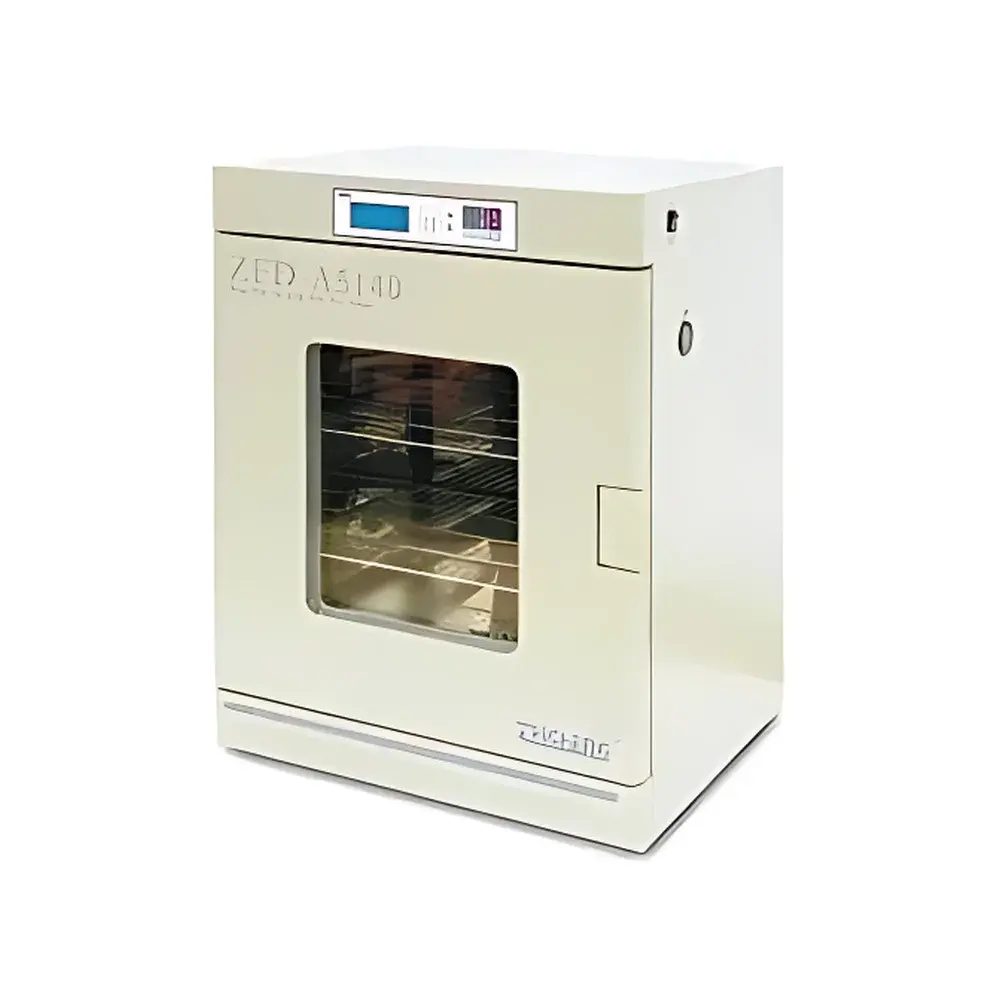
Zhicheng ZXFD-A5250 Ten-Stage Programmable Forced-Convection Dry Oven with Bottom-Mounted Heating
| Brand | Zhicheng |
|---|---|
| Origin | Shanghai, China |
| Manufacturer Type | Direct Manufacturer |
| Country of Origin | China |
| Model | ZXFD-A5250 |
| Quotation | Upon Request |
| Capacity | 250 L |
| Temperature Range | Ambient +5°C to 200°C |
| Temperature Resolution | 0.1°C |
| Temperature Uniformity | ≤ ±2.5% (at max operating temperature) |
| Temperature Fluctuation | ≤ ±1°C |
| Control Method | Fuzzy Logic Control |
| Display | LCD |
| Airflow Mode | Vertical Forced Convection from Bottom |
| Programmability | 10 Segments / 18 Steps |
| Time per Step | 1–999 min |
| Interior Dimensions (W×D×H) | 600 × 550 × 750 mm |
| External Dimensions (W×D×H) | 790 × 680 × 1220 mm |
| Net Weight | 108 kg |
| Power Rating | 2100 W |
| Voltage/Frequency | AC 220 V, 50/60 Hz |
| Safety Features | Independent Over-Temperature Protection (adjustable 30–80°C), Overheat Prevention Device, Leakage Current & Overcurrent Circuit Breaker, Power Failure Alarm, Sensor Fault Detection, Upper/Lower Limit Temperature Alarms |
| Connectivity | RS-232 Interface, Embedded Micro-Printer Output |
| Interior Material | Mirror-Finish Stainless Steel |
| Shelf Quantity | 2 standard (up to 4 optional) |
| Insulation | High-Efficiency Ceramic Fiber with Triple-Layer Door Sealing |
| Compliance | Designed per IEC 61010-1 (Safety Requirements for Electrical Equipment for Measurement, Control, and Laboratory Use) |
Overview
The Zhicheng ZXFD-A5250 is a precision-engineered, ten-stage programmable forced-convection dry oven specifically configured with bottom-mounted heating elements to ensure consistent thermal energy delivery and vertical airflow distribution. It operates on the principle of dry-heat sterilization—leveraging controlled convective heat transfer to achieve microbial inactivation through protein denaturation, oxidative damage, and electrolyte imbalance in microorganisms. Unlike natural convection ovens, this model employs a high-efficiency centrifugal blower system that draws ambient air through a pre-heated chamber and directs it upward in a laminar, vertically oriented flow path—minimizing thermal stratification and maximizing temperature homogeneity across the 250 L working volume. The unit complies with core safety and performance expectations outlined in IEC 61010-1 for laboratory electrical equipment, supporting GLP-compliant workflows in regulated environments where traceable thermal validation and reproducible dry-heat exposure are essential.
Key Features
- Fuzzy logic temperature control algorithm enabling adaptive response to load mass, door opening events, and ambient fluctuations—ensuring stable setpoint maintenance within ±1°C fluctuation.
- 10-segment, 18-step programmable sequence capability: Segment “0” serves as a pre-conditioning or standby phase; segments 1–9 support complex thermal profiles including ramp-hold-cool cycles, stepwise curing, and multi-stage dehydration protocols.
- Triple-layer insulated door with tempered outer glass surface maintained below 40°C under full-load operation—meeting EN 61000-3-2 and EU Low Voltage Directive requirements for operator safety.
- Dual independent safety systems: an adjustable over-temperature limiter (30–80°C range) and a hardwired, fail-safe overheat cut-off circuit—both electrically isolated from the main controller for redundancy.
- Mirror-polished 304 stainless steel interior chamber and electropolished stainless steel shelves resist corrosion, facilitate cleaning validation, and minimize particle shedding during high-temperature sterilization cycles.
- Embedded micro-printer and RS-232 serial interface enable real-time data logging, remote parameter interrogation, and integration into centralized lab information management systems (LIMS) or SCADA platforms.
- Auto-recovery function restores previous operational state—including active program step and elapsed time—after unexpected power interruption, preserving experimental integrity.
Sample Compatibility & Compliance
The ZXFD-A5250 accommodates a broad spectrum of sample formats: borosilicate glassware (e.g., Petri dishes, pipettes, flasks), metal instruments, ceramic substrates, polymer films, and moisture-sensitive powders. Its geometric cavity design minimizes dead zones and promotes uniform convective exchange—critical for validating dry-heat sterilization per ISO 17665-1 and USP . The unit supports routine verification using calibrated thermocouples per ASTM E2297 (Standard Guide for Validation of Thermal Sterilization Processes) and may be qualified for GMP applications when paired with IQ/OQ/PQ documentation packages. All electronic controls meet EMC standards per IEC 61326-1, and firmware includes audit-trail-capable event logging (power loss, alarm triggers, parameter changes) aligned with FDA 21 CFR Part 11 data integrity expectations.
Software & Data Management
While the ZXFD-A5250 operates via an embedded microcontroller with local LCD interface, its RS-232 port enables bidirectional communication with external PCs running custom or third-party thermal process monitoring software. Users can export time-stamped temperature logs, alarm histories, and program execution records in CSV format. The built-in printer produces hard-copy records of cycle start/end timestamps, peak temperatures, and fault codes—serving as primary evidence for internal audits or regulatory inspections. Parameter memory retains up to five user-defined programs with password-protected access (four-digit numeric code), preventing unauthorized modification of validated drying or sterilization protocols.
Applications
This oven is routinely deployed in life science and industrial quality control laboratories for: dry-heat sterilization of reusable glassware and stainless-steel tools (160°C for 120 min per ISO 17665); thermal denaturation studies of enzymes and nucleic acids; residual moisture removal from pharmaceutical excipients prior to lyophilization; accelerated aging tests of packaging materials; pre-baking of electronic components and PCB assemblies; thermal stability assessment of polymers and composites; and conditioning of environmental sampling filters. Its precise programmability also supports research-grade protocols such as gradient-based protein aggregation kinetics, controlled desiccation of botanical specimens, and thermal cross-linking of hydrogels.
FAQ
What is the maximum validated sterilization temperature and dwell time supported by this model?
The ZXFD-A5250 achieves stable operation up to 200°C, with typical dry-heat sterilization performed at 160–180°C for durations ranging from 30 to 120 minutes—fully compatible with ISO 17665-1 Annex B recommendations.
Can the oven be integrated into a networked laboratory infrastructure?
Yes—via RS-232 serial interface with optional USB-to-serial adapter, enabling connection to Windows/Linux-based host systems for automated data capture and remote monitoring.
Is calibration certificate included with shipment?
A factory calibration report (traceable to NIM, China) is provided; however, field calibration using NIST-traceable reference thermometers is recommended prior to first use and annually thereafter per ISO/IEC 17025 guidelines.
Does the unit comply with electromagnetic compatibility (EMC) standards for laboratory use?
Yes—it conforms to IEC 61326-1 for measurement/control equipment used in industrial and laboratory settings, including immunity to electrostatic discharge, radiated RF fields, and fast transient bursts.
What maintenance is required to sustain temperature uniformity over time?
Biannual inspection of blower motor performance, gasket integrity, and heater element resistance is advised; replacement of ceramic fiber insulation is recommended after 5 years of continuous operation above 150°C.




