
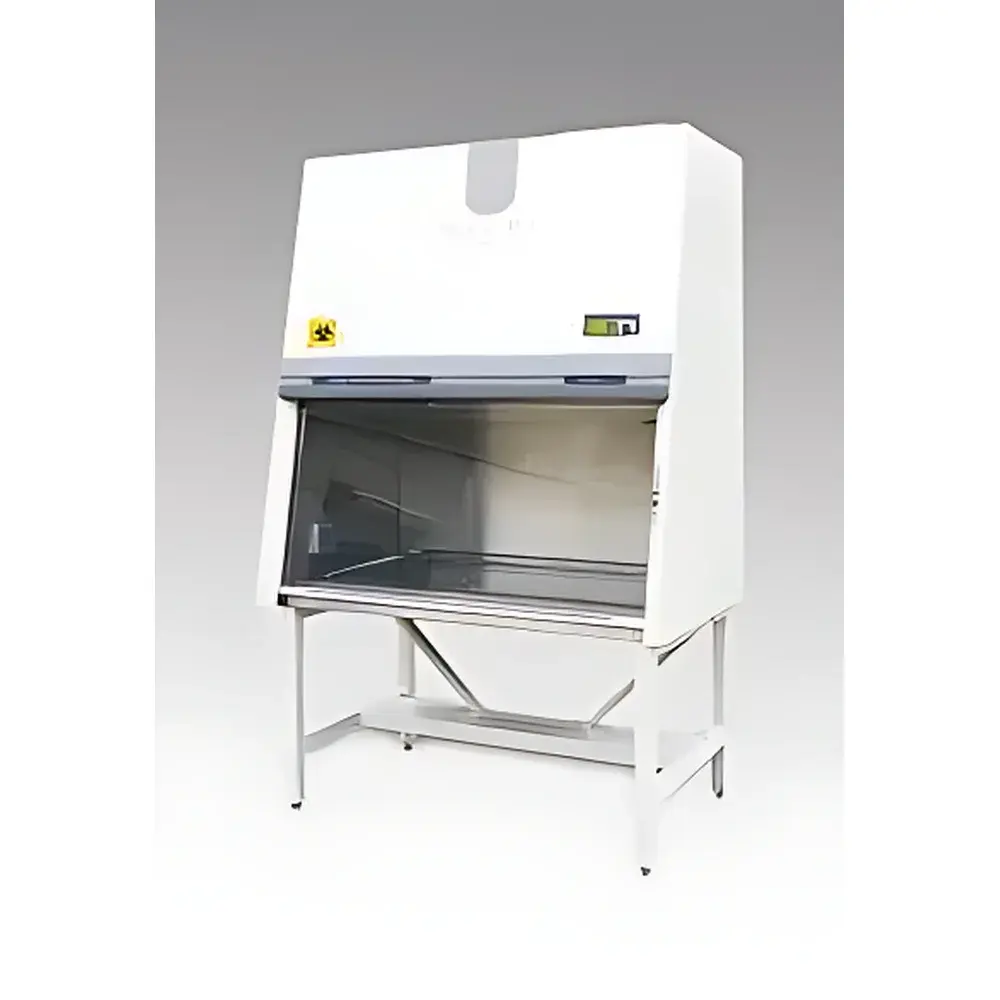
Zhicheng ZSB-1500IIA2 Class II A2 Biological Safety Cabinet
| Origin | Shanghai, China |
|---|---|
| Manufacturer Type | Authorized Distributor |
| Product Origin | Domestic (China) |
| Model | ZSB-1500IIA2 |
| Pricing | Upon Request |
Overview
The Zhicheng ZSB-1500IIA2 is a certified Class II, Type A2 biological safety cabinet engineered for precision containment in biosafety level 2 (BSL-2) and select BSL-3 applications. It operates on the principle of laminar airflow combined with dual-filtered recirculation and exhaust: approximately 70% of the inward air is recirculated through a ULPA filter after passing across the work surface, while 30% is exhausted via a dedicated ducted or thimble-connected system after passing through a secondary HEPA filter. This configuration ensures simultaneous protection of personnel, product, and environment—meeting NSF/ANSI 49-2022 and EN 12469:2000 requirements for Class II A2 cabinets. The unit integrates real-time aerodynamic monitoring, fail-safe alarm architecture, and passive negative-pressure containment to mitigate risks associated with voltage fluctuation, filter aging, or mechanical failure—addressing documented operational vulnerabilities in legacy A2 systems.
Key Features
- Constant Air Velocity Control System: Dynamically adjusts fan speed to maintain inflow velocity (0.5–0.6 m/s) and downward velocity (0.25–0.5 m/s) within ±0.015 m/s tolerance despite ULPA/HEPA resistance drift or supply voltage variation.
- Dual-Stage Filtration Architecture: Primary ULPA filter (≥99.999% efficiency at 0.1–0.2 µm) for recirculated air; secondary HEPA filter (≥99.99% at 0.3 µm) for exhaust air.
- Independent Low-Airflow Alarm Circuit: Hardwired backup alarm activated upon primary control failure—ensuring continuous audible/visual warning independent of main controller integrity.
- ULPA/HEPA Life Monitoring Suite: Predictive degradation alerts, end-of-life warnings, and physical breach detection via differential pressure tracking and real-time resistance profiling.
- Full-Parameter Digital Dashboard: 7-inch LCD display showing live metrics—including inflow/downward velocity, static pressure differential (0–500 Pa), cumulative runtime, filter status, UV lamp operation, and door height—each with configurable thresholds and alarm logging.
- Human-Centered Ergonomics: 10° inclined tempered glass sash with anti-reflective dual-layer lamination (UV-blocking, shatter-resistant); seamless stainless-steel work surface (304 grade, one-piece stamping); integrated splash-proof GFCI outlets and standardized utility ports.
- Fail-Safe Interlocks: UV lamp deactivation when sash exceeds safe height; automatic fan shutdown during sash overtravel or power anomaly; self-diagnostic exhaust/intake fan health monitoring.
Sample Compatibility & Compliance
The ZSB-1500IIA2 accommodates standard microbiological, molecular, and cell culture workflows involving non-volatile low-to-moderate risk agents (e.g., E. coli, S. cerevisiae, lentiviral vectors under BSL-2 containment). Its internal volume (1540 × 635 × 655 mm) supports multi-user benchtop operations including pipetting, centrifugation prep, and sterile transfer. All structural materials comply with ISO 14644-1 Class 5 cleanroom standards for particulate generation. The cabinet is validated per NSF/ANSI 49 Annex D (personnel protection), Annex E (product protection), and Annex F (environmental protection). Optional ducting kits enable full external exhaust compliance with local building codes and ASHRAE 110 tracer gas testing protocols. CE marking, NMPA registration (for domestic China use), and conformity to GB/T 25138-2010 are documented in factory test reports.
Software & Data Management
While the ZSB-1500IIA2 operates as a standalone hardware-controlled system without cloud connectivity, its embedded firmware provides audit-ready data integrity features aligned with GLP/GMP expectations. All alarms—including airflow deviation, filter saturation, sash mispositioning, and UV exposure events—are timestamped and stored locally for ≥12 months. Event logs export via USB to CSV format for integration into laboratory information management systems (LIMS). The interface supports 21 CFR Part 11–compliant user access levels (Operator, Supervisor, Administrator) with password-protected parameter modification rights. Calibration records, filter replacement history, and annual certification reports can be archived alongside operational logs to satisfy FDA inspection requirements for equipment qualification (IQ/OQ/PQ).
Applications
This cabinet serves core functions across regulated life science environments: aseptic processing of therapeutic proteins and monoclonal antibodies in biopharmaceutical QC labs; handling of clinical specimens in hospital diagnostic microbiology units; CRISPR/Cas9 editing and iPSC maintenance in academic stem cell facilities; environmental pathogen screening in public health laboratories; and clean assembly of microfluidic diagnostic devices in medical device R&D. Its robust construction and redundancy-driven safety logic make it suitable for high-throughput labs requiring >12 h/day operation under ISO 13485 or ICH Q5A-compliant conditions.
FAQ
Does the ZSB-1500IIA2 support external ducting to the outside?
Yes—it is fully compatible with hard-ducted or canopy-connected exhaust configurations, including optional flexible duct kits with balancing dampers and termination hoods.
What is the expected service life of the ULPA filter under typical usage?
Based on ISO 14644-3 recommended practices, average ULPA lifespan is 5–7 years at nominal airflow and ambient particulate load; real-time resistance monitoring enables predictive replacement scheduling.
Can the cabinet be validated for ISO Class 5 particle counts?
Yes—when operated per manufacturer specifications and certified annually by an ISO 17025-accredited第三方 provider, it achieves ≤3,520 particles/m³ (≥0.5 µm) in the work area per ISO 14644-1.
Is UV irradiation dose calibrated and traceable to NIST standards?
The quartz UV-C lamp (254 nm) delivers ≥400 µW/cm² at 15 cm distance; intensity verification is performed during commissioning using NIST-traceable radiometry.
How does the system handle power interruptions?
Upon resumption, the controller performs full self-check of airflow sensors, pressure transducers, and motor drivers before re-enabling operation—preventing unsafe restart conditions.




