
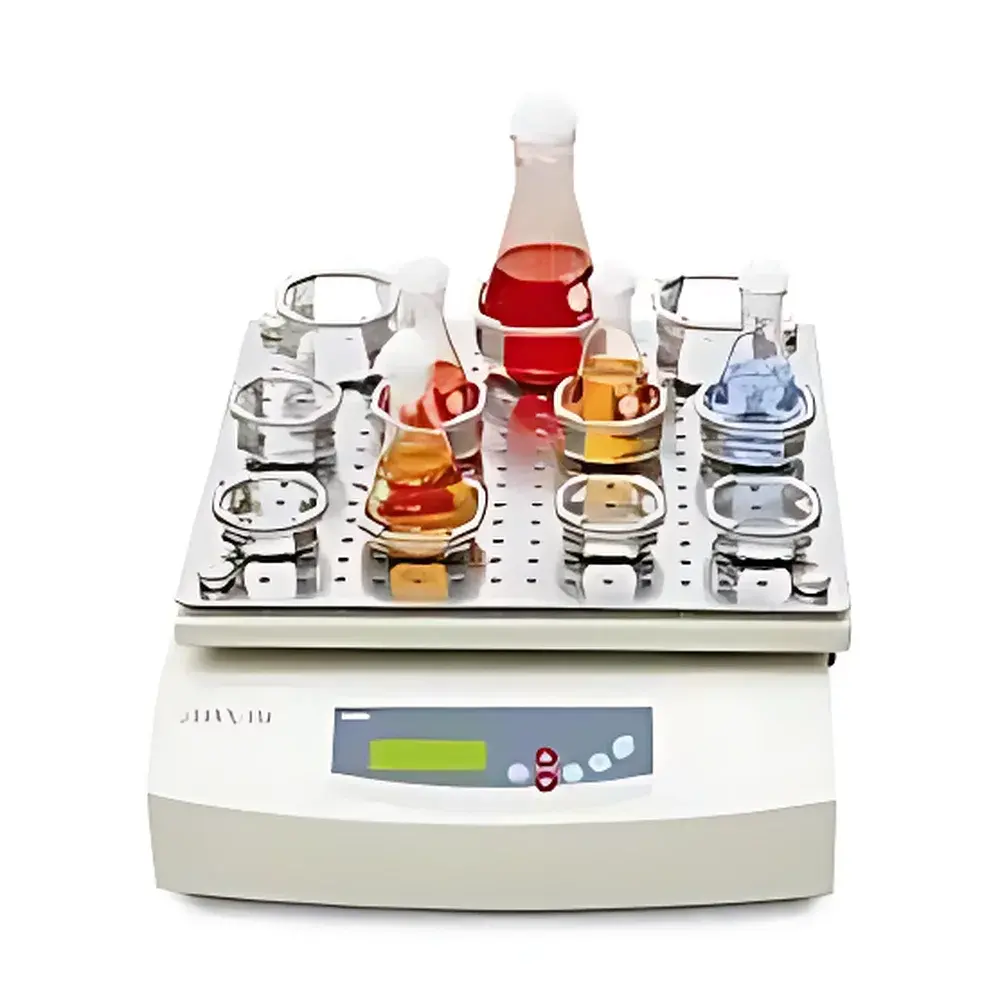
ZWF-334 Reciprocating Decolorizing Shaker
| Origin | Shanghai, China |
|---|---|
| Manufacturer Type | Authorized Distributor |
| Origin Category | Domestic (China) |
| Model | ZWF-334 |
| Pricing | Upon Request |
| Control Method | PID Microprocessor-Based Environmental Scanning Controller |
| Display | Backlit LCD |
| Oscillation Mode | Reciprocating |
| Ambient Temperature Range | 5–50 °C |
| Oscillation Frequency Range | 30–300 rpm |
| Frequency Accuracy | ±1 rpm |
| Stroke Amplitude Options | 20 / 24 / 30 / 40 mm |
| Max Load Capacity (incl. fixtures) | 7.5 kg |
| Timer Range | 0–500 h |
| Platform Dimensions | 330 × 350 mm |
| Platform Quantity | 1 |
| Net Weight | 13.2 kg |
| Gross Weight | 29 kg |
| External Dimensions | 400 × 350 × 150 mm |
| Packaging Dimensions | 520 × 470 × 300 mm |
| Power Consumption | 25 W |
| Input Voltage/Frequency | AC 220 V, 50/60 Hz |
| Additional Functions | Auto Restart After Power Failure, Parameter Locking, Parameter Memory, Auto Start/Stop, Timer Monitoring, Soft-Start Motor Control |
Overview
The ZWF-334 Reciprocating Decolorizing Shaker is a precision-engineered benchtop orbital shaker designed for controlled, low-shear agitation in molecular biology and biochemistry laboratories. Unlike rotary or rocking shakers, the ZWF-334 employs a linear reciprocating motion—horizontal back-and-forth displacement along a fixed axis—to ensure uniform reagent distribution across gels, membranes, and blotting matrices without inducing mechanical stress or sample displacement. Its compact footprint (400 × 350 × 150 mm) and low thermal output (25 W) enable safe operation inside refrigerated chambers (4–8 °C), cold rooms, or standard incubators—critical for temperature-sensitive protocols such as silver staining, antibody hybridization, or radiographic film development. The device utilizes a brushless DC motor with soft-start acceleration logic to eliminate abrupt torque application, thereby protecting fragile electrophoretic gels and nitrocellulose/PVDF membranes from cracking or delamination during prolonged agitation.
Key Features
- PID-based microprocessor controller with environmental scanning capability ensures stable frequency regulation across ambient temperatures from 5 °C to 50 °C
- Backlit LCD interface displays real-time parameters—including setpoint frequency, elapsed time, remaining timer duration, and stroke amplitude selection
- Four programmable stroke amplitudes (20, 24, 30, and 40 mm) allow optimization for diverse sample formats: mini-gels, large-format blots, multi-well plates, or staining trays
- 500-hour maximum timer with audible and visual end-point alert supports unattended overnight processing of multi-step protocols
- Parameter encryption function prevents unauthorized modification of critical settings—a requirement for GLP-compliant labs performing standardized staining workflows
- Power-failure recovery mode automatically resumes pre-interruption settings upon grid restoration, preserving experimental continuity and data integrity
- Single-platform design (330 × 350 mm) accommodates universal clamping accessories including gel racks, membrane holders, and universal tray adapters
- IP20-rated enclosure and thermally stable chassis construction meet IEC 61010-1 safety standards for laboratory electrical equipment
Sample Compatibility & Compliance
The ZWF-334 is validated for use with standard electrophoresis and blotting consumables: polyacrylamide and agarose gels (up to 20 × 20 cm), nitrocellulose and PVDF transfer membranes, X-ray film cassettes, and hybridization trays. It complies with ISO/IEC 17025 requirements for equipment suitability when integrated into accredited testing workflows. While not FDA 21 CFR Part 11–certified out-of-the-box, its parameter memory, audit trail–capable timer logging, and configuration locking support traceability in GMP-aligned environments where instrument qualification (IQ/OQ/PQ) is performed per internal SOPs. All electrical components conform to CE marking directives (EMC Directive 2014/30/EU and Low Voltage Directive 2014/35/EU).
Software & Data Management
The ZWF-334 operates as a standalone hardware platform with no external software dependency. All operational data—including total run hours, cumulative timer usage, and frequency calibration history—are retained in non-volatile memory. While it does not feature USB or Ethernet connectivity, its built-in timer monitoring and parameter memory functions satisfy basic ALCOA+ principles (Attributable, Legible, Contemporaneous, Original, Accurate) for manual recordkeeping in regulated labs. Users may document run logs via printed lab notebooks or LIMS-integrated entry forms referencing batch-specific settings (e.g., “ZWF-334 #SN-8842, 60 rpm, 30 mm stroke, 16 h timer, 4 °C chamber”).
Applications
- Coomassie Brilliant Blue and silver nitrate gel staining, fixation, and destaining
- Radiographic film development: uniform agitation during developer, fixer, and wash steps to minimize edge artifacts
- Western and Southern blot processing—including pre-hybridization blocking, probe hybridization, and post-hybridization stringency washes
- Antibody incubation on ELISA plates and membrane-based immunoassays
- Cell suspension maintenance during short-term incubation prior to harvesting or transfection
- RNA/DNA probe labeling reactions requiring gentle mixing at controlled temperatures
FAQ
Can the ZWF-334 operate inside a 4 °C cold room?
Yes—the unit is rated for ambient operation between 5 °C and 50 °C and generates minimal heat (25 W), making it suitable for continuous use in refrigerated environments.
Is the stroke amplitude adjustable during operation?
No—amplitude must be selected prior to startup; changes require stopping the unit and manually adjusting the mechanical linkage per the service manual.
Does the shaker include universal clamps for different gel sizes?
The base platform accepts optional accessory kits (sold separately), including adjustable gel racks, membrane frames, and multi-tray holders compatible with standard electrophoresis formats.
What safety certifications does the ZWF-334 carry?
It meets IEC 61010-1 for laboratory equipment safety and carries CE marking under applicable EU directives for electromagnetic compatibility and low-voltage operation.
How is calibration verified for frequency accuracy?
Frequency output is factory-calibrated to ±1 rpm tolerance using traceable tachometric reference standards; users may verify performance annually with an optical tachometer per internal QA protocol.




