
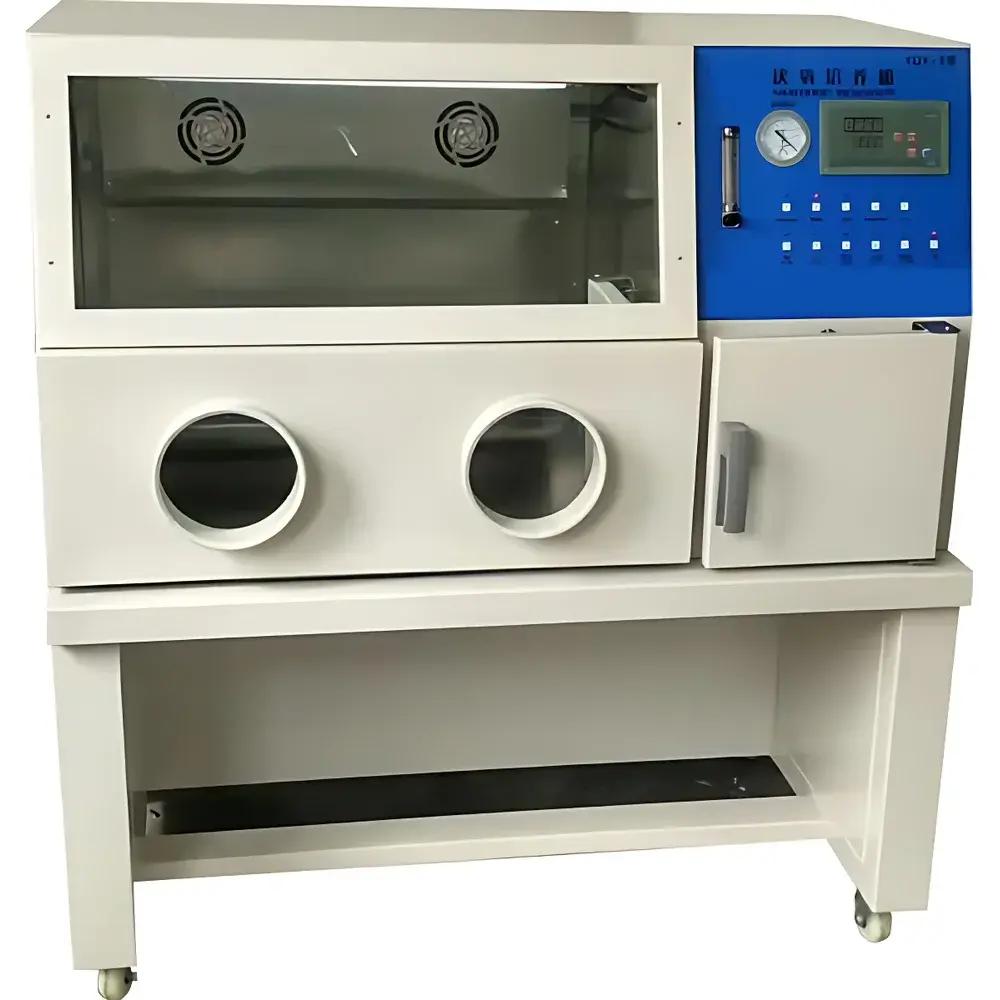
Chuanyi YQX-II Anaerobic Workstation with Glove-Free Sleeve Ports
| Brand | Chuanyi Instruments (Hangzhou Chuanyi Electronic Co., Ltd.) |
|---|---|
| Origin | Zhejiang, China |
| Manufacturer Type | OEM Manufacturer |
| Model | YQX-II |
| Price Range | USD 1,400–2,800 (FOB) |
| Temperature Control Range | Ambient +3°C to 50°C |
| Temperature Uniformity | ±1.0°C |
| Temperature Stability | ±0.5°C |
| Anaerobic Chamber Establishment Time (Operation Room) | <60 min |
| Sample Transfer Chamber Anaerobiosis Achievement Time | <5 min |
| Anaerobic Maintenance Duration (without gas replenishment) | ≥12 h |
| Chamber Dimensions (D×W×H) | 800×550×650 mm |
| Overall Dimensions (D×W×H) | 1200×730×1300 mm |
| Power Supply | 220 V, 50 Hz / 600 W |
| Gas Mixture Ratio | N₂ 85% / H₂ 5% / CO₂ 10% |
| Nitrogen Purity | ≥99.9% |
| UV Sterilization Lamp | Integrated |
| Stainless Steel Construction | 304 SS for Chamber Walls & Transfer Port |
| Viewing Window | Impact-Resistant Tempered Glass with Dual-Sealed Glove-Free Sleeve Ports |
Overview
The Chuanyi YQX-II Anaerobic Workstation is an engineered solution for cultivating obligate anaerobes, microaerophiles, and oxygen-sensitive cell lines under rigorously controlled atmospheric conditions. Unlike conventional incubators, this system integrates a thermally stable incubation chamber with a fully sealed, catalytically deoxygenated operation environment—eliminating reliance on disposable anaerobic jars or palladium-catalyst sachets. It operates on the principle of continuous gas-phase oxygen scavenging via heated palladium catalysts combined with precise mixed-gas dosing (N₂/H₂/CO₂), enabling rapid establishment (<60 minutes) and long-term maintenance (≥12 hours without replenishment) of O₂ concentrations below 10 ppm. Designed for compliance with ISO 11133:2014 (microbiological culture media preparation) and supporting GLP-aligned workflows, the YQX-II serves as a primary platform for clinical microbiology labs, academic anaerobe research groups, and biopharmaceutical QC units performing strict anaerobic enumeration (e.g., *Clostridium difficile*, *Bacteroides spp.*, *Fusobacterium nucleatum*).
Key Features
- Integrated dual-chamber architecture: independent temperature-controlled incubation zone (ambient +3°C to 50°C) and catalytic anaerobic operation chamber with mechanical forced convection and positive-pressure regulation.
- Glove-free sleeve port design: elastomeric sleeve interfaces allow direct hand entry without vacuum-purge cycles—reducing procedural time and operator fatigue while maintaining sterility integrity.
- Three-stage gas conditioning protocol: nitrogen purge → catalytic hydrogen-mediated deoxygenation → precision-mixed gas stabilization—validated by methylene blue indicator and optional integrated O₂ sensor (0–100 ppm range).
- Digital PID temperature controller with dual-setpoint capability (operating + safety limit), ±0.5°C stability, and real-time logging via RS-485 interface.
- UV-C germicidal lamp (254 nm) with timer-based activation; HEPA-filtered gas inlet; stainless steel 304 interior surfaces with electropolished finish for cleanability and corrosion resistance.
- Modular accessory compatibility: supports integration of benchtop shakers (e.g., orbital or reciprocating), colony counters, and mini-centrifuges within the operational workspace (800×550×650 mm internal volume).
Sample Compatibility & Compliance
The YQX-II accommodates standard Petri dishes (up to 150 mm), anaerobic blood agar plates, thioglycollate broth tubes, and custom microtiter formats. Its chamber geometry permits simultaneous handling of up to 48 samples per cycle without cross-contamination risk. All materials in contact with the anaerobic atmosphere meet USP Class VI biocompatibility standards. The system supports traceable workflow execution per FDA 21 CFR Part 11 requirements when paired with optional audit-trail-enabled software (sold separately). It conforms to ASTM E2612–21 (standard practice for validation of anaerobic systems) and facilitates adherence to CLSI M100 and EUCAST guidelines for antimicrobial susceptibility testing under anaerobic conditions.
Software & Data Management
While the base YQX-II operates via standalone hardware controls, optional firmware upgrade enables USB data export of temperature logs (1-min intervals), gas flow records, UV exposure duration, and catalyst activation history. When deployed in regulated environments, the workstation integrates with LIMS platforms via Modbus RTU or Ethernet/IP protocols. All critical parameters—including chamber O₂ status (via external sensor input), temperature deviation alerts, and door-open event timestamps—are stored with cryptographic hash integrity verification. Audit trail functionality complies with ALCOA+ principles (Attributable, Legible, Contemporaneous, Original, Accurate, Complete, Consistent, Enduring, Available) for GMP and ISO 17025 accreditation.
Applications
- Clinical isolation and identification of fastidious anaerobes from stool, wound, and abscess specimens.
- Antibiotic resistance profiling of *Prevotella*, *Porphyromonas*, and *Peptostreptococcus* isolates under standardized anaerobic MIC conditions.
- Microbiome research requiring strict O₂ exclusion during fecal microbiota transplantation (FMT) sample processing.
- Development and validation of novel anaerobic culture media formulations per ISO 11133 Annex B.
- Quality control of probiotic strains (e.g., *Bifidobacterium*, *Lactobacillus* variants with anaerobic phenotypes) in dietary supplement manufacturing.
- Education and training in medical microbiology laboratories where reproducible, hands-on anaerobic technique demonstration is required.
FAQ
What gas mixture is required for optimal operation?
The standard operating mix is 85% N₂, 5% H₂, and 10% CO₂ (certified ≥99.9% N₂ purity). Hydrogen enables catalytic recombination of residual O₂ at the palladium surface; CO₂ supports pH buffering in bicarbonate-dependent media.
Can the YQX-II support microaerophilic cultures?
Yes—by adjusting the gas ratio to 85% N₂, 10% CO₂, and 5% O₂ (using optional O₂ blending module), and disabling the palladium catalyst heater, the system can maintain 5–10% O₂ for *Campylobacter* or *Helicobacter* cultivation.
Is routine calibration required for the temperature controller?
The digital PID controller includes NIST-traceable factory calibration; annual verification using a Class A PT100 probe is recommended per ISO/IEC 17025.
How is contamination prevented during sample transfer?
The transfer chamber uses sequential vacuum–purge cycles (≤5 min total) with HEPA-filtered N₂ flush; all internal surfaces are autoclavable, and the viewing window features dual O-ring sealing.
What maintenance intervals apply to the palladium catalyst?
Catalyst cartridges require replacement every 12 months under continuous use or after 500 deoxygenation cycles—whichever occurs first—to ensure consistent O₂ removal efficiency below 5 ppm.





