
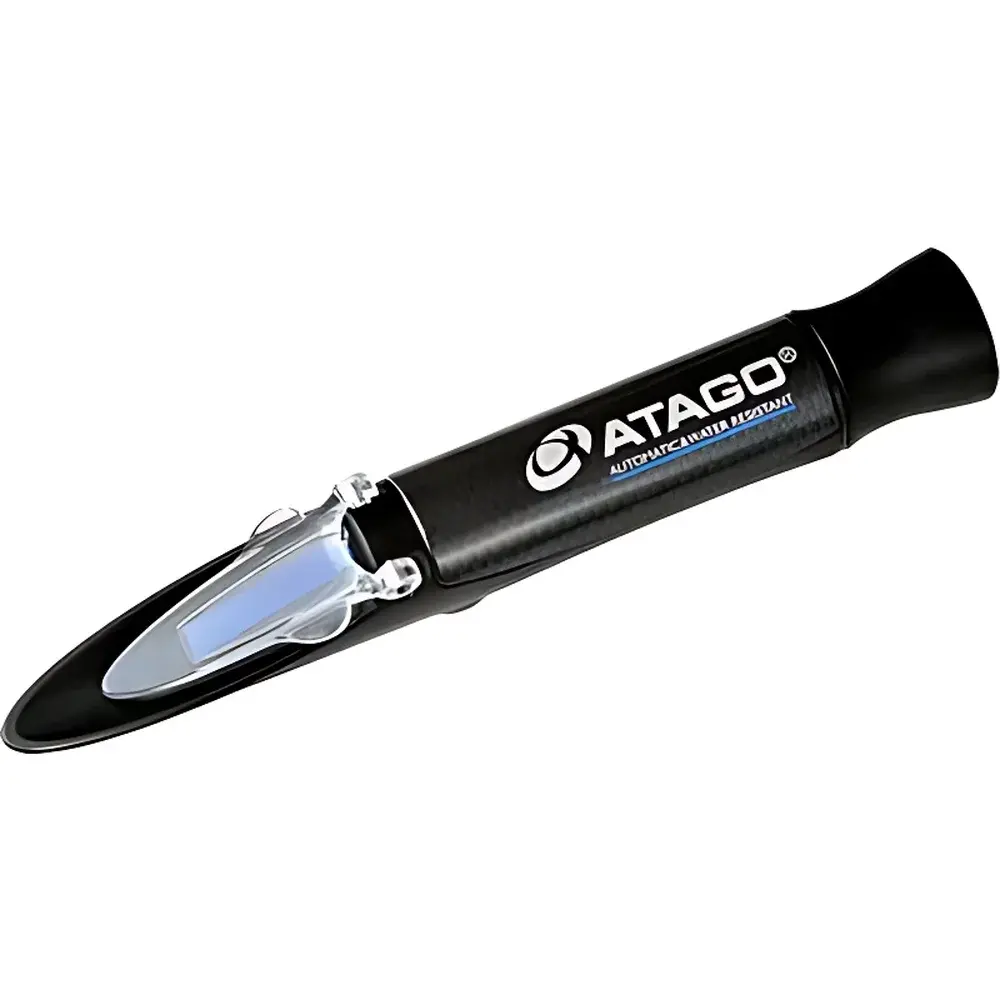
ATAGO MASTER-S/Millα Digital Salinity Refractometer
| Origin | Japan |
|---|---|
| Manufacturer Type | Authorized Distributor |
| Origin Category | Imported |
| Model | MASTER-S/Millα |
| Price | Upon Request |
| Scale Range | Salinity 0–100‰, Specific Gravity 1.000–1.070 |
| Minimum Scale Division | Salinity 1‰, Specific Gravity 0.001 |
| Accuracy | ±1‰ (salinity), ±0.001 (specific gravity) within 10–30°C |
| Temperature Compensation | Automatic (ATC), built-in thermistor |
| IP Rating | IP65 (excluding eyepiece) |
| Dimensions | 3.2 × 3.4 × 20.7 cm |
| Weight | 110 g |
| Replacement Prism Plate | RE-2471-56M |
Overview
The ATAGO MASTER-S/Millα Digital Salinity Refractometer is a precision optical instrument engineered for rapid, field-deployable measurement of seawater salinity and specific gravity based on the principle of critical-angle refractometry. It operates by measuring the refraction index of aqueous saline solutions—directly correlated to dissolved salt concentration—and converts this optical signal into calibrated salinity (‰, parts per thousand) and specific gravity (unitless) readings using an internal algorithm validated against standard NaCl reference solutions. Designed explicitly for marine and aquacultural applications, the MASTER-S/Millα integrates automatic temperature compensation (ATC) across 10–30°C, eliminating manual correction and ensuring metrological consistency in variable environmental conditions. Its compact, handheld architecture and IP65-rated housing (excluding the ocular assembly) enable reliable operation aboard research vessels, at fish hatcheries, in coastal monitoring stations, and within commercial aquarium facilities—where exposure to salt spray, humidity, and incidental water contact is routine.
Key Features
- Optical measurement principle: Critical-angle refractometry with high-stability LED light source and precision-ground sapphire prism
- Automatic temperature compensation (ATC) via integrated thermistor; eliminates manual correction and maintains accuracy across 10–30°C ambient range
- Dual-scale digital display: Simultaneous readout of salinity (0–100‰) and specific gravity (1.000–1.070) with 1‰ and 0.001 resolution respectively
- IP65 ingress protection rating (body and sample stage): Dust-tight and resistant to low-pressure water jets—suitable for deck-mounted or wet-lab use
- Ergonomic, lightweight design (110 g) with dimensions of 3.2 × 3.4 × 20.7 cm for extended handheld operation and portability
- Replaceable prism plate (RE-2471-56M) designed for long-term optical stability and ease of maintenance under repeated saline exposure
Sample Compatibility & Compliance
The MASTER-S/Millα is optimized for aqueous sodium chloride solutions typical of natural and artificial seawater, brine storage tanks, and aquaculture recirculation systems. It is not intended for non-aqueous, highly viscous, or turbid samples that may scatter incident light or adhere to the prism surface. Calibration is performed using standardized 0‰ (distilled water) and 35‰ NaCl reference solutions, traceable to NIST-traceable standards. While the instrument does not carry formal ISO/IEC 17025 accreditation, its measurement uncertainty profile (±1‰ salinity, ±0.001 SG) aligns with ASTM D1141-98 (Standard Practice for Marine Water Simulated) and supports data integrity requirements for GLP-compliant environmental monitoring programs. Routine verification per manufacturer-recommended intervals ensures continued conformance with operational specifications.
Software & Data Management
The MASTER-S/Millα is a standalone, battery-powered optical instrument with no embedded data logging, Bluetooth, or USB connectivity. All measurements are displayed in real time on a high-contrast LCD screen and must be manually recorded. This design prioritizes mechanical robustness, minimal power dependency, and immunity to electromagnetic interference—critical attributes for deployment on research vessels or remote coastal sites. For laboratories requiring audit trails or electronic record retention, external documentation workflows (e.g., LIMS-integrated field notebooks or tablet-based capture) are recommended. The absence of firmware or software components renders the device exempt from FDA 21 CFR Part 11 electronic signature requirements, though handwritten logs should follow institutional SOPs for instrument calibration and usage tracking.
Applications
- Oceanographic surveys: Real-time salinity profiling during underway CTD casts or discrete water sampling
- Mariculture and aquaculture: Monitoring salinity stability in larval rearing tanks, broodstock systems, and live-feed culture units
- Fishery post-harvest management: Verification of brine concentration for frozen fish preservation (e.g., 20–25‰ for ice-glazing efficacy)
- Aquarium life-support systems: Daily validation of synthetic seawater preparation and top-off water salinity
- Coastal environmental monitoring: Rapid assessment of estuarine mixing zones, desalination plant discharge plumes, and stormwater runoff impacts
FAQ
What is the temperature range for accurate measurement?
The instrument delivers specified accuracy (±1‰ salinity, ±0.001 SG) between 10°C and 30°C, enabled by built-in automatic temperature compensation.
Can it measure other dissolved solids besides NaCl?
No—it is calibrated specifically for sodium chloride solutions. Readings for other solutes (e.g., CaCl₂, MgSO₄) will deviate due to differing refractive contributions and are not supported.
Is the prism plate user-replaceable?
Yes—the RE-2471-56M prism plate is a field-serviceable consumable designed for straightforward replacement following ATAGO’s documented procedure.
Does it meet any international standards for marine instrumentation?
While not certified to a specific standard, its performance envelope conforms to the measurement tolerances referenced in ASTM D1141-98 and supports data quality objectives outlined in IOC-UNESCO manuals for oceanographic observations.
How often should calibration be verified?
ATAGO recommends daily verification before first use when operating in mission-critical environments; otherwise, prior to each measurement session or after significant ambient temperature shifts.




