
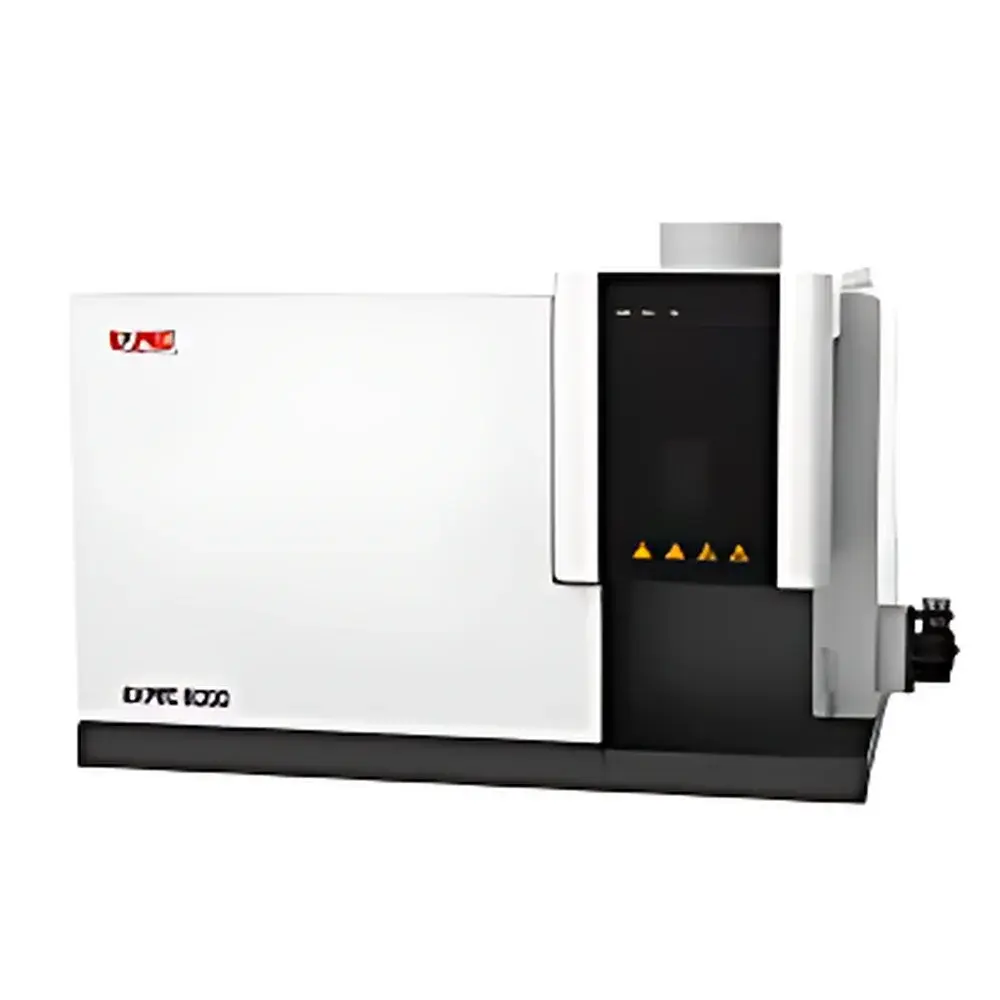
SpectrUM EXPEC 6000 Inductively Coupled Plasma Optical Emission Spectrometer
| Brand | SpectrUM / EXPEC |
|---|---|
| Origin | Zhejiang, China |
| Manufacturer Type | Authorized Distributor |
| Model | EXPEC 6000 |
| Instrument Type | Full-Spectrum Direct-Reading ICP-OES |
| Detection Limit | Not Specified |
| Precision (RSD) | Not Specified |
| Long-Term Stability | Not Specified |
| Wavelength Range | Not Specified |
| Optical Resolution | Not Specified |
Overview
The SpectrUM EXPEC 6000 is a full-spectrum direct-reading inductively coupled plasma optical emission spectrometer (ICP-OES) engineered for high-throughput elemental analysis in regulated and research-intensive laboratory environments. It operates on the fundamental principle of atomic emission spectroscopy: liquid samples are nebulized into an argon plasma at ~6,000–10,000 K, where constituent elements are atomized and excited; upon relaxation, they emit characteristic wavelengths detectable across the UV–visible spectrum (typically 165–900 nm). The EXPEC 6000 employs a robust echelle grating-based two-dimensional dispersion system coupled with a thermoelectrically cooled, back-illuminated CCD detector — enabling simultaneous acquisition of the entire emission spectrum without mechanical scanning. This architecture supports rapid multi-element quantification, spectral deconvolution of overlapping lines, and retrospective re-analysis of stored spectra without re-running samples — critical for method validation, troubleshooting, and regulatory compliance.
Key Features
- Stable echelle optical system with constant-temperature dual-axis dispersion optics, minimizing thermal drift and wavelength shift during extended operation.
- High-speed, deep-depletion back-illuminated CCD sensor with Peltier cooling to –15 °C, reducing dark current noise and enabling low-light detection sensitivity.
- Digitally controlled solid-state RF generator with auto-matching frequency tuning (700–1600 W continuous range), water-cooled design, and integrated power/temperature interlock circuitry for sustained plasma stability and operational safety.
- Precision sample introduction: four-channel peristaltic pump (12-roller, high-accuracy volumetric delivery), digitally regulated multi-gas mass flow controllers (Ar, auxiliary, nebulizer gases) with ±0.01 L/min control resolution.
- Modular torch assembly with self-aligning, segmented design — center tube exchange enables rapid adaptation between aqueous, organic, or high-salt matrices without realignment.
- FSC (Flexible Spectral Calibration) algorithm for dynamic wavelength calibration using internal reference lines, compensating for minor optical drift and maintaining long-term spectral fidelity.
Sample Compatibility & Compliance
The EXPEC 6000 accommodates a broad range of sample types — including aqueous digests (EPA 200.7, 200.8), soil extracts (ISO 11466), petroleum distillates (ASTM D5185), food homogenates (AOAC 993.14), and biological tissues (USP /). Its modular gas control and torch configuration support direct analysis of organic solvents (with oxygen ashing or micro-nebulization), high-TDS brines (via dilution or matrix-matched calibration), and suspended particulates (after acid digestion). The instrument architecture aligns with GLP and GMP data integrity expectations: all analytical parameters, calibration files, raw spectra, and audit trails are time-stamped and user-attributed within the Element V software environment. While not pre-certified for FDA 21 CFR Part 11, the software supports configurable electronic signatures, role-based access control, and immutable record retention — facilitating internal validation for regulated workflows.
Software & Data Management
Element V is a fully localized Chinese-language software platform built on a modular, database-driven architecture. It includes a comprehensive method library covering EPA, ISO, ASTM, and GB standards — accelerating method development and transfer. Analytical modes include external calibration, standard addition, internal standard correction, interference correction (e.g., background subtraction, line ratio correction), and semi-quantitative survey screening. Its adaptive integration algorithm dynamically adjusts integration windows and dwell times per emission line, optimizing signal-to-noise for trace analytes while avoiding saturation of major constituents. Raw spectral data (.spc binary format) and processed results (.csv, .xlsx) are exportable; APIs enable integration with LIMS, ELN, and automated sample handling systems via OPC UA or TCP/IP protocols. Remote diagnostics and software updates are supported over secure HTTPS channels.
Applications
The EXPEC 6000 delivers reliable performance across environmental monitoring (trace metals in drinking water, wastewater, and leachates), geochemical prospecting (multi-element soil and sediment profiling), metallurgical QC (alloy composition verification, inclusion analysis), petrochemical QA (catalyst poisons, wear metals in lubricants), and food safety testing (As, Cd, Pb, Hg in infant formula, rice, and seafood). Its full-spectrum capability supports complex matrix analysis where spectral interference is prevalent — such as Ca–Mg–Fe interferences in fertilizer testing or Cr–V–Ti overlaps in stainless steel grade identification. Method flexibility also extends to speciation support when coupled with hydride generation or cold vapor accessories.
FAQ
Is the EXPEC 6000 compliant with USP or ICH Q2(R2) guidelines for elemental impurities?
The instrument meets the instrumental performance criteria outlined in USP (e.g., specificity, linearity, LOD/LOQ estimation) when configured and validated per user-defined SOPs. Spectral resolution and background correction capabilities support interference assessment required under ICH Q2(R2).
Can the system be operated in a fully English-language interface?
Element V is delivered in Simplified Chinese by default; however, English-language localization packages are available upon request and installation — subject to software version compatibility.
What level of technical support and service coverage is provided outside mainland China?
SpectrUM offers international distributor partnerships with certified field service engineers in Southeast Asia, the Middle East, and Latin America. Remote diagnostics, application consulting, and annual preventive maintenance contracts are available globally.
Does the EXPEC 6000 support hyphenated techniques such as HPLC-ICP-OES?
Yes — the instrument features TTL-triggered acquisition mode and analog/digital I/O ports compatible with third-party chromatography systems for elemental speciation workflows.
How is calibration verification performed between analyses?
Element V supports real-time QC checks using bracketing standards, continuing calibration verification (CCV), and multi-point drift correction via internal reference lines — all logged with full traceability in the audit trail.
Related Products






