
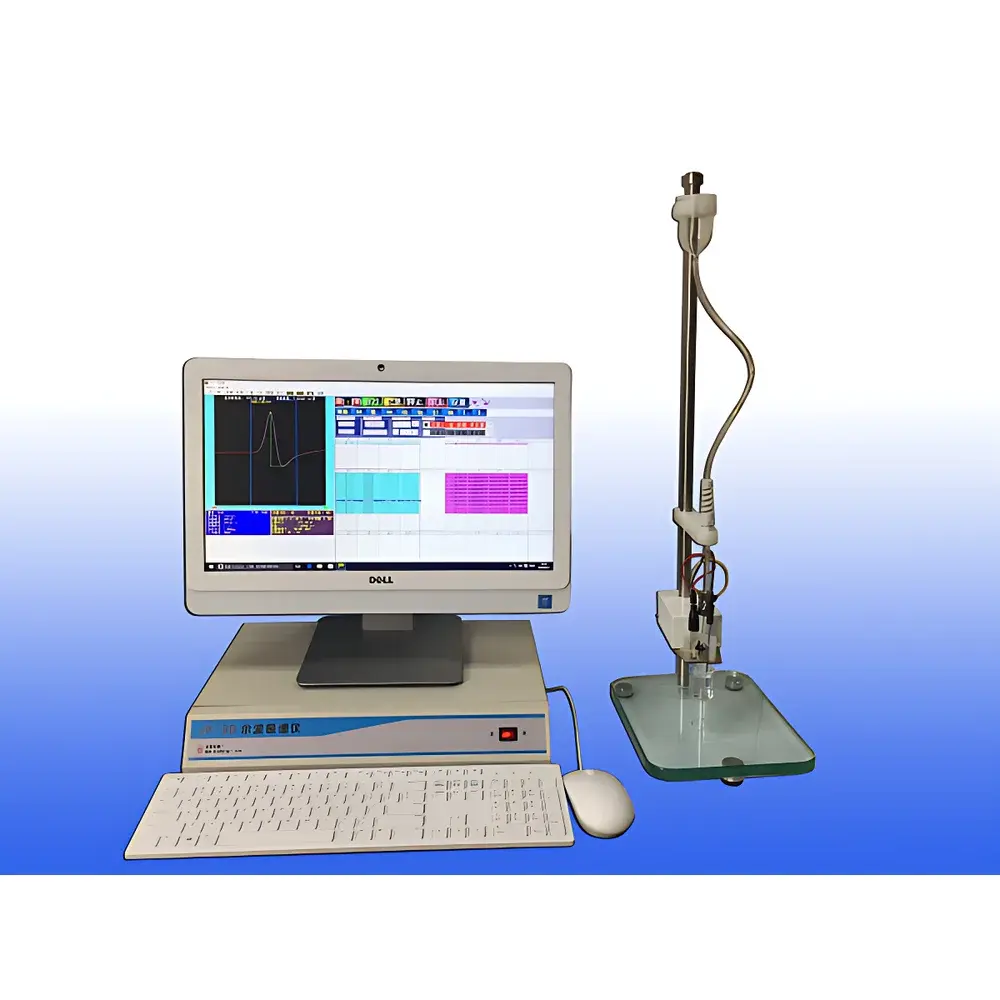
Chengyi JP-2D Oscilloscopic Polarograph
| Brand | Chengyi |
|---|---|
| Origin | Sichuan, China |
| Model | JP-2D |
| Polarographic Current Range | 15 nA–400 µA (F.S., 23 programmable ranges) |
| Polarization Potential Range | ±3904 mV (32 mV resolution) |
| Scan Rate | 50–1000 mV/s |
| Scan Amplitude | 50–1000 mV |
| Scan Period | 1–1000 s |
| Sensitivity | <5×10⁻⁸ mol/L (Cd²⁺, linear sweep polarography) |
| Resolution | <32 mV |
| Anti-Interference Ratio (pre-reduction substances) | >10⁴:1 |
| Repeatability Error | <0.3% |
| Range-Switching Error | <0.3% |
| ADC Precision | 18-bit |
| Power Supply | 100–240 VAC, 50/60 Hz |
| Power Consumption | ~30 W |
| Weight | 15 kg |
| Interface | USB 2.0 |
| Integrated Control Unit | 19.5″ all-in-one industrial PC (optional external Windows PC support) |
| Software | JP-2D Polarographic Analysis Suite (Windows 7/8/10, 32/64-bit |
Overview
The Chengyi JP-2D Oscilloscopic Polarograph is a microprocessor-controlled, high-stability voltammetric analyzer engineered for quantitative trace metal analysis via classical DC polarography and derivative polarographic techniques. Operating on the fundamental principle of diffusion-controlled current response at a dropping mercury electrode (DME), the instrument measures current as a function of applied potential to generate polarograms—voltammograms characterized by sigmoidal or peak-shaped responses corresponding to electroactive species in solution. Its core architecture integrates an ARM-based embedded control system with an 18-bit analog-to-digital converter, enabling high-fidelity signal acquisition, low-noise current measurement down to 15 nA full-scale, and precise potential stepping with 32 mV resolution across a ±3904 mV range. Designed for laboratory environments requiring regulatory-compliant data integrity, the JP-2D supports GLP-aligned workflows through timestamped, version-controlled method storage, electronic signature-capable operation logs, and full traceability of raw waveform data, calibration parameters, and statistical outputs.
Key Features
- Integrated 19.5″ industrial all-in-one PC with pre-installed JP-2D Polarographic Analysis Suite—no external computer required for standalone operation
- 23-step programmable current range (15 nA to 400 µA F.S.) with automatic range switching and <0.3% range-transition error
- Real-time display and storage of raw polarographic curves during acquisition, including conventional, first-derivative, and second-derivative modes
- Automated capacitive and residual current compensation algorithms to enhance signal-to-noise ratio and baseline stability
- Dual-element sequential measurement mode: switch between two independently defined analytical protocols (e.g., different scan rates, potentials, or pulse parameters) without solution replacement—ideal for multi-analyte systems with widely separated reduction potentials
- 18-bit high-resolution ADC ensures reproducible quantification with <0.3% repeatability error and sensitivity below 5×10⁻⁸ mol/L for Cd²⁺ using linear sweep polarography
- Comprehensive software-driven data processing: automatic peak detection and annotation, baseline subtraction, integration, regression analysis (linear and quadratic), and coefficient-of-variation calculation
Sample Compatibility & Compliance
The JP-2D is optimized for aqueous electrolyte solutions containing trace-level heavy metals (e.g., Pb²⁺, Cd²⁺, Zn²⁺, Cu²⁺, Tl⁺) and redox-active organic compounds. It accommodates standard three-electrode configurations (DME working electrode, Ag/AgCl reference, platinum auxiliary) and supports manual or automated cell handling. The instrument meets essential functional requirements outlined in ASTM D3559 (lead in water), ISO 8466-2 (calibration of analytical methods), and USP (for electrochemical validation in pharmaceutical excipient testing). While not certified to IEC 61010-1 for safety or ISO/IEC 17025 for accredited testing, its design facilitates compliance with internal QA/QC procedures, including instrument qualification (IQ/OQ/PQ), method validation per ICH Q2(R2), and audit readiness for FDA 21 CFR Part 11 when deployed with appropriate procedural controls and electronic record governance.
Software & Data Management
The JP-2D Polarographic Analysis Suite is a native Windows application (32/64-bit compatible, Windows 7 through 11) featuring a validated graphical user interface for method setup, real-time visualization, and post-acquisition processing. All measurement parameters—including scan rate, amplitude, delay time, filter settings, and electrode conditioning cycles—are stored as named, versioned methods with user-defined metadata. Raw current-potential datasets are saved in proprietary binary format (.jpd) with embedded calibration coefficients and timestamps; export options include CSV, TXT, and native Excel (.xlsx) with embedded regression charts, R² values, and confidence intervals. The software implements audit-trail functionality: every parameter change, measurement execution, and data export event is logged with operator ID, timestamp, and action type. Firmware and software updates are provided free of charge throughout product lifecycle, distributed via secure HTTPS download with SHA-256 checksum verification.
Applications
The JP-2D serves as a cost-effective, robust platform for teaching and research-level polarographic analysis in academic chemistry laboratories, environmental monitoring agencies, and quality control departments. Typical use cases include determination of trace cadmium in drinking water per EPA Method 2760A adaptations, speciation analysis of copper complexes in industrial effluents, electrochemical characterization of pharmaceutical intermediates, and validation of chelating agent efficacy in food-grade packaging leachates. Its dual-parameter capability enables rapid screening of coexisting analytes such as Pb/Cd or Zn/Ni in soil extracts without reconditioning the electrode or recalibrating between runs. In educational settings, the instrument supports hands-on instruction in electrode kinetics, diffusion-controlled mass transport, and the Nernst equation—visualized directly via live oscilloscopic traces synchronized with digital parameter readouts.
FAQ
Does the JP-2D support GMP/GLP-compliant data archiving?
Yes—when operated with documented SOPs and controlled access, the software’s method versioning, electronic logbook, and immutable raw-data storage enable alignment with GLP principles and foundational GMP data integrity expectations.
Can the instrument be used without the integrated PC?
Yes—external Windows PCs (Windows 7–11, 32/64-bit) connected via USB 2.0 can fully control acquisition, processing, and reporting functions.
What electrode configurations are supported?
Standard three-electrode setups: dropping mercury electrode (DME) or static mercury drop electrode (SMDE) as working electrode, Ag/AgCl (3 M KCl) reference, and platinum wire auxiliary electrode.
Is the software validated for regulated environments?
The software is not formally 21 CFR Part 11 validated out-of-the-box; however, its architecture—including audit trail, electronic signatures, and data immutability features—provides the technical foundation for site-specific validation under client-owned protocols.
How is blank subtraction handled?
The software provides both manual baseline selection and automated adaptive blank subtraction using pre-scan or post-scan background regions, with option to apply correction across entire batch sequences.






