
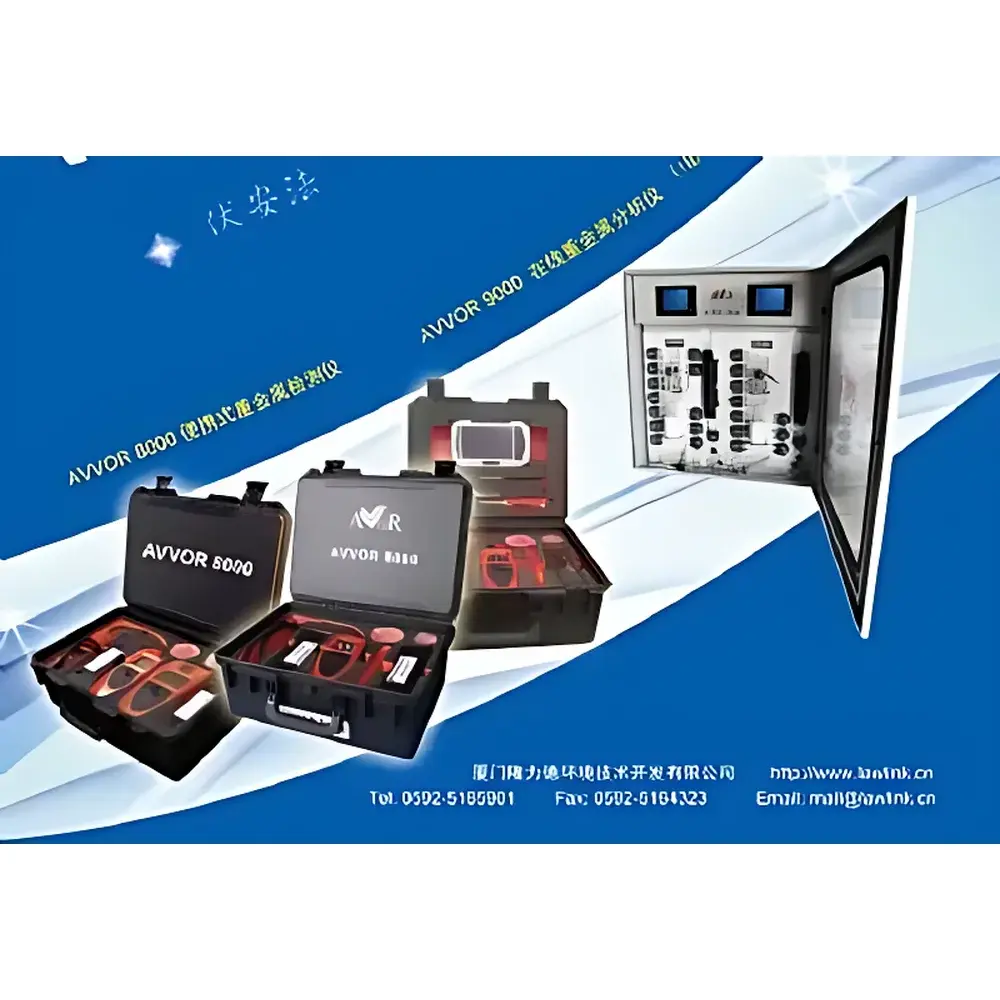
AVVOR 8000 & 9000 Portable and Online Heavy Metal Analyzers
| Brand | AVVOR |
|---|---|
| Origin | Canada |
| Model | AVVOR 8000 (HM-1, HM-2, HM-3) and AVVOR 9000 |
| Detection Principle | Anodic Stripping Voltammetry (ASV) |
| Measurement Range | Sub-ppb to ppm |
| Electrode Options | Gold, Mercury-film, Bismuth-film, and Bare Carbon Working Electrodes |
| Output Interfaces | Dual 4–20 mA analog outputs, RS-232, RS-485 |
| Compliance | Designed for ASTM D3559, ISO 11929 (uncertainty evaluation), USP <232>/<233>, and EPA Method 7000B |
| Software | Onboard data logging with timestamped audit trail, GLP-compliant reporting |
| Enclosure Rating | IP65 (AVVOR 8000 series), IP67 (AVVOR 9000 outdoor cabinet) |
Overview
The AVVOR 8000 and 9000 series heavy metal analyzers are engineered for precise, field-deployable and continuous electrochemical quantification of toxic metal ions in aqueous matrices. Built upon internationally standardized anodic stripping voltammetry (ASV), these instruments leverage controlled electrodeposition and subsequent oxidative dissolution to achieve high sensitivity and selectivity. The AVVOR 8000 family comprises three portable configurations—HM-1, HM-2, and HM-3—each optimized for distinct operational needs: HM-1 targets regulatory compliance testing for As(III), total As, Cd, Cu, Pb, Hg, Mn, Ni, and Zn at sub-ppb detection limits; HM-2 extends multi-element coverage to 12 metals (including Cr(VI), Fe, Al, B) across broader concentration ranges (ppb–ppm); HM-3 integrates a ruggedized tablet interface for real-time spectral visualization, expanded method library storage, and GPS-tagged sampling metadata capture. In contrast, the AVVOR 9000 is a modular online analyzer designed for unattended, 24/7 monitoring of industrial effluents, municipal wastewater, drinking water sources, and marine environments. Its dual-module architecture supports concurrent analysis of up to five metals per module, with configurable electrode selection (Au, Hg-film, Bi-film, or carbon) to match redox behavior and matrix interference profiles.
Key Features
- ASV-based detection validated against EPA Method 7000B and ISO 11929 for measurement uncertainty estimation
- Portable HM-1 and HM-2 models feature battery-powered operation (>12 h), integrated buffer dispensing, and single-button assay initiation
- HM-3 includes a certified IP65-rated Android tablet with preloaded calibration curves, multi-language UI, and encrypted SD-card data export
- AVVOR 9000 supports up to two independent test modules—configurable as As/Hg/Se, Zn/Cd/Pb/Cu/Mn/Sb/Tl/Fe/Ni/Sn, Cr/Ni/Co/Mo, or Au/Ag/Cr(VI)/Pd combinations
- Each module accepts one working electrode; automatic electrode cleaning cycles ensure >500 measurements per film renewal
- Dual 4–20 mA analog outputs assignable to any measured parameter; RS-485 Modbus RTU and RS-232 ASCII protocols supported
- Onboard diagnostics include flow sensor validation, electrode impedance monitoring, and electrolyte level detection
- Auto-calibration function triggered by user-defined schedule or event-based triggers (e.g., after 50 samples or 24 h runtime)
- IP67-rated outdoor enclosure with thermostatically controlled desiccant chamber for coastal or high-humidity installations
Sample Compatibility & Compliance
The AVVOR systems accept raw or pretreated water samples—including surface water, groundwater, treated wastewater, potable water, and seawater—with minimal sample preparation. For complex matrices, optional on-line UV digestion (for organo-metallic species) and acidification modules are available to meet EPA 200.8 and ISO 17294-2 requirements. All models comply with GLP data integrity principles: time-stamped audit trails record operator ID, calibration events, error logs, and manual overrides. Firmware supports 21 CFR Part 11–compliant electronic signatures when paired with external authentication servers. Instrument performance aligns with ISO/IEC 17025 clause 5.9 (method validation) and ASTM D3559 for lead, cadmium, and copper in drinking water.
Software & Data Management
AVVOR Control Suite (v4.2+) provides unified configuration, remote diagnostics, and report generation across both portable and online platforms. Data files are stored in CSV and XML formats compliant with ASTM E1461 and ISO 11452-5. Each measurement includes embedded metadata: temperature, pH (if external probe connected), electrode type, deposition time, scan rate, and peak integration parameters. Cloud synchronization via TLS 1.2–secured MQTT is optional; local storage retains ≥10,000 records with cyclic overwrite protection. Reporting templates follow ISO 14001 Annex A.3 and EU WFD (2000/60/EC) Annex V formatting conventions.
Applications
- Regulatory compliance monitoring for NPDES permits and EU Urban Wastewater Treatment Directive discharge limits
- Source water vulnerability assessment in watershed management programs
- In-process control of electroplating baths, mining leachates, and semiconductor rinse waters
- Emergency response screening during chemical spills or landfill leachate breaches
- Long-term trend analysis in lake sediment porewater and estuarine mixing zones
- Validation of membrane filtration and ion exchange system performance
FAQ
What electrode types are supported, and how do they affect selectivity?
Gold electrodes are used for As, Hg, Se, and Sb; mercury-film electrodes enhance sensitivity for Zn, Cd, Pb, Cu, and Tl; bismuth-film electrodes offer low-toxicity alternatives for Cd, Pb, and Zn; bare carbon enables Cr(VI) and Co detection without mercury. Electrode choice directly determines achievable LODs and intermetallic interference profiles.
Can the AVVOR 9000 operate without reagent addition?
Yes—the core ASV process requires only supporting electrolyte (e.g., acetate or phosphate buffer), which is supplied as a stable solid-phase cartridge with 90-day shelf life. No liquid acids or oxidants are consumed during routine operation.
How is data traceability ensured for audit purposes?
All firmware versions, calibration coefficients, measurement raw curves, and operator actions are cryptographically hashed and archived with UTC timestamps. Exported reports include digital signatures verifiable against the instrument’s embedded certificate authority.
Is method validation support available for laboratory accreditation?
AVVOR provides full validation documentation packages—including spike recovery studies, LOQ/LOD determination protocols, robustness testing matrices, and inter-laboratory comparison datasets—for ISO/IEC 17025 accreditation under CNAS, UKAS, or DAkkS scopes.
What maintenance intervals are recommended for field deployment?
Electrode films require replacement every 3–6 months depending on sample load; buffer cartridges every 90 days; and full system verification (including flow path integrity and analog output linearity) every 6 months per ISO 17025 clause 7.7.
Related Products







