
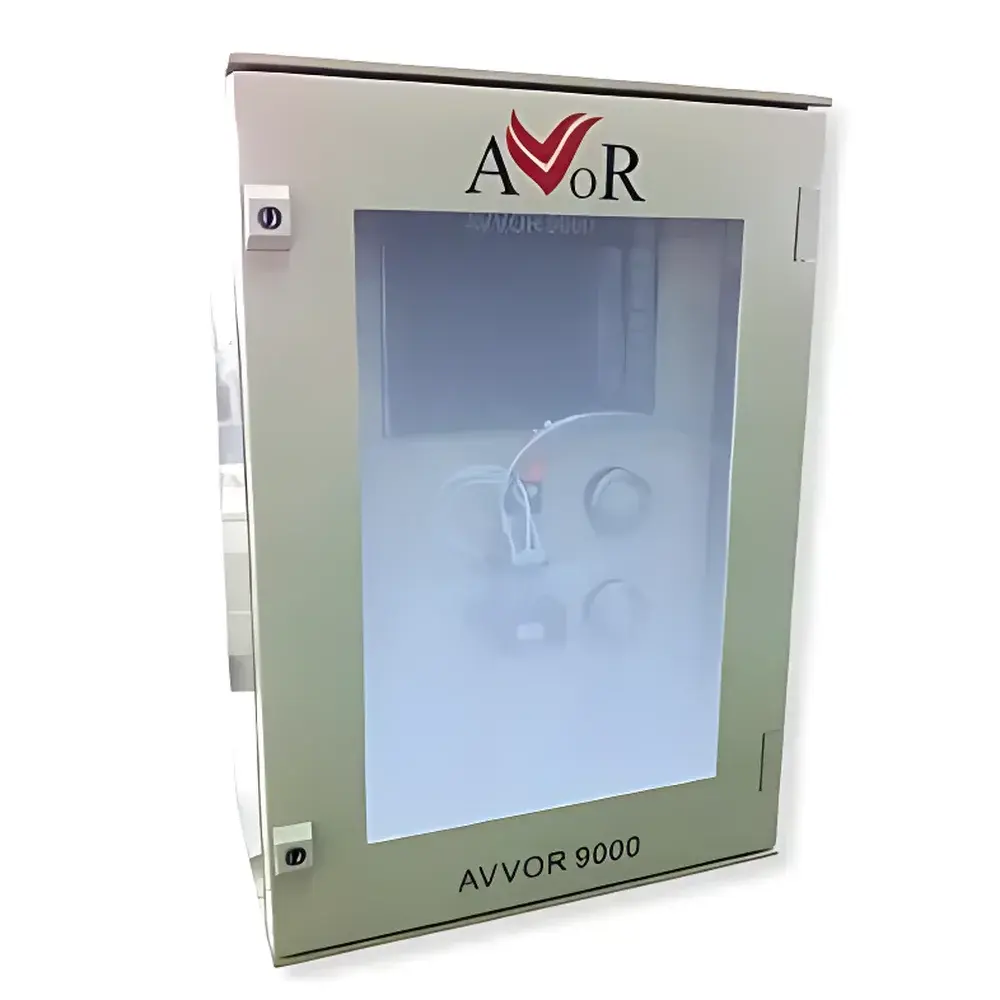
AVVOR 9000 Fluoride Ion Analyzer
| Brand | AVVOR |
|---|---|
| Origin | Canada |
| Model | AVVOR 9000 |
| Detection Principle | Potentiometric measurement using fluoride-selective ion electrode (F⁻-ISE) with TISAB-based sample conditioning |
| Measurement Range (F⁻) | 0.02–1900 ppm |
| Resolution | 0.01 ppm |
| Accuracy | ±5% of full scale |
| pH Operating Range | 4–9 (optimized with TISAB buffer) |
| Output Signal | Isolated 4–20 mA, max load 1 kΩ |
| Operating Temperature | 0–55 °C |
| Enclosure Rating | IP65 |
| Dimensions (H×W×D) | 400 × 300 × 150 mm |
| Display | 7-inch color touchscreen with multilingual UI |
| Data Storage | Internal memory + optional 8 GB microSD/USB storage |
| Auto-cleaning | Configurable timer-based cleaning cycle (cleaning module sold separately) |
| Calibration | ≥5-point linear or empirical calibration curve |
| Compliance | Designed for continuous water quality monitoring per ISO 10304-1, ASTM D1179, and EPA Method 300.0 guidelines |
| Sample Compatibility | Drinking water, surface water, wastewater, industrial effluent, and groundwater |
Overview
The AVVOR 9000 Fluoride Ion Analyzer is a field-deployable, potentiometric online analyzer engineered for continuous, high-reliability quantification of free fluoride ions (F⁻) in aqueous environmental and municipal water matrices. It operates on the Nernstian principle: a solid-state fluoride-selective ion electrode (F⁻-ISE) generates a stable millivolt potential proportional to the logarithm of F⁻ activity in solution. To ensure thermodynamic equilibrium and eliminate interference from metal-fluoride complexes (e.g., AlF₆³⁻, FeF₆³⁻) and variable pH, samples are automatically conditioned with Total Ionic Strength Adjustment Buffer (TISAB), which chelates interfering cations and fixes pH within the optimal range of 4–9. This electrochemical architecture delivers robust performance under fluctuating field conditions—without requiring reagent addition during routine operation—and meets the metrological requirements for regulatory compliance monitoring per ISO 10304-1 (determination of anions by liquid chromatography), ASTM D1179 (fluoride in water), and U.S. EPA Method 300.0 (ion chromatography and potentiometry).
Key Features
- 7-inch high-brightness color touchscreen interface with intuitive multilingual navigation (English, French, Spanish, German, Chinese), supporting real-time configuration, diagnostics, and alarm management.
- Integrated potentiometric signal processing unit with auto-zero stabilization and temperature compensation (via built-in Pt100 sensor), minimizing drift over extended unattended operation.
- Configurable automatic electrode cleaning protocol—user-defined interval and duration—compatible with optional pneumatic or ultrasonic cleaning modules to maintain long-term electrode sensitivity.
- Onboard data logging with non-volatile internal memory; supports optional 8 GB microSD card or USB flash drive for secure archival of time-stamped measurements, calibration logs, and event-triggered alarms.
- Flexible data export: CSV-formatted historical records via USB port or Modbus RTU/ASCII over RS-485; compatible with SCADA, DCS, and LIMS integration.
- IP65-rated NEMA 4X enclosure constructed from UV-stabilized polycarbonate and stainless-steel hardware, rated for outdoor mounting in ambient temperatures from 0 to 55 °C.
Sample Compatibility & Compliance
The AVVOR 9000 is validated for direct analysis of raw and treated drinking water, surface runoff, groundwater, and low-turbidity industrial effluents. Its TISAB-mediated measurement protocol ensures accurate F⁻ quantification even in samples containing up to 10 mg/L Al³⁺ or Fe³⁺, common in coagulated surface waters. The system conforms to Good Laboratory Practice (GLP) data integrity requirements: all calibrations, maintenance events, and alarm triggers are timestamped and stored with user ID attribution. Audit trails meet FDA 21 CFR Part 11 criteria when paired with validated third-party data acquisition software. Instrument design aligns with ISO/IEC 17025:2017 clause 6.4.3 (equipment verification) and supports traceable calibration against NIST-traceable fluoride standards.
Software & Data Management
The embedded firmware provides dual-mode operation: standalone monitoring with local visualization or networked deployment via Modbus TCP/IP (optional Ethernet module). Real-time data includes measured mV potential, compensated F⁻ concentration (ppm), temperature, pH (if external probe connected), and electrode impedance diagnostics. Historical trends are rendered as interactive line graphs with zoom, pan, and annotation capabilities. All calibration curves—including 5+ point linear, quadratic, or user-defined empirical fits—are retained with metadata (date, operator, standard lot numbers). Data export supports automated scheduled transfers via FTP or manual retrieval through USB mass storage mode.
Applications
- Regulatory compliance monitoring of fluoride in public drinking water systems (per WHO guideline value of 1.5 mg/L and U.S. EPA MCL of 4.0 mg/L).
- Process control in fluoridation plants, where precise dosing feedback is required to maintain target residual levels.
- Environmental impact assessment of industrial discharges from aluminum smelters, phosphate fertilizer production, and semiconductor etching facilities.
- Long-term groundwater quality surveillance in geologically fluoride-prone regions (e.g., Rift Valley, Deccan Traps).
- Research-grade field studies requiring high-temporal-resolution F⁻ profiling in stream-aquifer interaction zones.
FAQ
What sample pretreatment is required prior to analysis?
No filtration or acidification is needed. The integrated TISAB dosing system automatically conditions each sample to release complexed fluoride and stabilize pH—eliminating manual reagent handling.
Can the instrument measure other anions simultaneously?
The AVVOR 9000 is dedicated to fluoride ion analysis. However, its modular analog output (4–20 mA) and digital interfaces allow synchronized integration with parallel analyzers for chloride, nitrate, or conductivity in multi-parameter water stations.
How often must the fluoride electrode be calibrated?
Calibration frequency depends on application severity: daily for high-accuracy regulatory reporting; weekly for process control in stable influent streams. The system supports bracketing calibrations and automatic validation checks before critical measurements.
Is remote firmware update supported?
Yes—firmware upgrades can be performed locally via USB or remotely over Modbus TCP/IP using authenticated secure file transfer protocols.
Does the analyzer support alarm relay outputs?
Two programmable dry-contact relays are provided: one for concentration limit violation (high/low), and another for maintenance alert (e.g., cleaning overdue, calibration due, or electrode impedance out of spec).







