
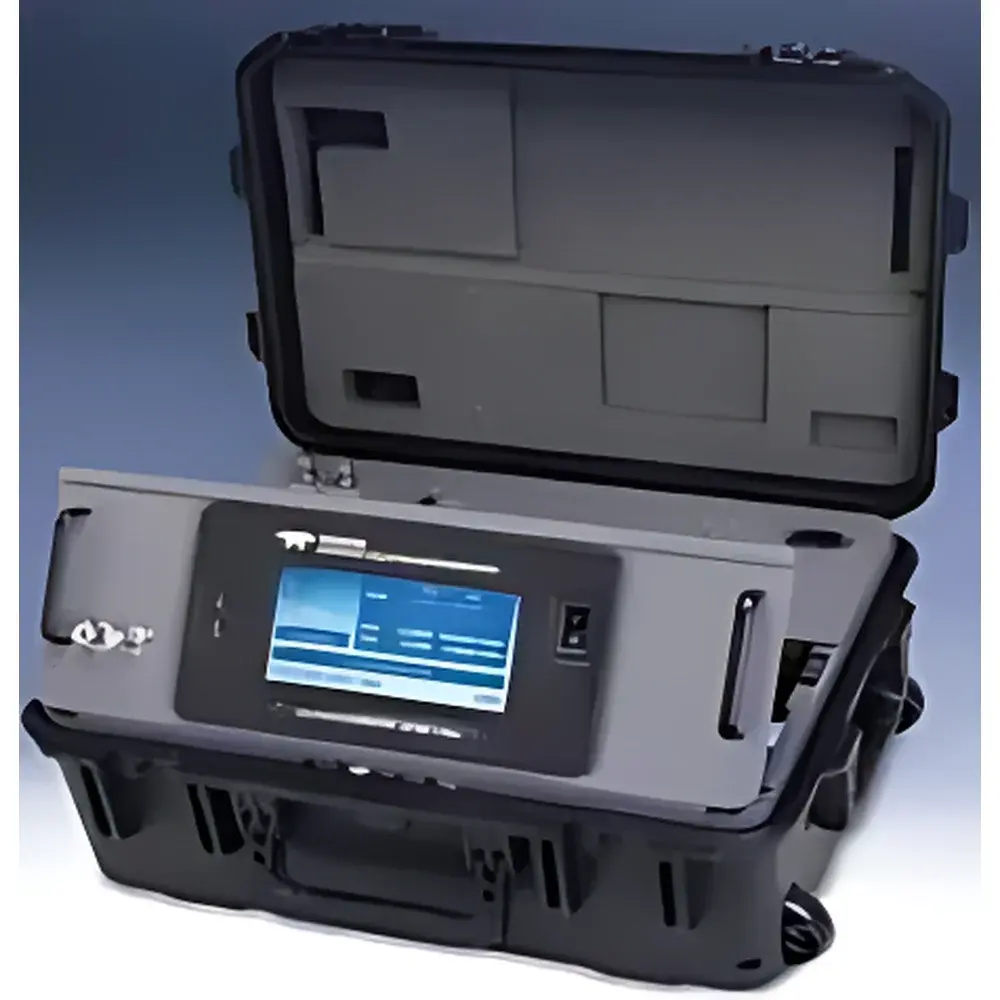
API T750U Portable Trace Gas Calibrator
| Brand | API |
|---|---|
| Origin | USA |
| Manufacturer Type | Authorized Distributor |
| Product Origin | Imported |
| Model | T750U |
| Pricing | Upon Request |
Overview
The API T750U Portable Trace Gas Calibrator is an engineered solution for high-precision, field-deployable calibration of trace-level gas analyzers—specifically targeting nitrogen oxides (NO, NO₂) and ozone (O₃) at sub-part-per-trillion to low-part-per-trillion concentrations. Built upon gas-phase titration (GPT) principles and dual-range ozone generation, the T750U enables quantitative, NIST-traceable calibration across dynamic ranges unreachable by conventional dilution calibrators. Its core architecture integrates a microprocessor-controlled mass flow controller (MFC) system with a thermally stabilized UV photometric ozone monitor, enabling real-time feedback control during GPT-based NO₂ synthesis. Unlike static span/zero generators, the T750U dynamically adjusts ozone concentration and flow rate to match user-defined target NO₂ levels—ensuring stoichiometric accuracy per ISO 10156 and ASTM D6348 compliance frameworks. Designed for ambient air monitoring networks, mobile emissions testing labs, and regulatory reference laboratories, it meets operational requirements under EPA Methods 214, 215, and EN 14625 for NOₓ analyzer verification.
Key Features
- Dual-mode ozone generator: High-range mode (up to 4.5 ppm) and fractional low-range mode (down to 3 ppb), enabling precise GPT-derived NO₂ generation from 20 ppb to <3 ppb
- Integrated UV photometer (0–100 ppb to 0–10 ppm selectable range) with 1.0 ppb detection limit and ±1.0% linearity error—used for closed-loop ozone concentration verification prior to titration
- Glass gas-phase titration (GPT) chamber with external ozone reference port, minimizing wall adsorption and ensuring reaction completeness per IUPAC kinetic standards
- Three independent thermal mass flow controllers (standard two; optional third MFC for extended dilution flexibility), each calibrated to ±1% FS accuracy and ±0.2% repeatability
- Capacitive touchscreen interface with full-color LCD display, supporting intuitive navigation, real-time diagnostics, and multi-language UI (English, Spanish, French)
- Robust transport housing: Molded high-density polyethylene case with recessed handles, heavy-duty casters, and IP54-rated internal sealing for field durability
- Comprehensive I/O architecture: Dual RS-232 ports (300–115,200 baud), 10/100Base-T Ethernet, 2× USB device ports, 8 digital outputs, 12 digital inputs, and 8 status outputs
Sample Compatibility & Compliance
The T750U is validated for calibration of chemiluminescence (CLD), UV absorption, and electrochemical NO/NO₂ analyzers operating in ambient, stack, or laboratory environments. It supports zero-air requirements up to 20 SLPM at 30 psi and accommodates cylinder gases up to 200 cc/min. All flow paths are electropolished stainless steel or PFA-lined to prevent catalytic decomposition or surface adsorption of reactive species. The system complies with ISO/IEC 17025 documentation requirements for calibration equipment and supports audit-ready electronic records when used with APIcom software under 21 CFR Part 11-compliant configurations (including electronic signatures, audit trails, and data integrity controls). Calibration certificates include traceability to NIST Standard Reference Materials (SRMs) for ozone and NO.
Software & Data Management
APIcom software provides local and remote configuration, real-time parameter monitoring, automated calibration sequence execution, and raw data export in CSV and XML formats. Firmware updates, method storage, and diagnostic logs are managed via front-panel USB port or Ethernet connection. The software supports GLP/GMP workflows through configurable user roles, password-protected access levels, and timestamped event logging—including all MFC setpoint changes, photometer readings, and GPT reaction timestamps. Historical calibration reports include uncertainty budgets calculated per GUM (JCGM 100:2008) guidelines, incorporating contributions from flow accuracy, ozone photometry, reaction kinetics, and temperature/pressure compensation.
Applications
- Field validation of regulatory-grade NOₓ analyzers deployed in EPA Air Quality System (AQS) stations
- Mobile source emissions testing—calibrating portable FTIR and CLD analyzers on chassis dynamometers or roadside measurement units
- Reference laboratory intercomparison studies requiring sub-5 ppb NO linearity verification per EU Directive 2008/50/EC Annex IX
- Development and verification of low-concentration calibration standards for research-grade cavity ring-down spectroscopy (CRDS) and laser-induced fluorescence (LIF) platforms
- QA/QC protocols for continuous emission monitoring systems (CEMS) subject to 40 CFR Part 60, Appendix B performance specifications
FAQ
What is the lowest NO₂ concentration the T750U can generate via gas-phase titration?
The T750U achieves certified NO₂ output down to 3 ppb using its fractional ozone mode and photometer-coupled feedback control.
Does the instrument require external zero air supply?
Yes—minimum 10 SLPM at 30 psi is required; a 20 SLPM option is available for high-dilution applications.
Can the T750U be operated remotely over a network?
Yes—via built-in Ethernet (10/100Base-T) and APIcom software, supporting secure remote configuration, monitoring, and data retrieval.
Is the UV photometer internally calibrated?
The photometer includes factory calibration traceable to NIST SRM 2241 (ozone in nitrogen); field verification uses the integrated ozone reference port with certified external standards.
What safety certifications does the T750U hold?
It conforms to UL 61010-1, CE marking per EMC Directive 2014/30/EU and Low Voltage Directive 2014/35/EU, and meets RoHS 2011/65/EU material restrictions.
Related Products







