
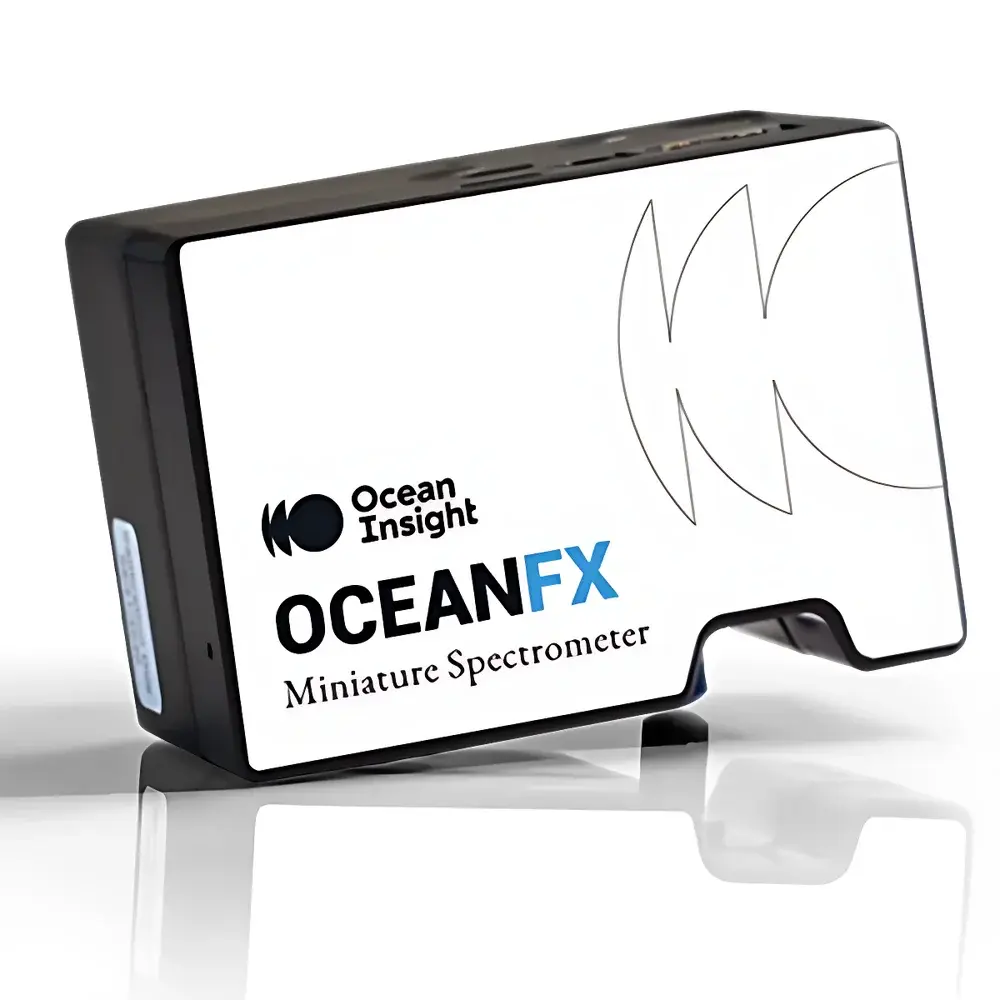
Ocean Optics FX Series High-Speed Network-Ready Spectrometer
| Brand | Ocean Optics |
|---|---|
| Model | FX UV-VIS / FX VIS-NIR / FX XR |
| Wavelength Range | 200–850 nm / 350–1000 nm / 200–1025 nm |
| Optical Resolution (FWHM) | 1.33 nm (typ.) / 1.69 nm (typ.) / Not Specified |
| Integration Time | 10 µs – 10 s |
| Detector | Back-Illuminated CMOS |
| A/D Resolution | 16 bit |
| Signal-to-Noise Ratio | 290:1 |
| Dynamic Range | 5000:1 |
| Onboard Buffer | 50,000 spectra |
| Max Acquisition Rate | 4,500 spectra/s |
| Grating Options | GRATING_#1 / GRATING_#3 / GRATING_#XR1 |
| Slit Width | 25 µm |
| Connectivity | Gigabit Ethernet, USB 3.0, RS-232, Wi-Fi |
| Onboard Processing | Spectral averaging (up to 5,000 spectra), timestamping, SNR enhancement |
Overview
The Ocean Optics FX Series is a family of high-speed, network-enabled miniature fiber-optic spectrometers engineered for demanding time-resolved and process-monitoring applications. Based on advanced back-illuminated CMOS detector technology and optimized optical architectures, the FX platform delivers exceptional acquisition speed—up to 4,500 full-spectrum scans per second—with precise microsecond-level integration timing (10 µs minimum). Its core measurement principle relies on fixed-grating dispersion coupled with linear array detection, enabling robust, repeatable spectral acquisition across ultraviolet, visible, and near-infrared regions. Unlike traditional scanning monochromators or low-speed CCD-based systems, the FX operates in snapshot mode, capturing the entire spectrum simultaneously—making it ideal for transient event capture, real-time reaction kinetics, plasma diagnostics, and inline industrial monitoring where temporal fidelity and synchronization are critical.
Key Features
- Ultra-High-Speed Acquisition: Sustained spectral rates up to 4,500 Hz with hardware-timed triggering and sub-millisecond latency—enabling resolution of rapid photophysical events such as laser-induced breakdown (LIBS) plasma decay, spark dynamics, or LED pulse characterization.
- Onboard Intelligence: Integrated FPGA-based processing supports real-time spectral averaging (up to 5,000 scans), timestamping with µs precision, and onboard signal-to-noise ratio (SNR) optimization—reducing host CPU load and minimizing data transfer bottlenecks.
- Large Spectral Buffer: On-device memory stores up to 50,000 complete spectra with embedded timestamps, ensuring no spectral data is lost during high-throughput acquisition—even under intermittent host communication or network congestion.
- Multi-Protocol Connectivity: Simultaneous support for Gigabit Ethernet (for deterministic, low-jitter network deployment), USB 3.0 (for lab integration), RS-232 (for legacy PLC interfacing), and optional Wi-Fi (for mobile or distributed sensor node configurations).
- Modular Optical Configurations: Three standard models cover complementary spectral ranges: FX UV-VIS (200–850 nm), FX VIS-NIR (350–1000 nm), and FX XR (200–1025 nm), each optimized with application-specific gratings (GRATING_#1, #3, or #XR1) and a fixed 25 µm entrance slit for consistent throughput and resolution trade-offs.
- OEM-Ready Architecture: Designed for seamless integration into analytical instruments, process control systems, or portable diagnostic platforms—available as bare-board modules, calibrated subassemblies, or fully configured turnkey spectrometers with factory-applied NIST-traceable calibration.
Sample Compatibility & Compliance
The FX Series interfaces with standard SMA 905 fiber-optic cables and accommodates diverse sampling geometries—including transmission cuvettes, integrating spheres, reflection probes, collimating optics, and LIBS collection lenses—without requiring recalibration. Its compact form factor (120 × 86 × 35 mm) and low power consumption (<3 W typical) enable deployment in space-constrained or battery-powered environments. From a regulatory standpoint, the FX platform supports audit-ready data integrity workflows when used with compliant software: spectral metadata (integration time, lamp reference, dark correction status, calibration date) is embedded in every acquired spectrum. When integrated into GxP environments, the system can be validated to meet requirements for electronic records under FDA 21 CFR Part 11 (with appropriate software controls), and its stable thermal design ensures <±0.05 nm/°C wavelength drift—critical for long-duration environmental or production-line monitoring per ISO 17025 and ASTM E275.
Software & Data Management
Ocean Insight’s OceanView™ software provides native support for FX-series devices, offering synchronized multi-channel acquisition, trigger-based burst modes, and real-time spectral math (e.g., absorbance calculation, peak tracking, ratio analysis). The SDK (available for Python, MATLAB, LabVIEW, C#, and .NET) enables full programmatic control of acquisition parameters, buffer management, and metadata tagging—facilitating integration into custom LIMS, SCADA, or MES platforms. All spectral data is exported in industry-standard formats (CSV, HDF5, JDX), preserving calibration coefficients, timestamps, and instrument configuration for traceability. For regulated environments, optional OceanInsight IQ™ software adds 21 CFR Part 11 compliance features including user role-based access, electronic signatures, and immutable audit trails for all acquisition and processing events.
Applications
- Laser-Induced Breakdown Spectroscopy (LIBS): Captures nanosecond-scale plasma emission with 10 µs integration—resolving time-gated elemental signatures for metals analysis in soils, alloys, or aqueous matrices.
- Industrial Process Monitoring: Real-time tracking of color shift, concentration gradients, or reaction endpoints in pharmaceutical coating, polymer curing, or chemical synthesis—synchronized via TTL triggers to PLCs or motion controllers.
- LED and Solid-State Lighting QA: High-speed binning based on CIE chromaticity coordinates, dominant wavelength (CWL), and spectral FWHM—leveraging short integration times to stabilize measurements against pulse-width modulation (PWM) artifacts.
- Plasma & Laser Process Control: In situ monitoring of atomic line intensities (e.g., Fe I at 371.99 nm, Cu I at 324.75 nm) during laser welding, PVD sputtering, or plasma etching to infer temperature, electron density, and stoichiometry.
- Transient Photophysics: Time-resolved fluorescence decay profiling, flash photolysis kinetics, and combustion emission spectroscopy—enabled by hardware-triggered burst acquisition with jitter <100 ns.
- Environmental & Field Deployments: Battery-operated, Ethernet-connected nodes for continuous water quality monitoring (e.g., nitrate, DOC, chlorophyll-a via UV-Vis absorption) or ambient air pollutant detection (NO₂, SO₂, O₃) using differential optical absorption spectroscopy (DOAS) principles.
FAQ
What is the shortest possible integration time, and how does it affect sensitivity?
The FX supports integration times as low as 10 µs. At this setting, photon collection is minimized—requiring high-brightness sources or signal-enhancing optics (e.g., -ES variant with cylindrical focusing lens) to maintain usable SNR. Sensitivity scales linearly with integration time; doubling integration time improves SNR by √2.
Can the FX resolve narrow laser lines?
Yes—provided the laser’s spectral linewidth exceeds the instrument’s optical resolution (e.g., 1.33 nm FWHM for FX UV-VIS). While absolute FWHM measurement requires resolution finer than the laser line, centroid (CWL) determination remains accurate even if the instrument’s resolution is broader—as long as detector saturation is avoided.
Is the FX suitable for GLP/GMP-compliant laboratories?
When paired with OceanInsight IQ™ software and documented validation protocols, the FX meets key elements of GLP and GMP data integrity requirements—including electronic signature support, audit trail generation, and calibration traceability to NIST standards.
How is synchronization handled across multiple FX units?
Hardware triggering via external TTL signals enables sub-microsecond synchronization across multiple FX spectrometers—essential for spatially resolved or multi-angle measurements. Gigabit Ethernet also supports IEEE 1588 Precision Time Protocol (PTP) for network-wide time alignment.
What calibration options are available?
Factory calibration includes wavelength (Hg/Ar lamp traceable to NIST SRM 2035) and radiometric (NIST-traceable tungsten halogen source). Custom calibrations—for irradiance, absorbance, or quantum efficiency—are available upon request and documented per ISO/IEC 17025.





