
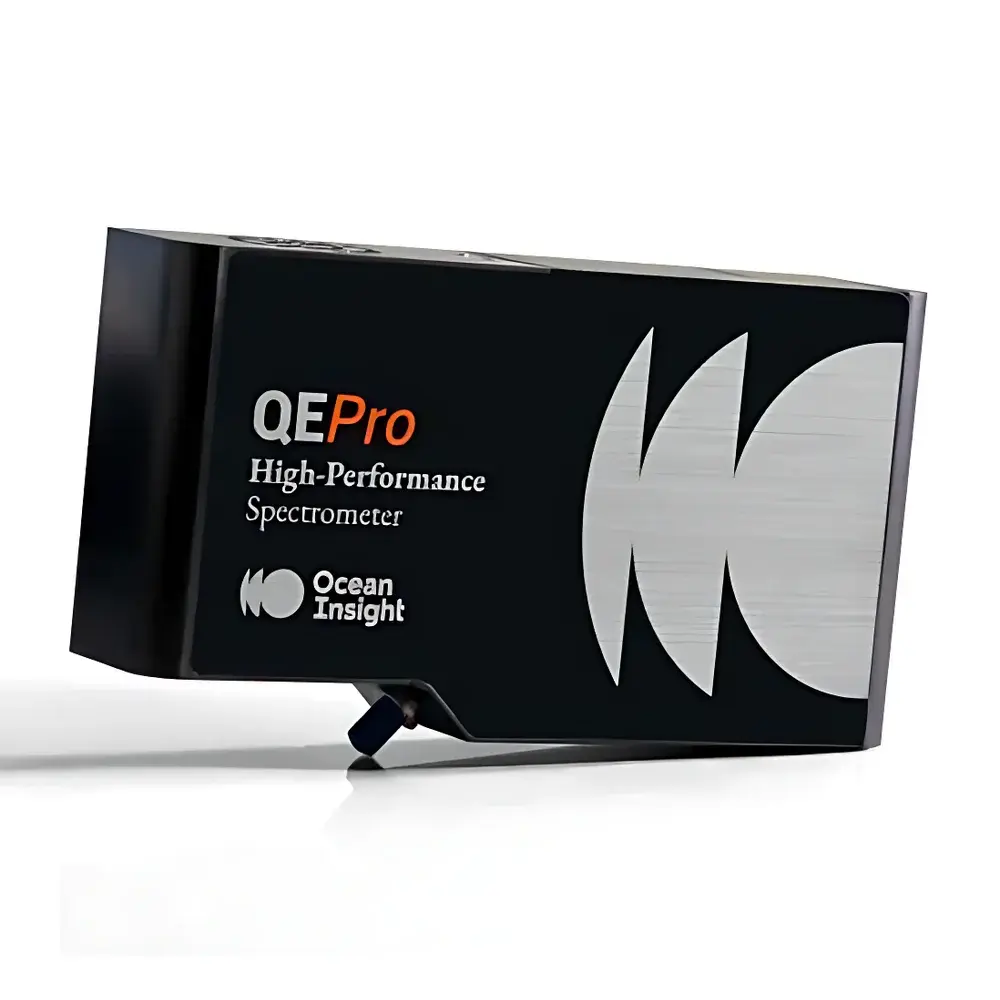
Ocean Optics QE Pro High-Performance, High-Sensitivity Fiber Optic Spectrometer
| Brand | Ocean Optics |
|---|---|
| Origin | USA |
| Detector Type | Back-Illuminated FFT-CCD |
| Spectral Range | UV-VIS-NIR (configurable from 200–1100 nm) |
| Resolution | 1.2–6.87 nm FWHM (model-dependent) |
| Bit Depth | 18-bit |
| Peak Quantum Efficiency | 90% |
| Signal-to-Noise Ratio | 1000:1 (single acquisition) |
| Dynamic Range | 85,000:1 (typical) |
| Stray Light | <0.08% at 600 nm |
| Integration Time | 8 ms – 3600 s |
| Dark Noise | 2.5 counts RMS |
| Linearity | ±0.5% nonlinearity |
| Operating Temperature | 0–50 °C |
| Dimensions | 182 × 110 × 47 mm³ |
| Weight | 1.15 kg |
Overview
The Ocean Optics QE Pro is a high-performance, thermoelectrically cooled fiber optic spectrometer engineered for demanding low-light applications requiring exceptional sensitivity, spectral fidelity, and thermal stability. Based on a back-illuminated, full-frame transfer (FFT) CCD detector, the QE Pro leverages deep-depletion silicon architecture to achieve peak quantum efficiency of 90% in the visible range and extended response into the ultraviolet (down to 200 nm) and near-infrared (up to 1100 nm). Its optical design minimizes stray light—<0.08% at 600 nm—enabling accurate quantification in fluorescence, Raman, and absorbance measurements where background suppression is critical. Unlike uncooled or Peltier-limited instruments, the QE Pro integrates two-stage thermoelectric cooling to stabilize detector temperature within ±0.1 °C, reducing dark current by over two orders of magnitude compared to ambient operation. This enables integration times up to one hour without significant thermal drift or spectral distortion—essential for trace-level detection in pharmaceutical QC, environmental monitoring, and forensic spectroscopy.
Key Features
- Thermoelectric Cooling System: Dual-stage TEC maintains detector temperature at –15 °C (typical), ensuring sub-2.5 RMS dark noise and enabling ultra-long integrations with minimal baseline drift.
- 18-Bit Onboard Digitization: Provides >262,000 intensity levels per pixel, preserving signal integrity across the full dynamic range without software binning or post-processing compression.
- Onboard Spectral Buffer: Stores up to 15,000 consecutive spectra in internal memory—critical for kinetic studies, process monitoring, and synchronization with external triggers (TTL, USB, or Ethernet).
- Modular Optical Configuration: Interchangeable slits (10–200 µm), gratings (UV-VIS, VIS-NIR, XR), and optional internal shutter support application-specific optimization without hardware replacement.
- Preconfigured Application Models: Factory-calibrated variants include Absorbance (200–950 nm), Fluorescence (350–1100 nm), UV-Vis (200–775 nm), Vis-NIR (350–925 nm), Extended Range (200–950 nm), and Raman-optimized versions (532/638/785 nm excitation).
Sample Compatibility & Compliance
The QE Pro interfaces seamlessly with standard SMA 905 fiber optics (core diameters 50–600 µm), integrating into cuvette holders, flow cells, probe-based immersion setups, and OEM optical benches. Its compact form factor (182 × 110 × 47 mm³) and low power consumption (<3 W) support portable field deployment, benchtop QA/QC labs, and embedded industrial systems. All QE Pro models comply with IEC 61326-1 (EMC for laboratory equipment), RoHS 2011/65/EU, and CE marking requirements. Spectral calibration files are traceable to NIST-traceable standards (e.g., HG/Ne, HgAr lamps), and factory calibrations meet ASTM E275 and ISO 17025 documentation protocols. For regulated environments, the Ocean Insight OceanView software supports 21 CFR Part 11-compliant audit trails, electronic signatures, and data integrity controls when deployed under validated SOPs.
Software & Data Management
Controlled via OceanView (Windows/macOS/Linux) or the modular OceanInsight SDK (Python, C++, MATLAB, LabVIEW), the QE Pro supports real-time spectral acquisition, multivariate analysis (PCA, PLS), and automated peak identification. OceanView includes built-in compliance features: configurable user roles, immutable raw-data archiving, timestamped metadata logging (including slit width, grating ID, integration time, and detector temperature), and export to CSV, HDF5, or vendor-neutral JCAMP-DX formats. The SDK enables integration into LIMS, SCADA, and MES platforms via TCP/IP or RESTful APIs. All firmware updates are digitally signed and validated during installation to ensure chain-of-custody integrity.
Applications
- Fluorescence Quantification: Detection of low-concentration biomarkers (e.g., NADH, tryptophan) in cell lysates and microplate assays, leveraging 90% QE and <0.4% stray light at 435 nm.
- Raman Spectroscopy: QE Pro-Raman variants deliver sharp, low-noise spectra for polymorph identification in APIs, illicit drug screening (e.g., fentanyl analogs), and explosive residue detection—validated per ASTM E2529 and USP .
- UV-Vis Absorbance: Compliant with pharmacopeial methods (USP , EP 2.2.25) for concentration determination, dissolution testing, and impurity profiling.
- In-Line Process Monitoring: Real-time tracking of reaction kinetics, catalyst degradation, or polymerization endpoints using fiber-coupled flow cells and buffered acquisition.
- Environmental Field Analysis: Portable measurement of chlorophyll-a, CDOM, and nitrate in water bodies using preconfigured Vis-NIR models and GPS-synchronized metadata tagging.
FAQ
What is the maximum integration time supported by the QE Pro?
The QE Pro supports integration times from 8 milliseconds to 3600 seconds (1 hour), enabled by active thermoelectric cooling and low dark-current detector architecture.
Can the QE Pro be used for Raman spectroscopy with 785 nm excitation?
Yes—the QE Pro-Raman+ model is specifically optimized for 785 nm excitation, featuring gold-coated optics, a thin-back-illuminated CCD, and calibrated wavenumber scales (0–3000 cm⁻¹) with 11 cm⁻¹ resolution.
Is spectral calibration traceable to NIST standards?
All factory calibrations are performed using NIST-traceable emission sources (e.g., mercury-argon lamp), and calibration certificates include uncertainty budgets per ISO/IEC 17025 requirements.
Does the QE Pro support GLP/GMP-compliant data handling?
When operated with OceanView v3.5+ and configured in Audit Trail mode, the system meets FDA 21 CFR Part 11 requirements for electronic records and signatures—including role-based access, immutable logs, and electronic signature workflows.
How is detector linearity verified across the dynamic range?
Linearity is characterized using neutral density filter stacks and verified to ±0.5% nonlinearity across 0–100% of full-scale intensity, documented in the Certificate of Conformance supplied with each unit.





