
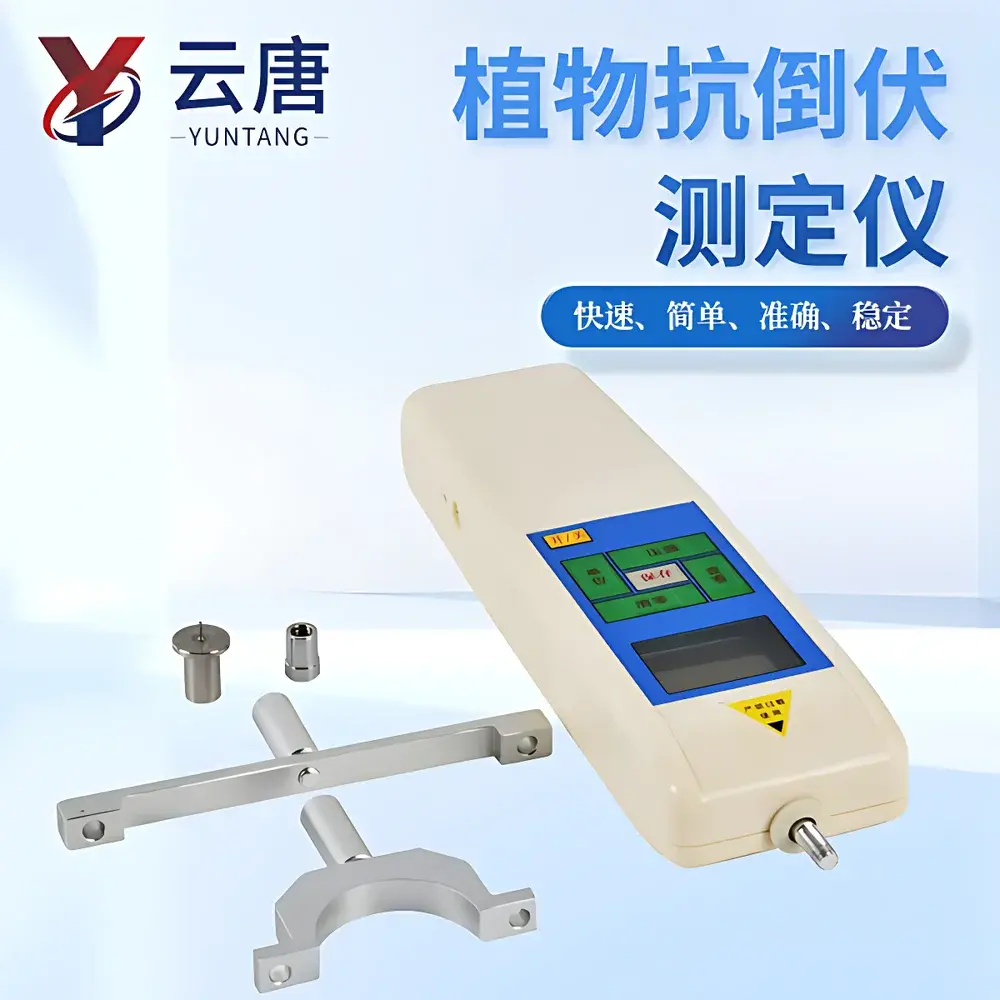
Yuntang YT-KD1/YT-ZG02 Crop Stem Strength Tester for Lodging Resistance Assessment in Maize, Wheat and Rice
| Brand | Yuntang |
|---|---|
| Origin | Shandong, China |
| Manufacturer Type | Direct Manufacturer |
| Region of Origin | Domestic (China) |
| Models | YT-KD1, YT-ZG02 |
| Price Range | USD 350 – 920 |
| Max Load | YT-KD1: 50 N |
| YT-ZG02 | 500 N |
| Resolution | YT-KD1: 0.01 N |
| YT-ZG02 | 0.1 N |
| Stem Diameter Measurement Range | 0–40 mm |
| Accuracy | ±0.5% FS |
| Units | N, kPa |
| Operating Temperature | −10 °C to +60 °C |
| Dimensions | 295 mm × 130 mm × 36 mm |
| Net Weight | ~600 g |
Overview
The Yuntang YT-KD1 and YT-ZG02 Crop Stem Strength Testers are portable mechanical force measurement instruments engineered for quantitative assessment of lodging resistance in cereal and tall-stemmed crops. Lodging—defined as the permanent displacement or bending of plant stems prior to harvest—is a major agronomic constraint affecting grain yield, harvest efficiency, and post-harvest quality. These instruments apply controlled three-point bending or lateral compression to intact, living stems in situ, measuring the maximum breaking force (in newtons) or corresponding stress (in kilopascals) required to induce structural failure. The underlying principle follows classical beam mechanics: stem flexural rigidity is derived from applied load, span length, and measured deflection, enabling correlation with anatomical traits such as rind thickness, vascular bundle density, and lignin content. Designed for field-deployable phenotyping, the testers support non-destructive or minimally invasive evaluation across key growth stages—from jointing to grain filling—providing objective biomechanical data essential for breeding programs, agronomic trials, and crop physiology research.
Key Features
- Two-tiered load capacity architecture: YT-KD1 (0–50 N) optimized for slender-stemmed cereals (wheat, rice, barley); YT-ZG02 (0–500 N) calibrated for thick-walled, high-biomass species (maize, sorghum, sugarcane, millet).
- High-resolution digital force transduction with ±0.5% full-scale accuracy—traceable to national metrological standards for agricultural instrumentation.
- Dual-unit display (N and kPa) with real-time conversion; kPa calculation incorporates user-input stem diameter (0–40 mm) to estimate cross-sectional stress.
- Integrated backlight LCD with auto-dimming (deactivates after 10 s of inactivity) and power-saving auto-shutdown (after 10 min idle time), extending battery life under field conditions.
- Ergonomic handheld form factor (295 × 130 × 36 mm; ~600 g) with reinforced aluminum alloy housing, IP54-rated ingress protection against dust and splashing water.
- No external power supply required—operates on standard AA alkaline batteries with >15 hours continuous use per set.
Sample Compatibility & Compliance
The testers accommodate live, upright stems without excision, preserving physiological integrity during measurement. Compatible with monocotyledonous species exhibiting cylindrical or slightly flattened culms, including but not limited to Triticum aestivum (bread wheat), Oryza sativa (rice), Zea mays (maize), Sorghum bicolor (sorghum), Saccharum officinarum (sugarcane), and Nicotiana tabacum (tobacco). Measurements adhere to standardized protocols aligned with ISO 21733:2020 (Plant phenotyping—Mechanical testing of stem lodging resistance) and FAO Technical Paper No. 589 (Field-based crop resilience assessment). Data outputs meet minimum requirements for GLP-compliant trial documentation, including timestamped force curves, peak load values, and operator ID logging when integrated with optional Yuntang AgriData Sync software.
Software & Data Management
While the core instrument operates as a standalone field meter, optional Bluetooth-enabled firmware (v2.3+) supports wireless data export to the Yuntang AgriPheno Desktop Suite (Windows/macOS). This platform enables batch calibration verification, statistical grouping by genotype/treatment/phenophase, and automated generation of lodging resistance indices (e.g., Flexural Stiffness Index, FSI = Load / (Diameter³)). All datasets include embedded metadata: GPS coordinates (via paired smartphone), ambient temperature, stem height above soil, and measurement date/time. Audit trails comply with ALCOA+ principles (Attributable, Legible, Contemporaneous, Original, Accurate, Complete, Consistent, Enduring, Available), satisfying baseline traceability needs for national variety registration trials and public-sector breeding programs.
Applications
- High-throughput phenotyping of lodging resistance QTLs in biparental mapping populations and association panels.
- Evaluation of plant growth regulator (PGR) efficacy—e.g., trinexapac-ethyl or paclobutrazol—on stem wall reinforcement.
- Comparative analysis of nitrogen management regimes on culm biomechanics and internode strength distribution.
- Validation of remote sensing-derived lodging risk scores using ground-truthed mechanical metrics.
- Supporting national seed certification protocols where stem strength thresholds define varietal suitability for high-wind or high-rainfall agroecologies.
- Integration into undergraduate and graduate agronomy curricula for hands-on biomechanics instruction.
FAQ
What distinguishes YT-KD1 from YT-ZG02 beyond load range?
YT-KD1 features a narrower jaw aperture and higher force resolution (0.01 N) to resolve subtle differences among wheat cultivars; YT-ZG02 employs a reinforced loading arm, extended travel path, and thermal-compensated strain gauge for stable high-load measurements under variable ambient temperatures.
Can the device measure stem strength at multiple heights along the same plant?
Yes—users may position the lower support anvil at defined internodes (e.g., basal, penultimate, flag leaf node) and record comparative stiffness profiles, enabling identification of weak-link zones critical to lodging initiation.
Is calibration certificate included with shipment?
Each unit ships with a factory calibration report (traceable to CNAS-accredited reference standards) and a 12-month recalibration recommendation interval. Field recalibration kits (NIST-traceable test weights) are available separately.
Does the instrument comply with FDA or EU regulatory frameworks?
As a non-invasive field phenotyping tool—not intended for food safety testing or residue analysis—it falls outside FDA 21 CFR Part 11 or EU Regulation (EC) No 396/2005 scope. However, its data integrity features align with OECD GLP Principles for regulatory crop trials.







