
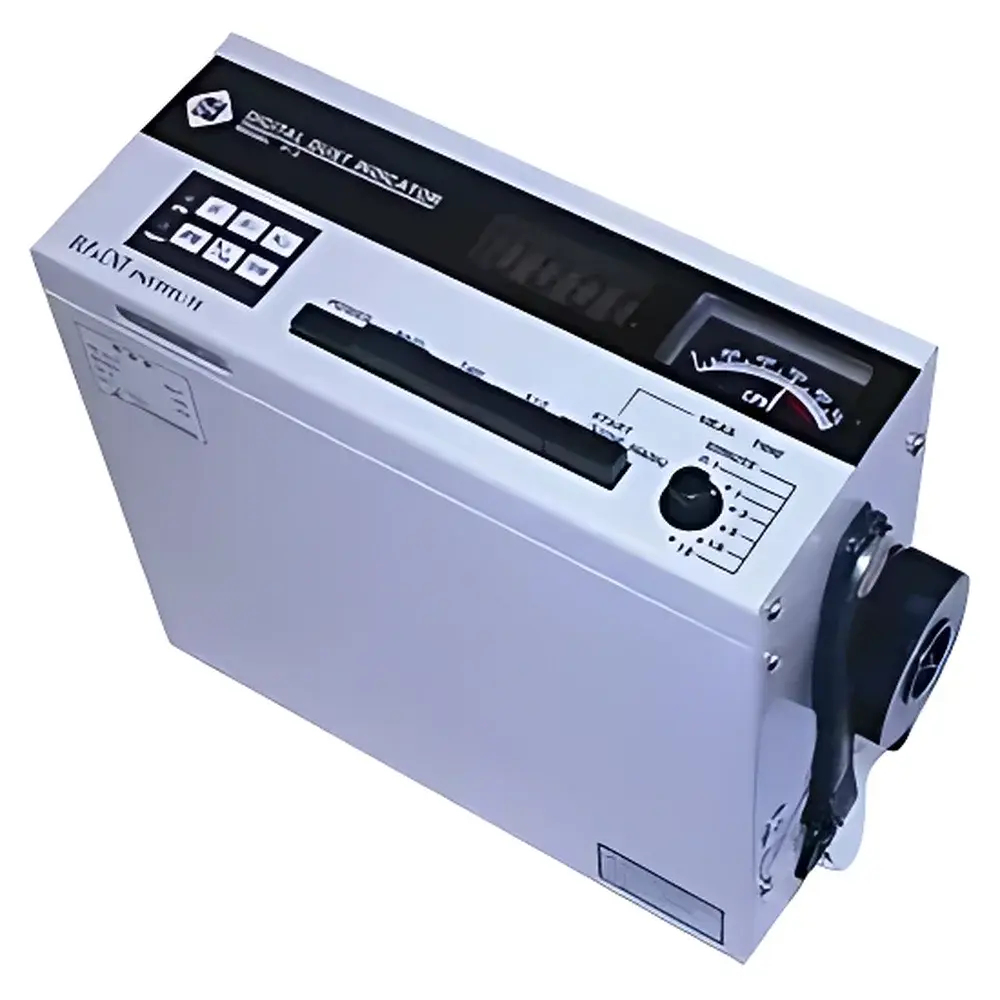
P-5L2C Portable Microcomputer Dust Monitor
| Origin | Beijing, China |
|---|---|
| Manufacturer Type | Distributor |
| Origin Category | Domestic (China) |
| Model | P-5L2C |
| Price | Upon Request |
| Detection Principle | Light Scattering (Nephelometry) |
| Sensitivity | 0.01 mg/m³ |
| Measurement Range | 0.01–100 mg/m³ |
| Sampling Duration Options | 0.1, 1, 3, 5, 10, 15 min + manual mode |
| Repeatability Error | ±2% |
| Accuracy | ±10% |
| Display | 4-digit LCD showing CPM and mass concentration (mg/m³) |
| Data Output | RS232 serial interface for PC connection or dedicated thermal printer |
| Data Storage | 99 measurement records |
| Environmental Operating Temperature | 0–40 °C |
| Power Supply | NiMH ×9 rechargeable battery (12 h continuous operation) |
| Dimensions | 202 × 85 × 168 mm |
| Weight | 2.4 kg |
Overview
The P-5L2C Portable Microcomputer Dust Monitor is a field-deployable, light-scattering (nephelometric) instrument engineered for rapid, on-site quantification of airborne particulate matter concentrations. Designed to meet stringent regulatory requirements for occupational and environmental monitoring, it delivers real-time mass concentration readings in mg/m³ for respirable dust (PM10) and total suspended particulates (TSP). Its optical detection system employs a calibrated scattering chamber with a stable light source and photodetector array, enabling direct correlation between scattered light intensity and particle mass concentration—based on Mie theory assumptions for spherical, non-absorbing particles in the 0.1–10 µm aerodynamic diameter range. The instrument was developed through localized enhancement of the Shimadzu P-5L2 platform, integrating an embedded microcontroller for improved signal processing, timing control, and data handling. It serves as a primary screening tool in industrial hygiene surveys, workplace exposure assessments, indoor air quality audits, and public health surveillance programs.
Key Features
- Real-time nephelometric detection with factory-calibrated optical path and temperature-compensated electronics
- Direct readout of both counts-per-minute (CPM) and mass concentration (mg/m³) on a high-contrast 4-digit LCD display
- Configurable sampling durations: 0.1, 1, 3, 5, 10, and 15 minutes, plus user-defined manual mode for flexible protocol alignment
- Onboard memory stores up to 99 complete measurement records—including timestamp, duration, CPM, and calculated mg/m³
- Integrated NiMH battery pack (9-cell) supports ≥12 hours of continuous operation; includes universal AC/DC charging adapter (220 VAC input, 12 VDC output)
- Compact, ruggedized housing (202 × 85 × 168 mm; 2.4 kg) optimized for belt-clip mounting and handheld use in confined or mobile environments
- RS232 serial interface enables bidirectional communication with Windows-based PCs using provided terminal software
Sample Compatibility & Compliance
The P-5L2C is validated for ambient and workplace air sampling of inhalable particulate fractions conforming to ISO 7708:1995 (inhalable dust convention) and PM10 definitions per EPA and WHO guidelines. It complies with multiple national standards governing occupational and public health monitoring: GB/T 17095–1997 (formerly Hygienic Standard for Inhalable Particulates in Public Places, approved by China’s Standardization Committee in 1999), LD 98–1996 (Light Scattering Method for Dust Concentration in Workplace Air), and TB/T 2323–1992 (Railway Dust Monitoring: Relative vs. Absolute Mass Concentration Conversion). While not certified for GLP or ISO/IEC 17025-accredited laboratories, its documented repeatability (±2%) and accuracy (±10%) support Tier 2 exposure assessment under OSHA and NIOSH guidance frameworks. No filter collection or gravimetric validation is required during routine use—though periodic verification against reference methods (e.g., cyclone + gravimetric analysis per ISO 7708 or EN 481) is recommended for audit readiness.
Software & Data Management
Data export is supported via ASCII-formatted RS232 transmission at 9600 baud. A dedicated Windows application (compatible with Windows 7–11, 32/64-bit) provides automated import, time-stamped record indexing, and statistical post-processing—including arithmetic mean, standard deviation, min/max values, and comparison against user-defined threshold limits (e.g., OELs or MAC values). All imported datasets retain original instrument metadata (model, serial, calibration date, operator ID if entered manually). The software generates CSV and PDF reports compliant with internal QA documentation requirements. Audit trail functionality is limited to file creation/modification timestamps; full 21 CFR Part 11 compliance requires integration with third-party LIMS platforms supporting electronic signatures and immutable log archiving.
Applications
- Routine monitoring of respirable dust (PM10) in mining, construction, foundry, and cement manufacturing facilities
- Workplace exposure assessment during abrasive blasting, grinding, sanding, and powder handling operations
- Indoor air quality evaluation in schools, hospitals, and office buildings following ASHRAE 62.1 ventilation guidelines
- Field verification of local exhaust ventilation (LEV) system performance and filter integrity
- Short-term exposure limit (STEL) and time-weighted average (TWA) estimation when used with standardized sampling protocols
- Public health response during dust storms, wildfire smoke events, or post-demolition site inspections
FAQ
What particle size fraction does the P-5L2C measure?
It responds primarily to particles within the inhalable convention (up to 100 µm aerodynamic diameter), with peak sensitivity aligned to PM10 (≤10 µm). Its inlet does not incorporate a size-selective cyclone; therefore, results represent total or respirable dust depending on optional external pre-separators.
Is factory calibration traceable to NIST or equivalent standards?
Calibration is performed using polydisperse aerosols generated from Arizona Test Dust and verified against reference gravimetric samplers. Traceability to national metrology institutes is not inherent but can be established through third-party calibration services accredited to ISO/IEC 17025.
Can the instrument be used in high-humidity environments?
Operation is specified for 0–40 °C and ≤85% RH (non-condensing). Prolonged exposure above 70% RH may cause optical window fogging or hygroscopic particle swelling, leading to overestimation; use with desiccant-cooled inlet accessories is advised in humid climates.
Does the device support external pump flow control?
No. The P-5L2C uses an integrated axial fan with fixed volumetric flow rate (~1.7 L/min). Flow rate stability is maintained via pressure-compensated motor control, eliminating need for external flow meters or regulators.
How often should the optical chamber be cleaned?
Visual inspection is recommended before each use. Cleaning with lens-grade tissue and isopropyl alcohol is advised after every 20 hours of cumulative operation or immediately following exposure to oil mists, sticky aerosols, or high-concentration dust events.
Related Products







