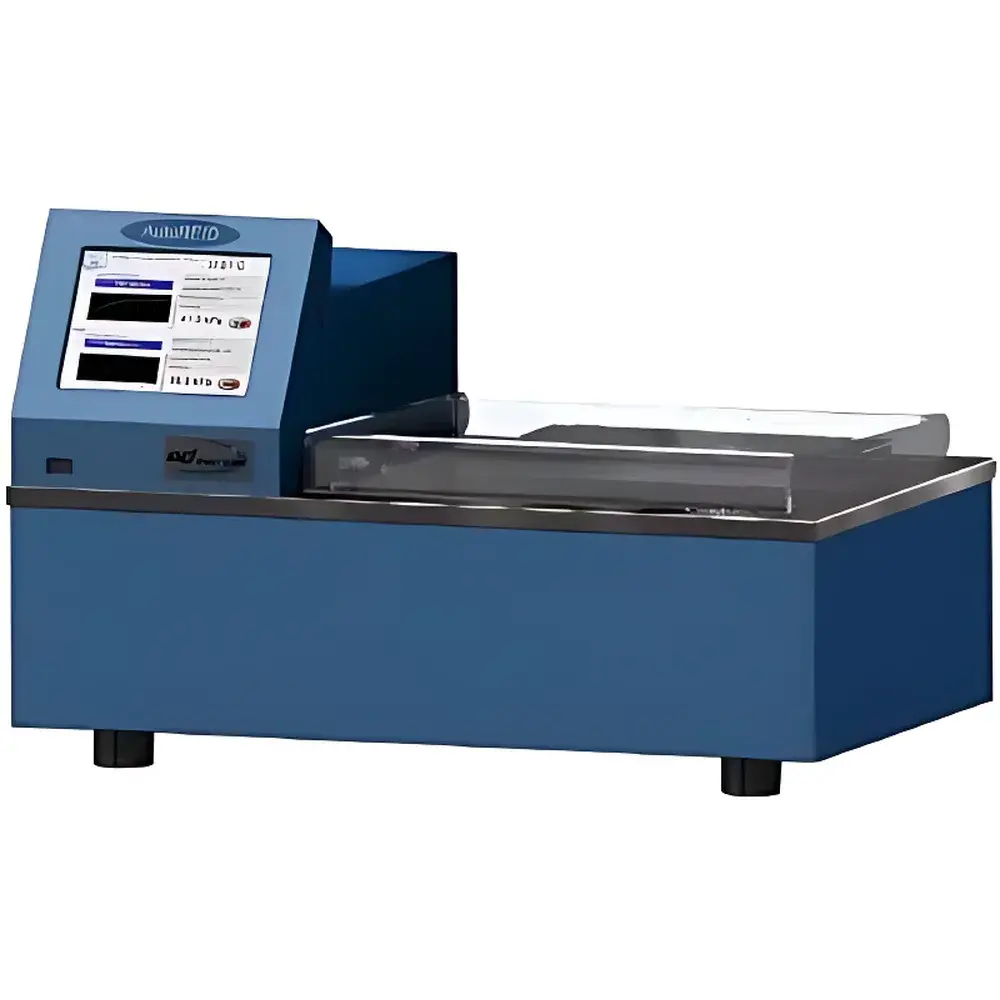
AutoREID- Advanced Automated Reid Vapor Pressure (RVP) Tester by AD Systems
| Brand | AD Systems |
|---|---|
| Origin | France |
| Manufacturer Type | Authorized Distributor |
| Origin Category | Imported Instrument |
| Model | AutoREID- |
| Price | Upon Request |
| Standard Compliance | ASTM D323-B, ASTM D4953, ISO 3007, GB/T 8017-87 |
| Pressure Range | 0–250 kPa |
| Resolution | 0.1 kPa |
| Test Duration | <15 min per sample |
| Display | 8-inch color touchscreen |
| Languages | English, French, Russian |
| Data Storage | Internal database, USB 2.0 (2×), Ethernet (LAN) |
| Dimensions (W×D×H) | 720 × 440 × 460 mm |
| Weight | 30 kg |
| Power Supply | 230 V, 8 A, 50 Hz |
Overview
The AutoREID- Advanced Automated Reid Vapor Pressure (RVP) Tester is a fully integrated, dual-station analytical instrument engineered for precise, repeatable determination of Reid Vapor Pressure in accordance with ASTM D323-B, ASTM D4953, ISO 3007, and GB/T 8017-87. RVP is defined as the absolute vapor pressure exerted by volatile petroleum products—such as gasoline, crude oil, naphthas, and light distillates—at 37.8 °C (100 °F) under specified equilibrium conditions between liquid and vapor phases in a sealed, calibrated test chamber. The AutoREID- implements the classical Reid method without empirical correction factors, delivering direct RVP measurement through real-time digital pressure transduction and thermally stabilized vapor-phase equilibration. Its design eliminates manual agitation, subjective endpoint judgment, and operator-dependent sealing procedures—replacing legacy hand-shaken methods with programmable mechanical inversion, pressure curve monitoring, and automated endpoint detection based on pressure stability criteria (e.g., ΔP ≤ 0.1 kPa over 60 s). This ensures high reproducibility across laboratories, particularly critical for custody transfer, refinery blending control, and regulatory compliance reporting.
Key Features
- Dual independent test stations enabling concurrent analysis of two samples—reducing throughput time and improving lab efficiency without cross-contamination risk.
- Patented rapid-connect vapor chamber system with O-ring-sealed, quick-coupling interfaces for air and liquid chambers—minimizing setup time and ensuring leak-tight integrity prior to immersion.
- Automated mechanical inversion mechanism that subjects the assembled chamber to controlled, high-frequency oscillation—accelerating vapor–liquid equilibrium, especially for viscous or particulate-laden crudes where conventional shaking proves insufficient.
- Integrated real-time pressure–time curve visualization on an 8-inch color touchscreen interface—allowing immediate assessment of equilibration kinetics and identification of anomalous behavior (e.g., slow rise, drift, or leakage).
- Comprehensive safety and quality supervision: continuous monitoring of bath temperature stability (±0.1 °C), fluid level, pressure sensor integrity, and overpressure/overtemperature thresholds—triggering automatic test suspension if deviations exceed IEC 61000-4-30 Class B limits.
- Full traceability architecture: all calibration events—including reference gauge verification via T-connector, bath temperature validation using certified NIST-traceable thermometers, and sensor zero/span checks—are timestamped, user-annotated, and archived in an immutable log compliant with ALCOA+ principles.
Sample Compatibility & Compliance
The AutoREID- is validated for use with a broad spectrum of hydrocarbon-based liquids, including but not limited to: reformulated gasoline blends, unfinished oils, condensates, synthetic crudes, and biofuel mixtures (e.g., ethanol-gasoline E10/E15). Its robust chamber design accommodates samples containing suspended mechanical impurities or elevated viscosity (up to 500 cSt at 20 °C), eliminating pre-filtration requirements that may alter volatile composition. All wetted parts are constructed from ASTM F519-compliant 316 stainless steel and fluoropolymer-sealed components resistant to H2S, mercaptans, and organic acids. Regulatory alignment extends beyond method standards: the system supports 21 CFR Part 11-compliant electronic records and signatures when deployed with optional audit trail extension; raw data files adhere to ASTM E2500-17 structural metadata conventions for GxP environments. Routine operation meets GLP and refinery QA/QC requirements for Method Validation (per ASTM E2655) and Equipment Qualification (IQ/OQ/PQ).
Software & Data Management
The embedded firmware provides multilingual (English/French/Russian) operation with intuitive workflow navigation and context-sensitive help. Each test generates a structured data packet comprising: sample ID, operator ID, acquisition timestamp, ambient barometric pressure (if externally linked), full pressure–time series (1 Hz sampling), final RVP value, statistical confidence interval (based on duplicate runs), and chamber temperature profile. Data persist in a relational SQLite database with ACID compliance and optional encryption-at-rest. Export options include CSV, PDF reports (with customizable templates), and direct transmission to LIMS or ELN systems via standard TCP/IP protocols (HTTP POST or MODBUS TCP). Search functionality supports multi-parameter queries—e.g., “all RVP results > 95 kPa for Sample Type ‘Crude A’ between 2024-01-01 and 2024-06-30”—with export to Excel-compatible formats. Calibration history, maintenance logs, and system event traces are retained separately and accessible only to authorized users with role-based permissions.
Applications
- Refinery process control: real-time RVP feedback for stabilizer column optimization and blendstock specification adherence.
- Custody transfer verification: field-deployable RVP confirmation prior to pipeline injection or marine loading, reducing disputes and retesting costs.
- Fuel formulation R&D: screening volatility impact of oxygenates, alkylates, or renewable components under standardized conditions.
- Regulatory submissions: generation of auditable RVP data packages for EPA Tier 3, EU Fuel Quality Directive (2009/30/EC), and national petroleum product specifications.
- Third-party testing laboratories: ISO/IEC 17025-compliant service delivery with built-in uncertainty estimation per GUM (JCGM 100:2008).
FAQ
Does the AutoREID- require daily calibration verification?
No—routine calibration is performed per defined intervals (e.g., weekly or per 20 tests), but the system supports on-demand verification using a certified reference pressure gauge via its dedicated T-connector port.
Can the instrument measure RVP for samples containing water or sediment?
Yes—the dual-chamber design and mechanical inversion tolerate up to 0.5% v/v free water and non-abrasive particulates; however, emulsified water may affect accuracy and should be removed per ASTM D4057 guidance.
Is remote diagnostics supported?
Yes—via secure SSH-enabled Ethernet connection, authorized service engineers can access system logs, firmware version, and sensor health metrics without physical presence.
How is temperature uniformity maintained across both test stations?
The thermostatic bath employs dual PID-controlled heating elements with redundant Pt100 sensors and forced-circulation flow—validated to ±0.05 °C spatial uniformity across the immersion zone per ASTM E1137.
What happens if a pressure leak is detected during testing?
The software immediately halts agitation, displays a fault code, logs the exact time and pressure decay rate, and prevents result export until the chamber seal is verified and retested.