
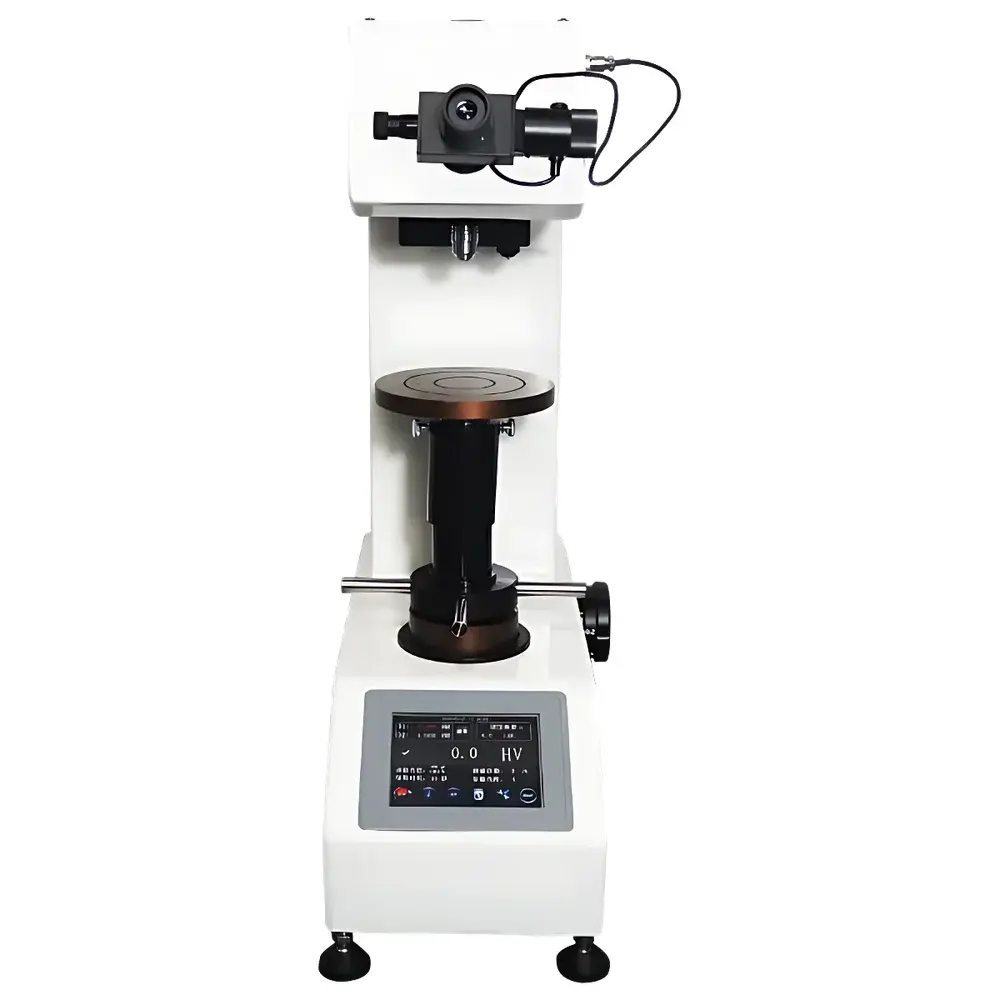
YANRUN HVI-5/10/20/30/40/50/100MZ Sensor-Feedback Digital Vickers Hardness Tester
| Brand | YANRUN |
|---|---|
| Origin | Shanghai, China |
| Manufacturer Type | Manufacturer |
| Model | HVI-5/10/20/30/40/50/100MZ |
| Hardness Tester Type | Vickers Hardness Tester |
| Measurement Range | 8–3000 HV |
| Test Force Options | 0.2–100 kgf (12–16 selectable steps per load range) |
| Loading Method | Motor-driven, fully automatic (load-hold-unload) |
| Turret | Automatic |
| Standards Compliance | GB/T 4340, ISO 6507 |
| Eyepiece Magnification | 10× digital eyepiece |
| Objective Lenses | 10× (observation & measurement), 20× (measurement only for ≤10 kgf models) |
| Total Magnification | 100× (observation), 200× (measurement for ≤10 kgf) |
| Minimum Detectable Indentation Step | 0.12 µm (10×), 0.06 µm (20×) |
| Dwell Time | 0–60 s (1 s increments) |
| Max Specimen Height | 235 mm |
| Distance from Indenter to Chamber Wall | 130 mm |
| Power Supply | AC 220 V / 50 Hz |
| Dimensions (L×W×H) | 570 × 220 × 680 mm |
| Net Weight | 46.0 kg |
Overview
The YANRUN HVI-5/10/20/30/40/50/100MZ is a fully automated, sensor-feedback digital Vickers hardness tester engineered for precision metallurgical and materials quality control laboratories. It operates on the fundamental principle of Vickers micro- and macro-hardness testing: applying a precisely controlled diamond pyramid indenter (136° apex angle) under defined test forces onto a polished specimen surface, followed by optical measurement of the resulting diagonal impressions. The instrument implements closed-loop force control via high-resolution load sensors—eliminating mechanical lever-arm dependencies and eliminating manual weight calibration or setup drift. This architecture ensures traceable, repeatable indentation forces across its full 0.2–100 kgf range, supporting both microhardness (e.g., case depth profiling) and macrohardness (e.g., bulk alloy verification) applications in accordance with ISO 6507-1 and GB/T 4340.1.
Key Features
- Fully motorized loading system with real-time sensor feedback for ±0.5% force accuracy across all 12–16 programmable test force steps per model variant (5, 10, 20, 30, 40, 50, and 100 kgf configurations)
- Automatic turret with dual objective lens positioning (10× for observation, 20× for high-resolution measurement on ≤10 kgf models; 10× only for ≥20 kgf models)
- Digital 10× eyepiece with integrated encoder-based indentation measurement—no manual micrometer scale reading required
- Minimum measurable indentation step resolution: 0.06 µm (with 20× objective), enabling reliable quantification of shallow case depths and thin coatings
- Programmable dwell time from 1 to 60 seconds in 1-second increments, compliant with ASTM E384 and ISO 6507-1 hold-time requirements
- Integrated data handling: automatic storage of individual indent measurements, with on-device calculation of mean, max, min, and range values per test sequence
- Touchscreen HMI interface with intuitive workflow navigation—no external PC required for routine operation
- Robust mechanical design featuring trapezoidal lead screw Z-axis lift mechanism and rigid C-frame construction (net weight: 46.0 kg)
Sample Compatibility & Compliance
The HVI-5/10/20/30/40/50/100MZ accommodates specimens up to 235 mm in height and 130 mm from indenter center to internal chamber wall—suitable for standard metallographic mounts, heat-treated components, weld cross-sections, and coated substrates. Its modular force architecture allows users to select optimal test loads for diverse material classes: low-load (0.2–1 kgf) for thin films and brittle ceramics; medium-load (1–20 kgf) for steels, aluminum alloys, and titanium; and high-load (30–100 kgf) for cast irons, tool steels, and large-section forgings. The system is certified to meet GB/T 4340 and ISO 6507-1 for method validation, and supports audit-ready documentation when paired with optional GLP-compliant reporting software (exportable CSV/Excel). While not FDA 21 CFR Part 11–certified out-of-the-box, its deterministic test sequencing and immutable local data logging provide foundational traceability for GMP-aligned environments.
Software & Data Management
The embedded touchscreen OS manages all operational parameters—including force selection, dwell time, number of indents per sample, and XY stage positioning (if equipped with optional motorized stage). All hardness values (HV), raw diagonal measurements (µm), test date/time stamps, and operator IDs are stored locally in non-volatile memory. Data export is supported via USB port to standard spreadsheet formats, enabling integration into LIMS or QA databases. Optional PC-based analysis software (sold separately) adds statistical process control (SPC) charts, depth-profile plotting, and multi-sample comparative reports—fully compatible with ISO/IEC 17025 laboratory accreditation requirements for uncertainty estimation and measurement traceability.
Applications
- Heat treatment verification: carburized, nitrided, and induction-hardened case depth analysis
- Quality assurance of aerospace alloys (e.g., Ti-6Al-4V, Inconel 718) and nuclear-grade stainless steels
- Thin-film and PVD/CVD coating hardness evaluation (using ≤1 kgf loads)
- Failure analysis labs: correlating hardness gradients with microstructural features observed via SEM/EDS
- Research & development of new metallic composites and additive-manufactured parts
- Supplier qualification testing per automotive OEM specifications (e.g., VW 39D, GMW14872)
FAQ
Is this instrument suitable for ISO 17025-accredited laboratories?
Yes—when operated within its validated force and magnification ranges and paired with documented calibration certificates for the indenter and optical system, it meets the metrological requirements of ISO/IEC 17025 for hardness testing.
Can the system be integrated with a motorized XY stage?
Yes—optional motorized stage modules are available with programmable coordinate mapping for automated grid-based hardness mapping.
What calibration standards are recommended?
Certified Vickers hardness reference blocks traceable to NIST or PTB, covering the full 8–3000 HV range, must be used for daily verification per ISO 6507-2.
Does the instrument support Rockwell or Brinell testing?
No—it is dedicated exclusively to Vickers hardness measurement. Separate Rockwell or Brinell testers are required for those scales.
How is force accuracy verified during routine maintenance?
Via periodic verification using calibrated load cells and certified reference blocks—not through internal self-calibration, as the sensor feedback loop requires external metrological validation at defined intervals.



