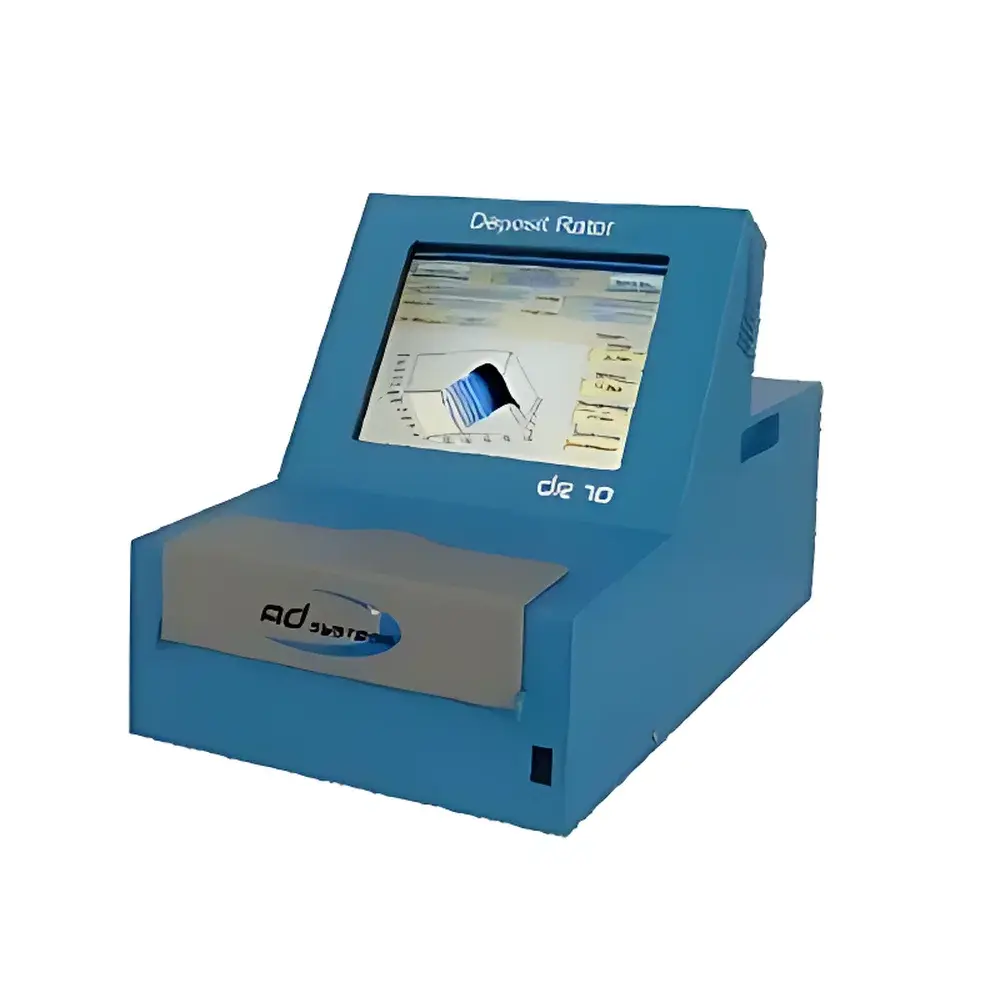
AD SYSTEMS DR10 Fully Automated Jet Fuel Thermal Oxidation Deposits Analyzer
| Brand | AD SYSTEMS |
|---|---|
| Origin | France |
| Model | DR10 |
| Measurement Principle | Optical Interferometry |
| Thickness Range | 0–1200 nm |
| Volume Range | 0–0.5 mm³ |
| Measurement Points per Tube | 1200 |
| Scan Time | ≤15 min |
| Data Storage Capacity | Up to 100,000 records (internal database) |
| Interface | Ethernet (RJ45), USB 2.0 (for printer/data export), LAN/LIMS compatible |
| Dimensions (W×D×H) | 250 × 160 × 290 mm |
| Weight | 10 kg |
| Power Supply | 115–230 V AC, 2 A, 50/60 Hz |
Overview
The AD SYSTEMS DR10 Fully Automated Jet Fuel Thermal Oxidation Deposits Analyzer is an engineered solution for objective, quantitative assessment of thermal oxidation deposits formed on aluminum heater tubes during ASTM D3241-compliant jet fuel stability testing. Unlike conventional visual rating methods—where operator-dependent color interpretation against standard chromatic charts introduces significant inter-observer variability—the DR10 applies white-light optical interferometry to directly measure nanoscale deposit thickness with traceable metrological rigor. The instrument illuminates the tube surface with a collimated broadband beam; reflected light undergoes spectral interference due to the air–deposit–aluminum phase boundary, generating wavelength-dependent fringe patterns captured by a high-resolution spectrometer. Proprietary algorithms reconstruct thickness profiles across the entire 50-mm test length with sub-nanometer resolution, enabling unambiguous correlation between physical deposit morphology and fuel thermal stability performance.
Key Features
- Quantitative, non-contact thickness measurement via optical interferometry—eliminating subjectivity inherent in ASTM D3241 visual grading.
- Full circumferential scan of 1200 discrete points over a 50-mm tube segment in ≤15 minutes.
- Compliance-ready reporting: outputs Standard Spot Thickness (ASTM D3241-defined average of six thickest points within a 2.5 mm² area), Maximum Thickness, Average Thickness, and Deposit Volume (integrated over scanned length).
- Real-time 3D topographic visualization: regions exceeding 85 nm thickness are highlighted in red for rapid pass/fail assessment per industry thresholds.
- Embedded database supporting up to 100,000 test records with timestamped metadata, operator ID, and sample batch information.
- Modular connectivity: native Ethernet (RJ45) for LIMS integration, dual USB 2.0 ports for external storage or optional thermal printer, and full support for FDA 21 CFR Part 11–compliant audit trails when deployed in regulated environments.
Sample Compatibility & Compliance
The DR10 is validated for use with ASTM D3241–prepared aluminum heater tubes (Type 1100 or 6061 alloy, 6.35 mm OD × 0.76 mm wall thickness) exposed to jet fuels including Jet A, Jet A-1, JP-5, and JP-8 under standardized thermal stress conditions (260 °C, 2.5 h, 1.0 mL/min flow rate). It satisfies metrological requirements referenced in ASTM D3241, IP 323, ISO 6249, and GB/T 9169 for deposit quantification. Its traceable interferometric calibration eliminates reliance on reference color standards, thereby aligning with GLP/GMP principles that prioritize objective, instrument-based measurement over human-perceived attributes. The system supports routine verification using NIST-traceable step-height reference standards.
Software & Data Management
The DR10 runs on a real-time embedded OS with dedicated analytical software providing guided workflow execution—from sample registration and tube positioning confirmation to automated scan initiation and result validation. All raw spectral data and processed thickness maps are stored in vendor-neutral formats (CSV, TIFF, XML) compliant with laboratory informatics systems. Audit trail functionality logs user actions, parameter changes, and calibration events with immutable timestamps. Data export options include direct USB transfer to portable media, network transmission via TCP/IP to central servers, and scheduled synchronization with enterprise LIMS platforms. Software updates are delivered via secure HTTPS and require cryptographic signature verification.
Applications
The DR10 serves critical roles across the aviation fuel lifecycle: refinery QC laboratories performing batch release testing per ASTM D1655; pipeline terminal operators verifying fuel integrity after extended storage or transit; military logistics units enforcing DEF STAN 91-91 specifications; and research institutions investigating antioxidant efficacy or deposit inhibition mechanisms. Its compact footprint (250 × 160 × 290 mm) and 10 kg mass enable deployment in mobile labs, field service vehicles, and space-constrained facilities without compromising analytical fidelity. The instrument’s repeatability (CV < 2.5% at 100 nm thickness) ensures consistent ranking of fuel formulations during development and qualification studies.
FAQ
Does the DR10 replace ASTM D3241 testing, or only the visual rating step?
The DR10 does not replace the thermal exposure procedure defined in ASTM D3241—it replaces only the subjective visual assessment of the heated tube. Users must still perform the full 2.5-hour heating cycle per ASTM D3241 before inserting the tube into the DR10.
Can the DR10 measure deposits on substrates other than aluminum heater tubes?
The system is calibrated and validated exclusively for ASTM D3241–compliant aluminum tubes. Use on alternative materials (e.g., stainless steel, copper) is not supported due to refractive index and surface finish dependencies in the interferometric model.
Is the 85 nm threshold for red-highlighting configurable?
Yes—the visualization threshold is user-definable in the software interface and may be adjusted to match internal quality specifications or regulatory limits beyond the commonly adopted 85 nm benchmark.
How is instrument calibration verified between tests?
Daily verification uses a certified step-height reference standard traceable to NIST SRM 2161. Full recalibration is performed annually by AD SYSTEMS-certified engineers using interferometric alignment fixtures and spectral reference lamps.
Does the DR10 meet FDA 21 CFR Part 11 requirements for electronic records?
When operated with enabled audit trail and electronic signature modules (configured during installation), the DR10 satisfies Part 11 criteria for record retention, authenticity, and tamper-resistance in pharmaceutical-adjacent fuel testing applications.