
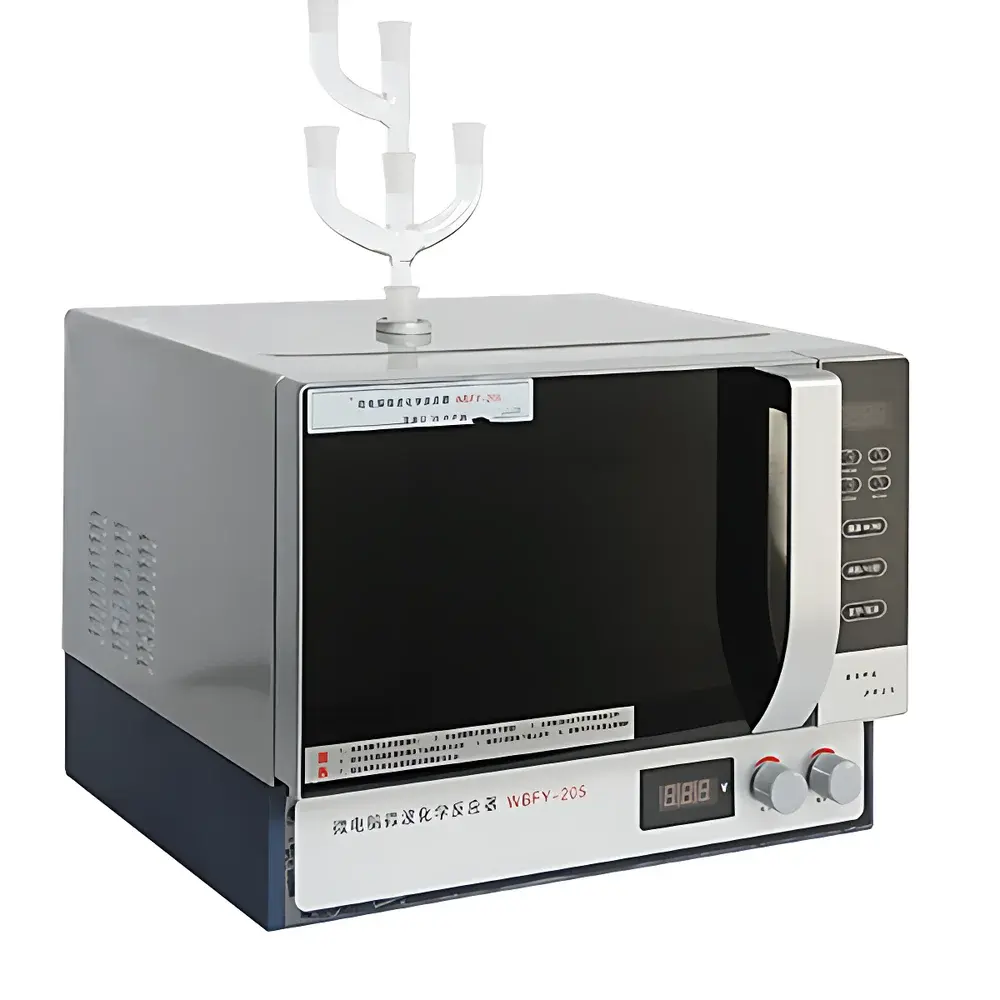
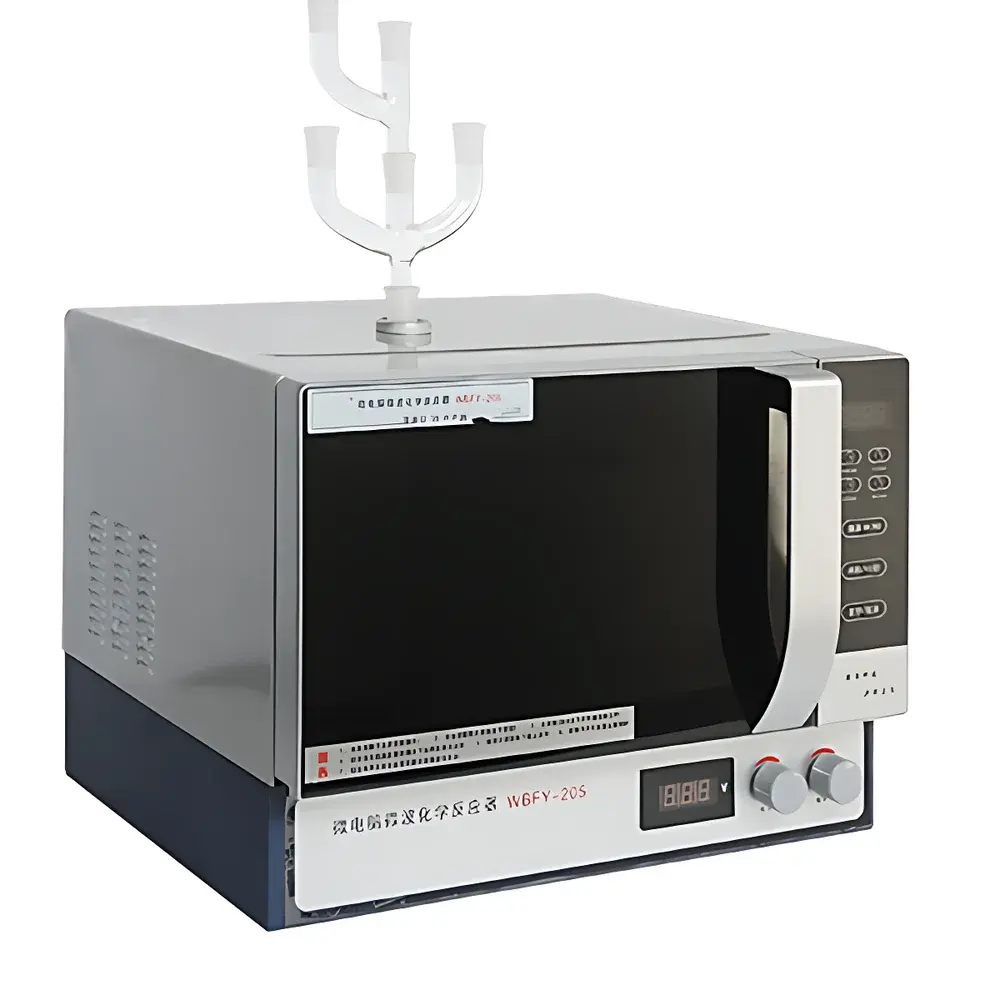
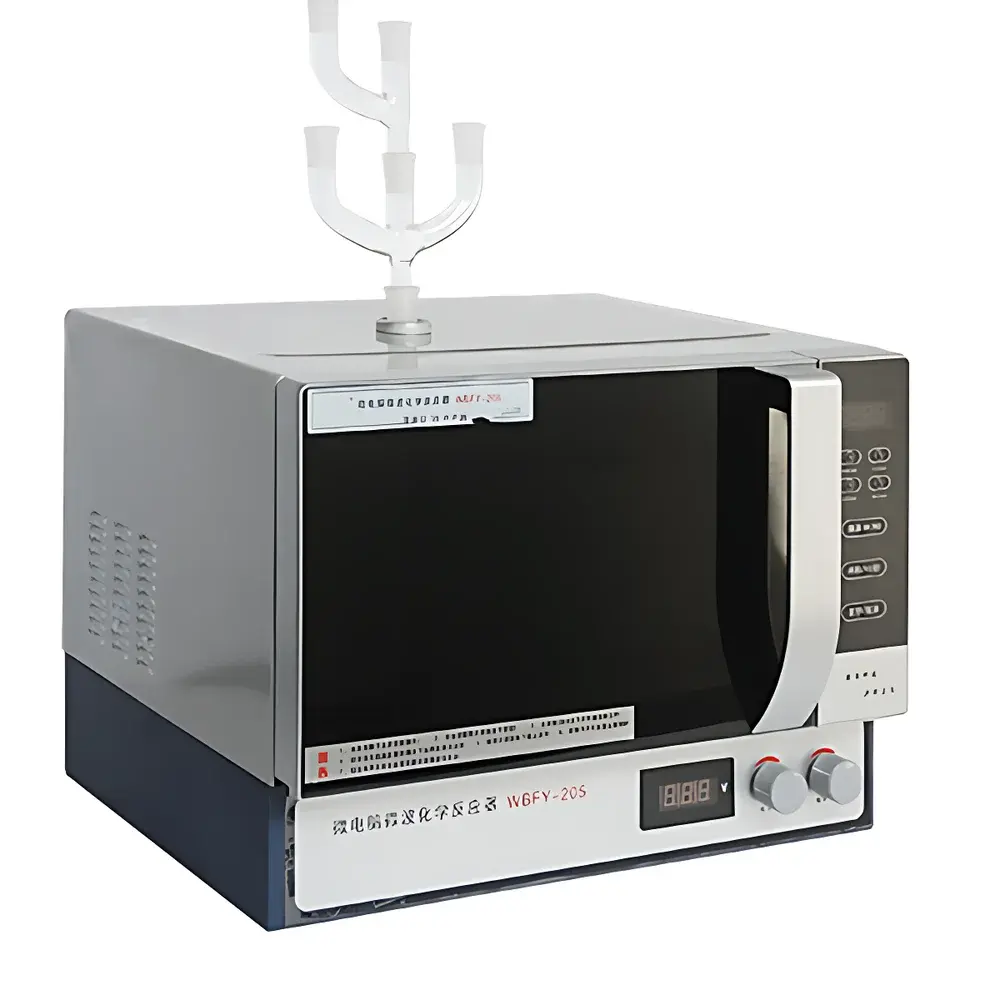
Gongyi Yuyi MCR-3 Microwave Chemical Reactor
| Brand | Gongyi Yuyi Instrument |
|---|---|
| Origin | Henan, China |
| Model | MCR-3 |
| Microwave Frequency | 2450 MHz ±15 Hz |
| Microwave Output | Continuous wave, adjustable up to 800 W |
| Total Input Power | ≤1300 W |
| Temperature Control Range | Ambient to 250 °C |
| Temperature Control Accuracy | ±1 °C |
| Temperature Measurement Method | Contact-type PTFE-coated platinum resistance sensor (Class 0.2 accuracy) |
| Maximum Operating Pressure | Medium-pressure compatible (with optional vacuum accessory: –0.098 MPa) |
| Reaction Vessel Compatibility | 50–500 mL standard ground-glass joints (open-system configuration) |
| Construction Material | Stainless steel cavity and housing |
| Integrated Features | Built-in magnetic stirrer (stepless speed control), inert gas inlet port, ventilation/exhaust ducting, safety interlock door switch, magnetron overheat protection, multi-segment programmable operation (up to 5 segments), real-time temperature curve display, Flash memory parameter retention |
Overview
The Gongyi Yuyi MCR-3 Microwave Chemical Reactor is an engineered platform for controlled, energy-efficient synthesis under microwave irradiation. It operates on the principle of dielectric heating: when polar molecules—such as solvents or reagents—interact with a 2450 MHz electromagnetic field, they undergo rapid dipole rotation and intermolecular friction, resulting in volumetric, non-contact thermal energy deposition. Unlike conventional conductive heating, microwave energy penetrates the reaction mixture uniformly, enabling simultaneous internal and external heating with reduced thermal gradients and improved kinetic control. Designed for laboratory-scale synthetic chemistry, the MCR-3 supports reproducible method development in catalysis, heterocyclic synthesis, nanoparticle preparation, and green chemistry protocols where precise thermal management and rapid heating/cooling profiles are critical.
Key Features
- Continuous-wave microwave output (≤800 W): Eliminates transient electromagnetic spikes associated with pulsed operation, ensuring stable energy delivery and minimizing molecular degradation or side reactions.
- Adaptive PID temperature regulation: Microprocessor-based self-tuning algorithm dynamically adjusts proportional-integral-derivative parameters in response to changes in sample volume, polarity, heat capacity, or ambient conditions—maintaining ±1 °C control accuracy across diverse reaction matrices.
- PTFE-coated platinum resistance temperature sensor: Direct immersion probe with electromagnetic shielding ensures accurate, drift-free internal temperature measurement (0.2-class precision) and chemical resistance to acids, bases, and organic solvents.
- Five-segment programmable operation: Independent configuration of power, target temperature, and duration per segment enables complex thermal protocols—including ramp-hold-cool sequences—without manual intervention.
- Real-time graphical temperature monitoring: 120 × 80 mm LCD (240 × 128 pixels) displays live temperature curves, current operating parameters, microwave status, and elapsed time across all active segments.
- Integrated magnetic stirring: Stepless speed control synchronizes mixing efficiency with thermal homogeneity, especially critical for heterogeneous or viscous reaction systems.
- Open-system modular design: Accommodates standard taper-joint glassware (100–1000 mL), condensers, reflux adapters, dropping funnels, and Dean-Stark traps via customizable ports and sealing interfaces.
- Safety-critical engineering: Interlocked door switch immediately terminates microwave emission upon opening; magnetron overheat cutoff prevents thermal runaway; robust stainless steel cavity meets IEC 61000-4 EMC immunity standards.
Sample Compatibility & Compliance
The MCR-3 supports a wide range of chemically aggressive media due to its PTFE-sheathed sensor, fluorosilicone O-rings (Φ8 × 1.9 mm), and corrosion-resistant stainless steel chamber. It is routinely employed in ASTM E2877-compliant solvent-free esterifications, USP auxiliary synthesis workflows, and ISO 17025-accredited method validation studies requiring traceable thermal profiles. While not certified for GMP production environments, its Flash-memory parameter retention, audit-ready temperature logging (via optional RS232/USB export), and deterministic control logic support GLP-aligned documentation practices. Vacuum compatibility (–0.098 MPa with accessory kit) extends utility to low-boiling-point solvent removal or moisture-sensitive transformations.
Software & Data Management
The reactor operates autonomously via embedded firmware—no external PC required. All user-defined parameters (segment settings, calibration offsets, default power levels) are stored in non-volatile Flash memory, surviving power loss or shutdown. Real-time temperature data is displayed graphically and numerically; historical curves can be reviewed via front-panel navigation. Optional data logging modules (sold separately) enable timestamped CSV export compliant with FDA 21 CFR Part 11 requirements—including electronic signatures, audit trails, and user-access controls—when integrated into validated laboratory information management systems (LIMS).
Applications
- Accelerated organic synthesis: Suzuki, Heck, and Buchwald–Hartwig couplings under controlled microwave conditions
- Nanomaterial synthesis: Rapid nucleation and growth of metal oxides, quantum dots, and MOFs
- Pharmaceutical intermediate preparation: Solvent-free cyclizations and deprotections with minimized decomposition
- Environmental sample digestion: Microwave-assisted extraction (MAE) of PAHs, PCBs, and heavy metals from soil/sediment matrices
- Food chemistry: Enzyme inactivation studies, lipid oxidation kinetics, and Maillard reaction modeling
- Polymer chemistry: Ring-opening polymerizations and crosslinking reactions requiring precise thermal ramping
FAQ
Is the MCR-3 suitable for pressure-controlled reactions?
The base unit is configured for open-vessel or medium-pressure operation. For sealed high-pressure synthesis, users must integrate third-party rated autoclave vessels and pressure-monitoring accessories—not supplied with the standard configuration.
Can temperature calibration be verified or adjusted onsite?
Yes. The system includes a digital temperature offset correction function, allowing users to apply a user-defined bias (±10.0 °C in 0.1 °C increments) based on independent NIST-traceable reference measurements.
What safety certifications does the MCR-3 hold?
It complies with GB 4706.21 (Chinese national standard for microwave ovens) and meets IEC 61000-4-3 radiated immunity requirements. CE marking is not applicable as it is classified as laboratory research equipment, not consumer-grade appliance.
Is remote monitoring or control supported?
Native remote operation is not available. However, RS232 serial interface enables integration with custom LabVIEW or Python-based control scripts for automated batch sequencing and data aggregation.
How is cooling managed during extended operation?
Forced-air convection via dual rear-mounted fans maintains magnetron and power supply temperatures within safe operational limits. Ambient air intake is filtered to reduce particulate ingress; exhaust ducting (Φ50 mm) is provided for fume evacuation in ventilated hoods.



