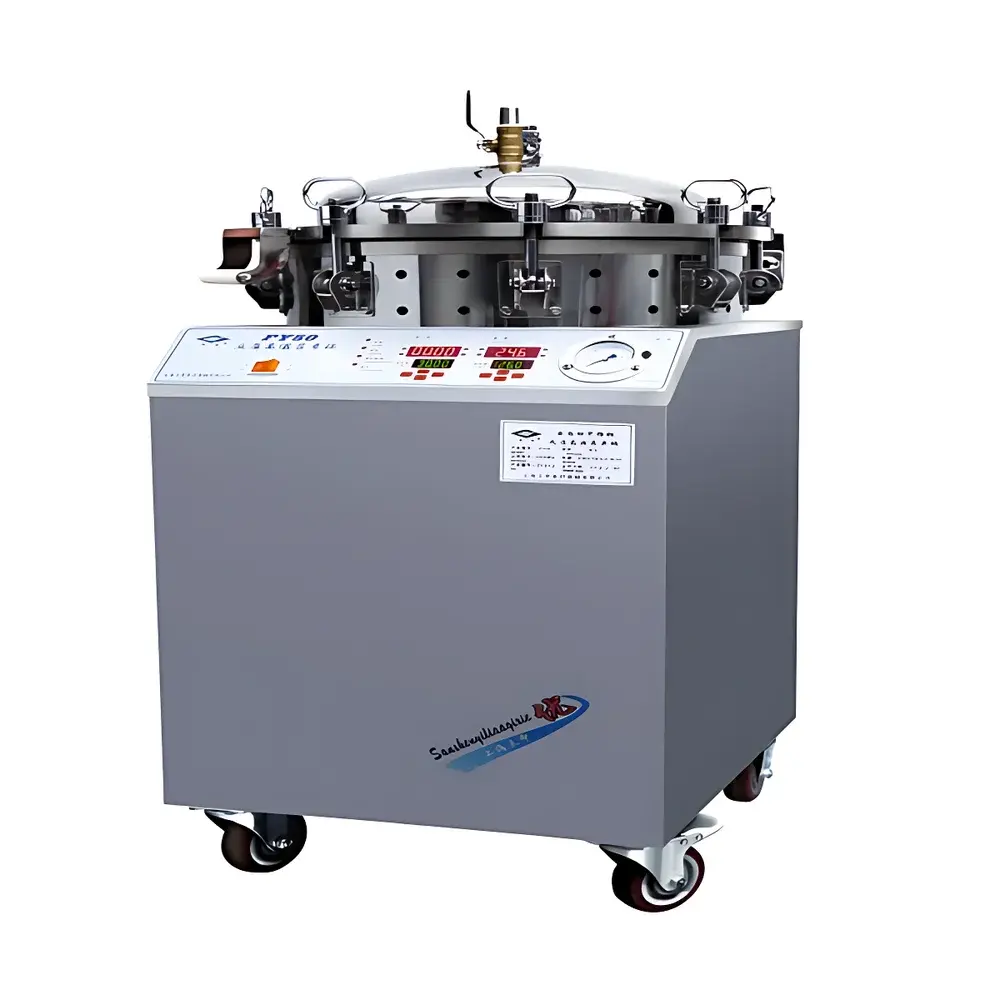
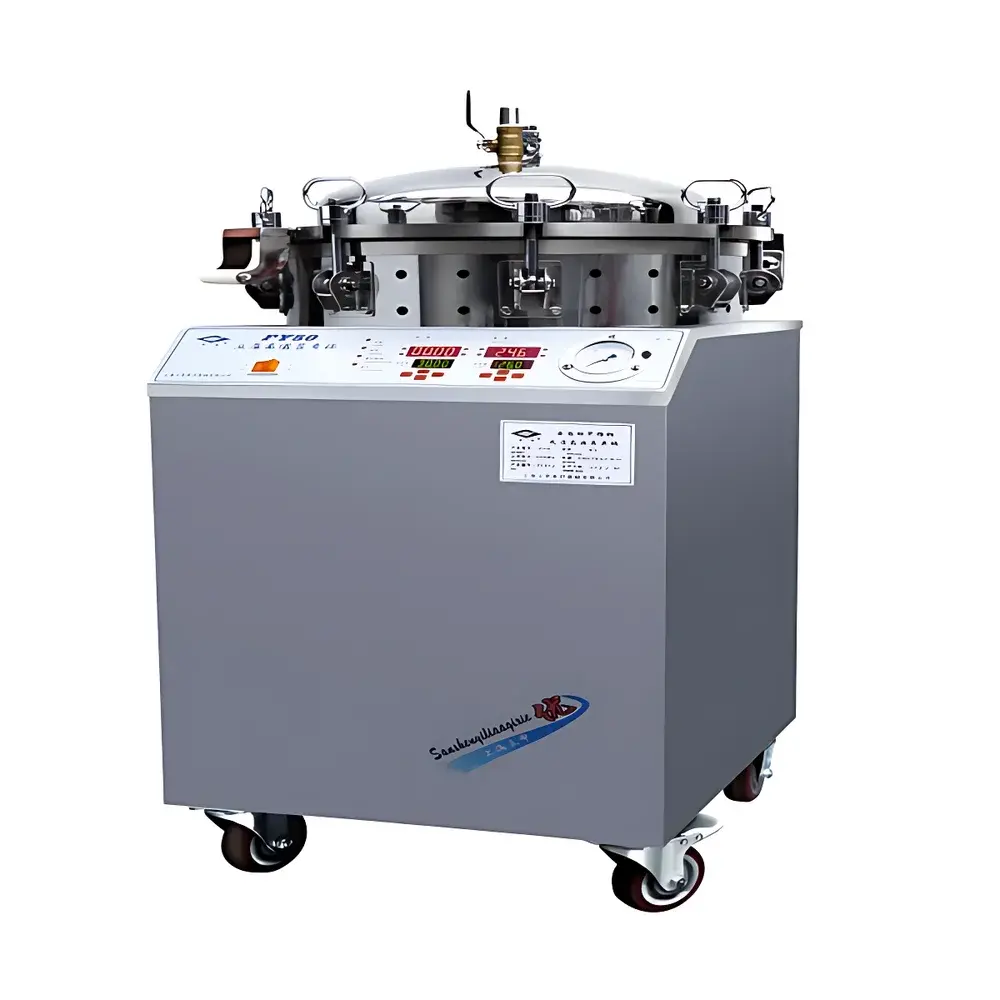
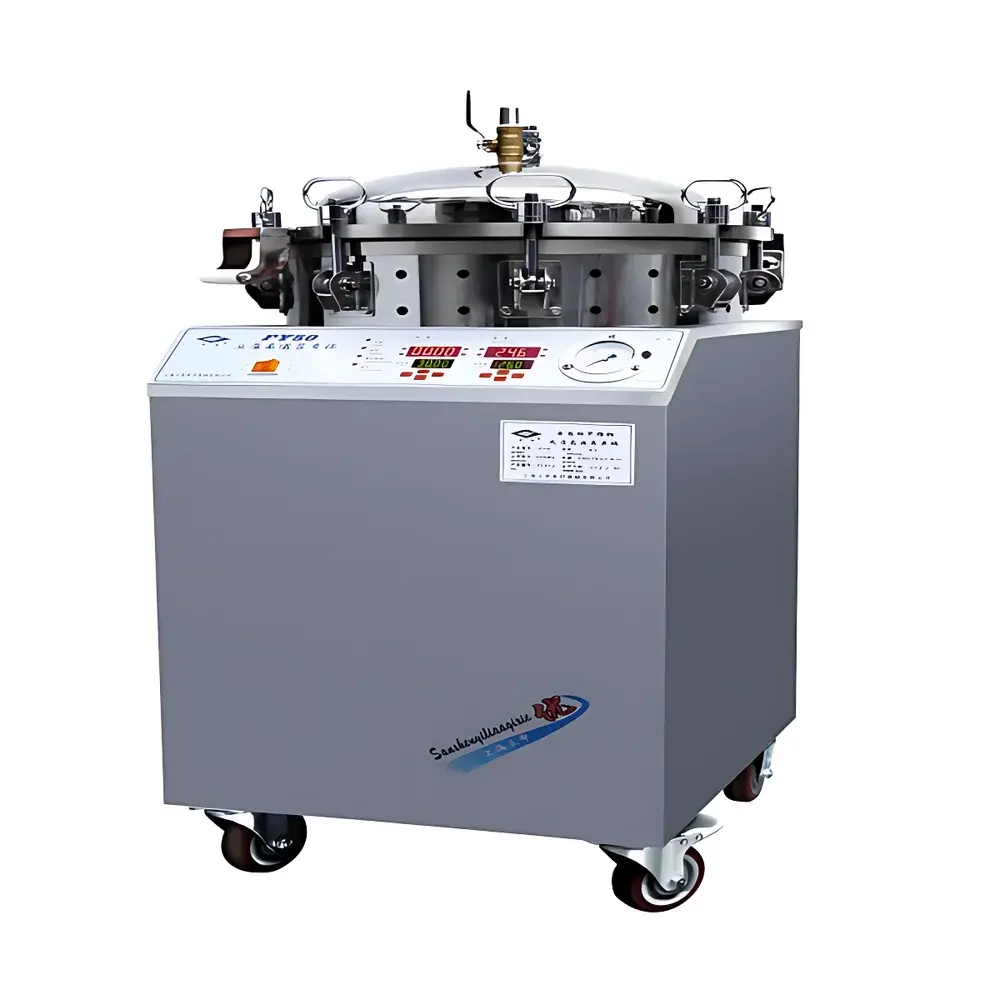
Shanghai Shen FY50 Retort Sterilizer with Counter-Pressure Control
| Brand | Shanghai Shen |
|---|---|
| Origin | Shanghai, China |
| Manufacturer Type | Authorized Distributor |
| Region | Domestic (China) |
| Model | FY50 |
| Pricing | Upon Request |
| Construction | Stainless Steel (AISI 304) |
| Power Supply | ~220 V / 50 Hz |
| Heating Power | 3.8 kW |
| Chamber Volume | 50 L |
| Minimum Water Supply Pressure | ≥0.20 MPa |
| Maximum Operating Pressure | ≤0.35 MPa |
| Temperature Range | Ambient +5 °C to 135 °C |
| Programmable Holding Time | 1–99 min or 1–99 h |
| Internal Temperature Uniformity | ±1.5 °C |
| Dimensions (W×D×H) | 155 × 66 × 100 cm |
| Packing Size (Wooden Crate) | 76 × 86 × 118 cm |
| Safety Features | Dual-limit thermal cutoff (±2 °C over setpoint), pressure relief valve (0.23 MPa), low-water auto-refill with audible/visual alarm, gravity-assisted steam exhaust, radial self-sealing silicone gasket, integrated cold-water spray cooling system (135 °C → ambient in 8–10 min), optional air counter-pressure module, drain valve for condensate removal, casters with brakes |
Overview
The Shanghai Shen FY50 Retort Sterilizer is a fully programmable, counter-pressure-controlled thermal processing system engineered for precise, repeatable sterilization and heat stabilization of low-acid and high-acid packaged foods, pharmaceuticals, and medical devices. Designed according to fundamental principles of saturated steam thermodynamics and pressure-assisted thermal kinetics, the FY50 employs gravity-based steam displacement (gravity displacement cycle) to establish a pure, non-air-entrapped chamber environment—ensuring uniform heat penetration and validated lethality (F0) delivery. Its core architecture integrates immersion-type electric heating elements, PID-driven temperature regulation with auto-tuning capability, and real-time digital monitoring via LED display and status indicators. The unit complies with foundational requirements for thermal process validation under ISO 11134 (sterilization of health care products by moist heat) and aligns with operational expectations defined in FDA 21 CFR Part 117 (Current Good Manufacturing Practice for Food) for retort operations. It is not intended for terminal sterilization of parenterals but serves as a robust platform for shelf-stable product development, QC/QA validation studies, and pilot-scale thermal process optimization.
Key Features
- Stainless steel (AISI 304) construction throughout chamber, door, and frame—resistant to corrosion, thermal fatigue, and repeated cleaning-in-place (CIP) cycles
- Inclined control panel with intuitive microprocessor interface for seamless parameter entry, cycle selection, and real-time status visualization
- PID temperature controller with self-tuning algorithm—minimizes overshoot, maintains stability within ±0.5 °C of setpoint during hold phase
- Integrated low-water detection and automatic refill system with dual-mode alarm (audible buzzer + visual LED)—resumes heating upon replenishment without cycle interruption
- Radial self-expanding silicone rubber gasket ensures consistent sealing force across full door circumference; rated for >5,000 cycles at 135 °C
- Dual safety interlocks: independent overtemperature cutoff (activated at +2 °C above setpoint) and mechanical pressure relief valve (set at 0.23 MPa)
- Cold-water spray cooling system—reduces internal load temperature from 135 °C to ambient in 8–10 minutes, minimizing post-process thermal degradation
- Optional air counter-pressure module available—prevents package deformation and seal failure during depressurization of flexible pouches and retortable films
- Drain valve located at chamber base enables periodic removal of condensed water and mineral deposits, extending service life and maintaining thermal efficiency
- Four heavy-duty swivel casters with locking brakes—facilitates repositioning within laboratory or pilot plant environments while ensuring stable operation
Sample Compatibility & Compliance
The FY50 accommodates standard retort-compatible containers including metal cans (up to 100 mm diameter), glass jars (with screw or lug closures), and flexible laminated pouches (e.g., PET/AL/PE, PET/AL/CPP). Its 50 L chamber volume supports batch testing of up to 12× 300 mL jars or 24× 150 mL pouches per cycle. The unit meets essential design and operational criteria referenced in ASTM F1901 (Standard Test Method for Measuring the Seal Strength of Flexible Package Seals After Thermal Processing), ISO 22000 (Food Safety Management Systems), and GB/T 10790 (Chinese national standard for canned food sterilization processes). While not certified to ASME BPVC Section VIII Division 1, its pressure vessel design incorporates third-party verified calculations for maximum allowable working pressure (MAWP) and safety margin verification. Documentation packages—including calibration records, IQ/OQ templates, and maintenance logs—are provided to support GLP-compliant lab operations and internal audit readiness.
Software & Data Management
The FY50 operates via embedded firmware with no external PC dependency. All process parameters—including temperature setpoint, pressure target, heating ramp rate, dwell time, and cooling profile—are stored in non-volatile memory and retain settings after power loss. Cycle execution data (time-stamped temperature/pressure readings at 10-second intervals) are logged internally and exportable via USB port in CSV format for traceability. The system supports manual cycle recall and editable program storage for up to 20 custom protocols. Audit trail functionality includes operator ID input (via numeric keypad), start/stop timestamps, and anomaly flagging (e.g., “low water event”, “overtemp abort”). Data integrity conforms to ALCOA+ principles (Attributable, Legible, Contemporaneous, Original, Accurate, Complete, Consistent, Enduring, Available) and satisfies baseline documentation requirements for FDA 21 CFR Part 11 compliance when paired with controlled access procedures and electronic signature protocols implemented at the facility level.
Applications
- Thermal process validation of low-acid canned foods (pH > 4.6) per FDA 21 CFR Part 113 guidelines
- Accelerated shelf-life testing (ASLT) of retortable packaging materials under simulated commercial conditions
- Microbial challenge studies using biological indicators (e.g., Geobacillus stearothermophilus spores) to determine D-value and z-value parameters
- QC release testing of sterilized medical device packaging (ISO 11607-2) prior to gamma or EtO sterilization
- Development of novel thermal profiles for sous-vide or high-moisture pet food formulations
- Education and training in food engineering labs on F0 calculation, come-up time analysis, and lethality mapping
FAQ
What is the maximum allowable operating temperature and pressure?
The FY50 is rated for continuous operation up to 135 °C and 0.35 MPa gauge pressure. Safety margins are maintained per ASME-recommended design factors.
Does the unit support automated data export for regulatory submissions?
Yes—cycle logs are saved internally and exportable via USB in timestamped CSV format, supporting traceability for FDA, EFSA, or NMPA submissions.
Is the cold-water spray system compatible with all container types?
It is optimized for rigid and semi-rigid containers. For flexible pouches, the optional air counter-pressure module must be engaged before initiating spray cooling to prevent vacuum-induced collapse.
Can the FY50 be integrated into a networked lab information management system (LIMS)?
No native Ethernet or RS-485 interface is included; however, exported CSV files can be ingested into LIMS via scheduled import scripts or middleware gateways.
What maintenance intervals are recommended for long-term reliability?
Gasket inspection every 200 cycles; pressure relief valve functional test quarterly; full calibration of temperature and pressure sensors annually by accredited metrology service.