
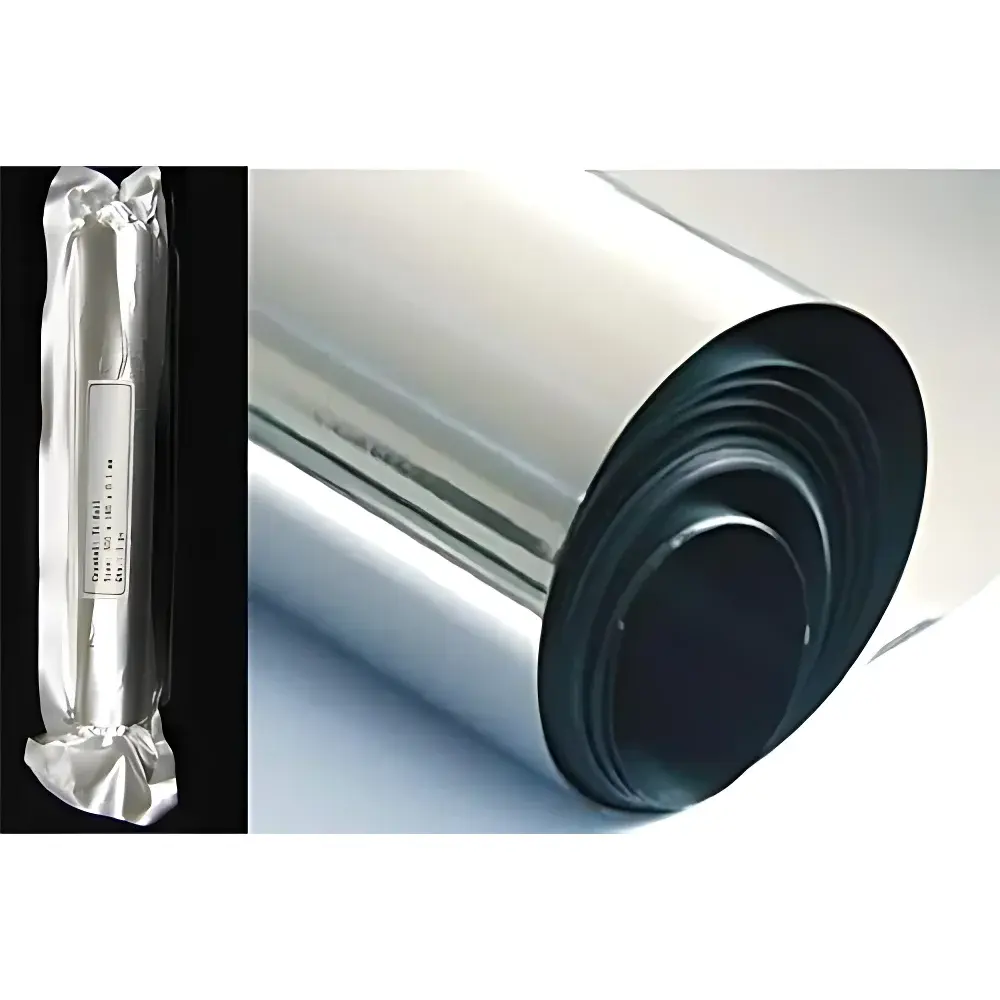
Hefei Kejing Metal Foil Sheets (A–Z Elements) for Quartz Crystal Microbalance (QCM) Applications
| Brand | Hefei Kejing |
|---|---|
| Origin | Anhui, China |
| Manufacturer Type | Authorized Distributor |
| Product Origin | Domestic (China) |
| Model | Metal Foil Sheets (Element-Specific) |
| Thickness | 0.1 mm (standard) |
| Purity | >99.9% (3N) |
| Available Elements | Ag, Al, Au, Cu, Co, Cr, Li, In, Ni, Mo, Pb, Ti, Ta, V, W, Zr, Stainless Steel |
| Price Range | USD 0.50 – 5,800.00 (per piece or custom roll, depending on element, size, and quantity) |
Overview
Hefei Kejing’s A–Z metal foil sheets are precision-engineered thin-film substrates designed specifically for integration into quartz crystal microbalance (QCM) sensor platforms, electrochemical cells, and thin-film deposition calibration workflows. Each foil is fabricated from high-purity elemental metals (>99.9% purity, 3N grade), with a nominal thickness of 0.1 mm—optimized to balance mechanical stability, electrical conductivity, and mass sensitivity in QCM-based gravimetric sensing. These foils serve as functional electrode layers, mass-loading standards, or sacrificial templates in real-time monitoring of adsorption, interfacial reactions, thin-film growth, and corrosion kinetics. Unlike evaporated or sputtered films, mechanically rolled foils provide consistent bulk composition, low defect density, and reproducible surface topography—critical for baseline stability and quantitative mass–frequency correlation under ISO/IEC 17025-aligned measurement protocols.
Key Features
- Element-specific selection across 17 standard options: Ag, Al, Au, Cu, Co, Cr, Li, In, Ni, Mo, Pb, Ti, Ta, V, W, Zr, and austenitic stainless steel (e.g., 304/316)
- Controlled thickness tolerance: ±5 µm at 0.1 mm nominal, verified by calibrated micrometry and cross-sectional SEM
- Surface finish: As-rolled, double-sided, with RMS roughness <0.4 µm (measured per ISO 25178-2), minimizing scattering-induced frequency noise in QCM resonators
- Traceability documentation available: Certificate of Analysis (CoA) includes ICP-MS impurity profiling (Fe, Cu, Ni, Si, O residuals ≤100 ppm total)
- Cut-to-size capability: Custom rectangular, circular, or annular geometries (down to Ø3 mm) compatible with standard 14 mm and 25 mm QCM electrodes
- Non-reactive packaging: Vacuum-sealed, argon-flushed pouches with anti-tarnish barrier film (for Ag, Cu, Li, and other oxidation-sensitive metals)
Sample Compatibility & Compliance
These foils are validated for use in commercial QCM systems (e.g., Q-Sense E4, MaxiQ, and Stanford Research Systems QCM200) and custom-built electrochemical QCM (EQCM) cells operating in aqueous, non-aqueous, and gas-phase environments. All lots comply with ASTM E290–22 (Standard Specification for Metallic Foil for Laboratory Use) for dimensional consistency and surface integrity. For regulated environments—including pharmaceutical process development and battery materials R&D—the foils support GLP-compliant documentation packages (including lot-specific CoAs, handling SOPs, and storage condition logs). Lithium foil variants meet UN 3090 transport requirements when packaged per IATA Packing Instruction 954.
Software & Data Management
While the foils themselves are passive components, their integration enables traceable, repeatable QCM data acquisition. When used with QCM instruments supporting Sauerbrey or Voigt modeling, these foils facilitate calibration of Δf vs. Δm relationships under known mass loading conditions. Hefei Kejing provides optional digital asset packs—including standardized .csv templates for mass-thickness-frequency mapping, reference spectra libraries (XPS survey scans for each element), and MATLAB-compatible scripts for baseline drift correction—supporting FDA 21 CFR Part 11–compliant data integrity workflows where electronic records are required.
Applications
- QCM sensor electrode fabrication for gas-phase H2, NOx, or VOC detection (e.g., Au foil for thiol-functionalized chemiresistors)
- In-situ EQCM studies of SEI formation on Li-metal anodes using Li foil working electrodes
- Calibration of mass sensitivity in polymer brush grafting experiments (e.g., PMMA adsorption on Cr foil)
- Corrosion rate quantification in simulated cooling water matrices using Cu or stainless steel foils as reference electrodes
- Thin-film stress analysis via wafer curvature methods, where Ti or Ta foils serve as compliant backing layers
- Standards for TEM lamella preparation and FIB lift-out, leveraging Mo and W foils for high electron transparency and milling resistance
FAQ
Are these foils suitable for ultra-high vacuum (UHV) deposition chambers?
Yes—All foils undergo in-house vacuum bake-out validation (10−6 mbar, 200 °C, 2 h) with residual gas analysis confirming H2O and hydrocarbon outgassing rates <5×10⁻¹¹ mbar·L/s·cm².
Can I request certified surface oxide thickness measurements?
Yes—XPS depth profiling (with Ar+ sputtering) is available as an add-on service; typical native oxide thicknesses range from 0.7 nm (Al) to 3.2 nm (Ti), reported per ISO 18118.
Do you supply foils with pre-patterned microstructures?
No—These are planar, unpatterned foils. However, we collaborate with lithography service providers for post-delivery patterning (e.g., photolithography + wet etch on Ni or Cu foils).
What is the minimum order quantity (MOQ) for custom alloys?
MOQ is 50 g for non-standard compositions (e.g., Ni–Cr 80/20); lead time is 8–12 weeks from alloy certification approval.
Is there lot-to-lot variability in QCM frequency response?
No—Each production lot undergoes QCM resonance testing on a reference 10 MHz AT-cut crystal; Δf deviation across 10 consecutive lots is ≤±0.8 Hz under identical mounting torque (0.15 N·m) and temperature (25.0 ± 0.1 °C).




