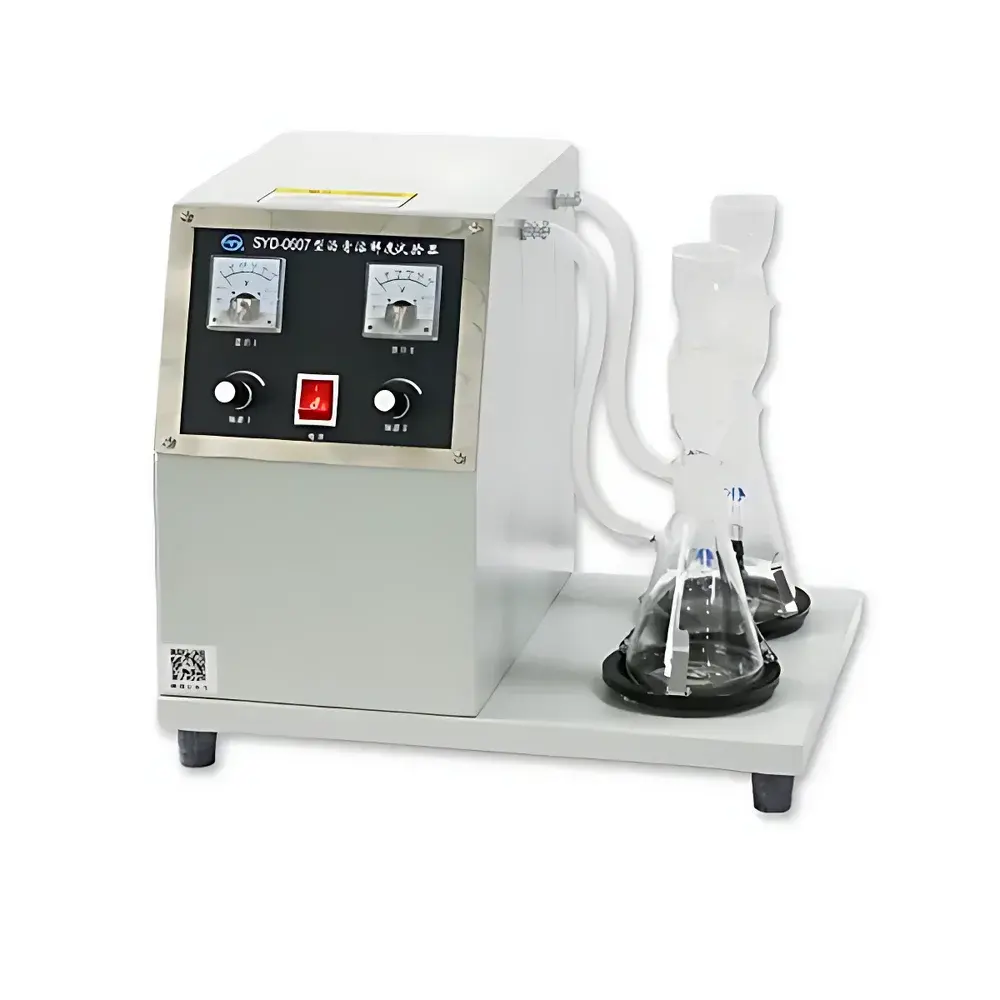
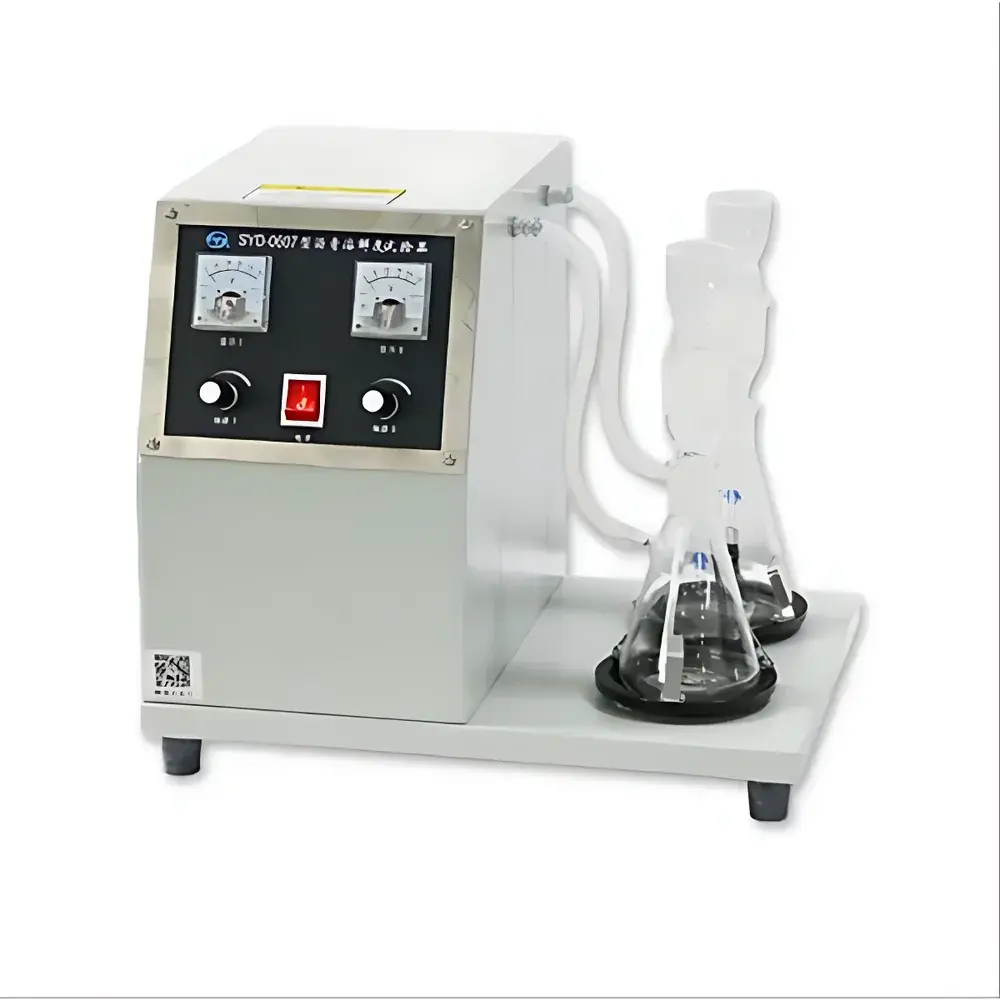
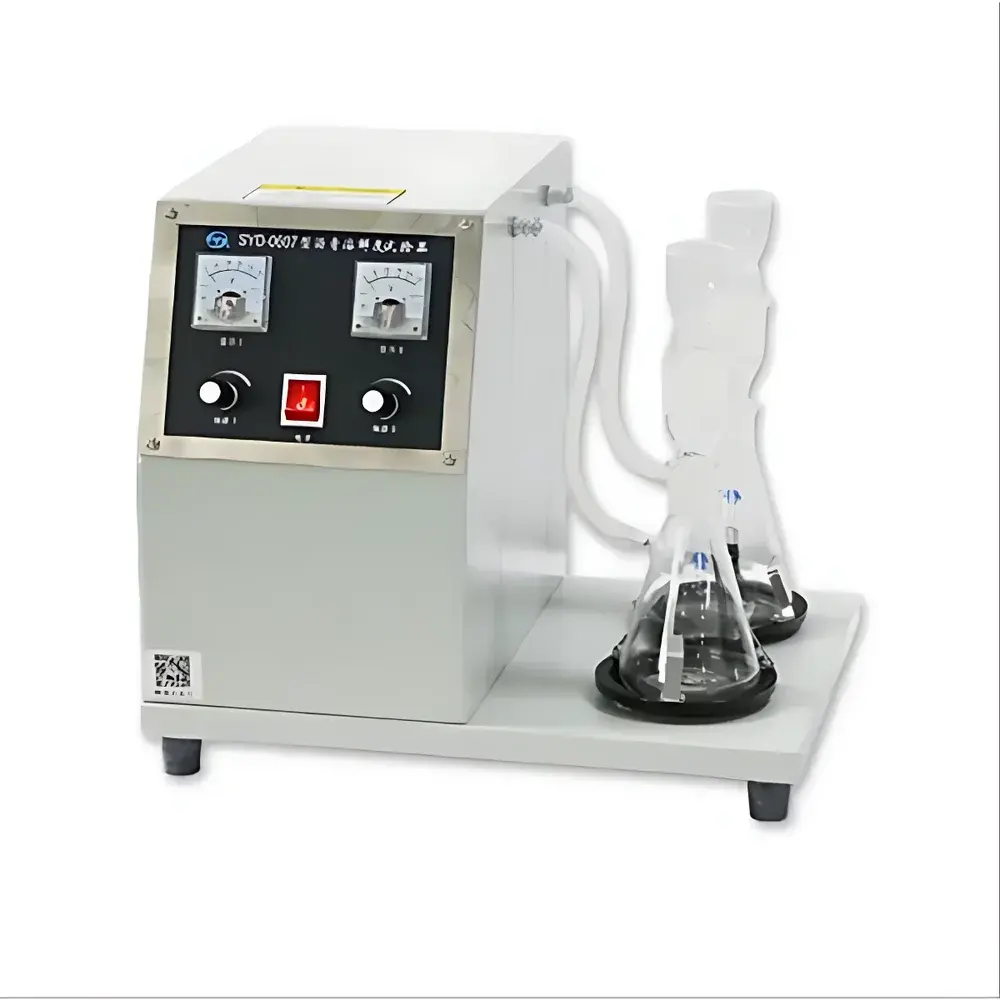
Changji Instruments SYD-0607 Asphalt Solubility Tester
| Brand | Changji Instruments |
|---|---|
| Origin | Shanghai, China |
| Manufacturer Type | Authorized Distributor |
| Country of Origin | China |
| Model | SYD-0607 |
| Pricing | Upon Request |
| Operating Mode | Dual-channel |
| Filtration Method | Adjustable Vacuum Pump Suction |
| Filter Membrane | Glass Fiber, 0.65 µm Pore Size |
| Solvent | Trichloroethylene (TCE) |
| Power Supply | AC 220 V ±10%, 50 Hz |
| Power Consumption | ≤100 W |
| Ambient Operating Temperature | 15–35 °C |
| Relative Humidity | ≤85% |
| Dimensions (L×W×H) | 420 × 320 × 360 mm |
| Net Weight | 8.8 kg |
Overview
The Changji Instruments SYD-0607 Asphalt Solubility Tester is a precision benchtop instrument engineered for quantitative determination of solubility in petroleum bitumen and residue from emulsified asphalt following evaporation—strictly in accordance with GB/T 11148–2008, the People’s Republic of China National Standard equivalent to ASTM D5404 and aligned with ISO 4626 principles for hydrocarbon solvent extraction gravimetry. The device operates on a vacuum-assisted gravimetric filtration principle: a weighed asphalt sample is dissolved in trichloroethylene (TCE), filtered through a pre-weighed glass fiber membrane (0.65 µm nominal pore size), and the insoluble residue is dried, cooled in a desiccator, and re-weighed. Solubility is calculated as the mass percentage of dissolved material relative to the original sample. This method is specifically validated for unmodified petroleum-based bitumens and evaporated emulsion residues; it is not applicable to polymer-modified or rubber-modified asphalts due to incomplete dissolution and potential membrane clogging.
Key Features
- Dual-channel independent operation enables simultaneous parallel testing of two samples—enhancing throughput and statistical reliability per ASTM E177 guidelines for repeatability assessment.
- Integrated adjustable vacuum pump system provides continuous, stepless control of suction pressure—ensuring consistent filtration rate across varying sample viscosities and preventing membrane rupture or premature channel blockage.
- Compact monolithic benchtop architecture (420 × 320 × 360 mm) minimizes laboratory footprint while maintaining mechanical stability during filtration and drying phases.
- Filter support assembly is designed for rapid, tool-free membrane exchange and full accessibility to the filtration chamber—reducing cross-contamination risk and supporting GLP-compliant cleaning protocols.
- Electrical system complies with IEC 61010-1 safety requirements for laboratory equipment, including overcurrent protection and reinforced insulation for solvent-handling environments.
Sample Compatibility & Compliance
The SYD-0607 is validated for use with penetration-grade and viscosity-grade petroleum bitumens (e.g., AASHTO M226, EN 13924), as well as evaporated residues from anionic/cationic emulsified asphalts meeting ASTM D977 or EN 13808 specifications. It explicitly excludes styrene-butadiene rubber (SBR), polyethylene, or crumb rubber–modified binders, which yield non-gravimetrically stable residues under TCE dissolution. All operational procedures adhere to GB/T 11148–2008, with traceability to ISO/IEC 17025 calibration requirements for mass measurement (using Class A analytical balances) and environmental monitoring (temperature/humidity logging). Users must implement engineering controls—including fume hoods certified to ANSI/AIHA Z9.5—and comply with local hazardous substance handling regulations (e.g., OSHA 29 CFR 1910.120, EU CLP Regulation EC No. 1272/2008) when using trichloroethylene.
Software & Data Management
The SYD-0607 is a manually operated, hardware-only instrument with no embedded microprocessor or digital interface. Data recording follows paper-based or LIMS-integrated manual entry workflows. Users are required to document initial sample mass, membrane tare weight, post-filtration residue mass, drying duration/temperature (per GB/T 11148–2008: 105 ± 2 °C for 1 h), and ambient lab conditions. For laboratories operating under FDA 21 CFR Part 11 or ISO/IEC 17025, handwritten records must include analyst signature, date/time stamp, and review sign-off. Digital templates for solubility calculation (Solubility % = [(m₁ − m₂) / m₁] × 100, where m₁ = initial sample mass, m₂ = insoluble residue mass) are available for integration into validated Excel-based spreadsheets or ELN platforms.
Applications
- Quality control of refinery-produced bitumen prior to shipment—verifying conformance to contractual solubility limits (typically ≥99.0% for paving grades).
- Performance evaluation of emulsified asphalt formulations during R&D—assessing surfactant efficiency and residue purity after water evaporation.
- Forensic analysis of field-collected pavement cores to detect contamination (e.g., clay fines, oxidized binder fractions) via elevated insoluble content.
- Third-party certification testing for highway construction projects governed by JTG E20–2011 (Chinese Highway Engineering Test Specifications) or AASHTO TP 101.
- Teaching laboratories demonstrating fundamental principles of solvent extraction, gravimetric analysis, and asphalt chemistry.
FAQ
Is the SYD-0607 compatible with solvents other than trichloroethylene?
No. GB/T 11148–2008 mandates trichloroethylene as the sole specified solvent. Substitution with toluene, chloroform, or xylene invalidates compliance and alters dissolution kinetics.
Can the instrument be used for modified asphalt testing?
No. Polymer- or rubber-modified asphalts produce non-filterable gels or colloidal suspensions in TCE, violating the gravimetric assumption of discrete insoluble particulates.
What maintenance is required for the vacuum pump?
The diaphragm-type pump requires quarterly inspection of check valves and annual replacement of carbon vanes per manufacturer service bulletin #SYD-0607-MNT-2023.
Does the unit include calibration certificates?
No. Users must procure NIST-traceable weights (Class M1 or better) and validate balance performance per ISO 17025 prior to each test series.
Is explosion-proof configuration available?
Not standard. Integration into classified hazardous locations (e.g., Zone 1/21) requires third-party ATEX/IECEx retrofitting and cannot be performed by Changji Instruments.