
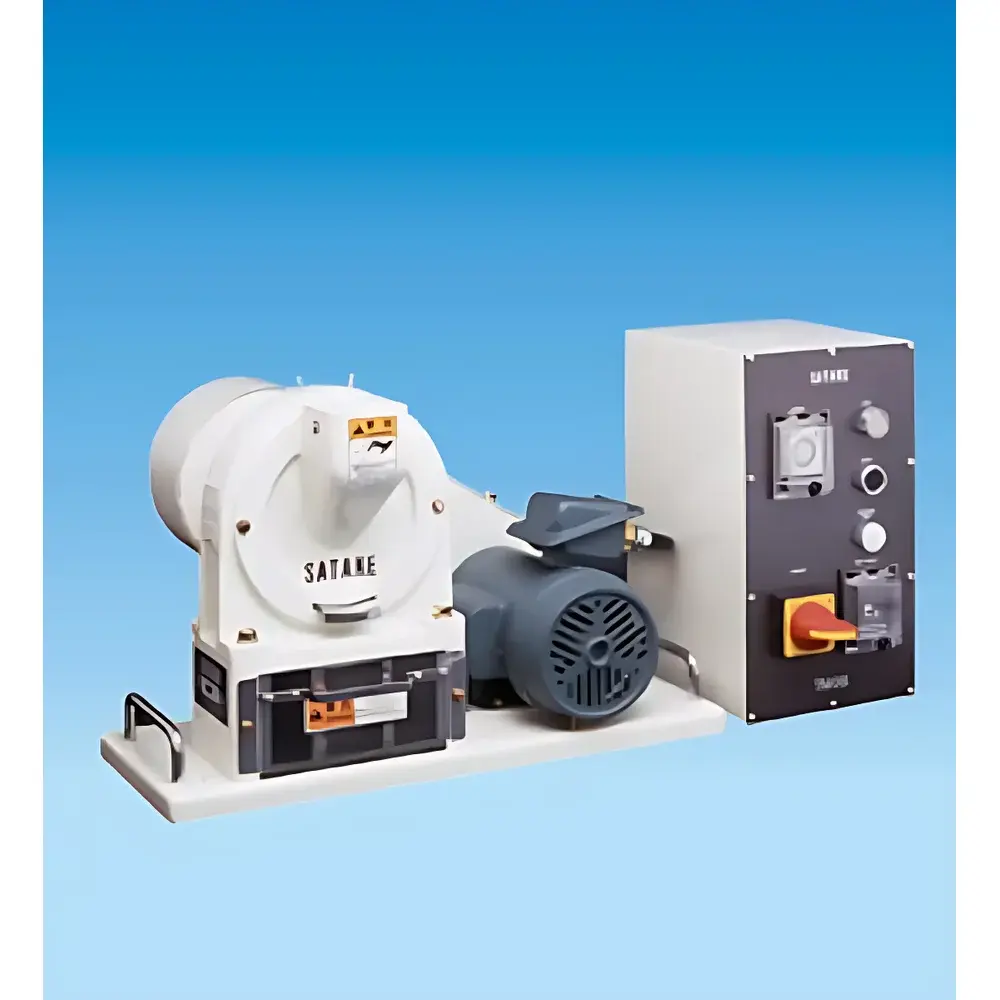
SATAKE TM05C Laboratory Rice Mill
| Brand | SATAKE |
|---|---|
| Origin | Japan |
| Model | TM05C |
| Instrument Type | Benchtop |
| Analysis Time | 0.5 min |
| Sample Capacity | 1.2 kg |
| Feed Rate Control | Adjustable via 8-step pulley system |
| Abrasive Roll Rotation Speed | 750–1450 rpm |
| Power Supply | Single-phase AC 100 V, 50/60 Hz |
| Power Consumption | 0.4 kW |
| Dimensions (H×W×D) | 386 × 580 × 374 mm |
| Net Weight | 43.2 kg |
| Wavelength Range | Not applicable (mechanical milling device) |
| Scan Speed | Not applicable |
Overview
The SATAKE TM05C Laboratory Rice Mill is a precision-engineered benchtop milling instrument designed for controlled, reproducible paddy-to-white-rice processing in research, quality control, and breeding laboratories. Unlike industrial-scale rice mills, the TM05C operates on a mechanical abrasive principle—utilizing rotating corundum-coated abrasive rolls to remove bran and germ layers from brown rice kernels under precisely regulated rotational speed and feed conditions. Its primary function is not spectral or optical analysis, but rather physical grain transformation: enabling users to simulate commercial milling conditions at micro-scale to assess milling yield (head rice recovery), whiteness index, degree of polish, and kernel integrity prior to full-scale production. The device serves as a critical pre-validation tool in varietal development programs, grain procurement evaluation, and post-harvest quality assurance protocols aligned with ISO 7301 (Rice — Specification) and JIS Z 8401 (Accuracy of Measurement).
Key Features
- Eight-stage variable-speed drive system using stepped pulleys, enabling precise abrasive roll rotation control between 750 and 1450 rpm—critical for correlating speed with degree of polish and minimizing kernel fracture.
- Interchangeable abrasive rolls: three distinct roll types (standard, fine-polish, and low-breakage configurations) allow method optimization across rice varieties—including japonica, indica, and glutinous genotypes—with differing hull adhesion and kernel hardness profiles.
- Benchtop footprint (580 mm width) and integrated ergonomic feed hopper support rapid sample turnover; typical milling cycle completes within 0.5 minutes per 1.2 kg batch, ensuring high-throughput screening capability.
- Robust cast-iron frame and vibration-damped mounting minimize operational drift and enhance repeatability across sequential runs—essential for GLP-compliant grain testing environments.
- Single-phase 100 V AC input (50/60 Hz compatible) ensures stable operation in standard laboratory power infrastructure without requiring dedicated three-phase circuits or external voltage regulators.
Sample Compatibility & Compliance
The TM05C accepts dehusked brown rice (paddy after husking) in whole-kernel form, with optimal performance observed for moisture contents between 12.5% and 14.5% w.b., per ISO 6540 and USDA ARS milling guidelines. It accommodates both long-grain and short-grain varieties, though kernel length uniformity improves yield consistency. The instrument does not incorporate optical sensors or spectral components; therefore, “wavelength range” and “scan speed” parameters listed in marketing documentation refer neither to built-in measurement capabilities nor to compliance with optical standards (e.g., CIE, ASTM E308). Instead, its compliance framework centers on mechanical safety (JIS B 9701), electrical safety (JIS C 61000-4-2), and traceability of milling parameters—supporting audit readiness for ISO/IEC 17025-accredited grain testing laboratories.
Software & Data Management
The TM05C is a standalone electromechanical instrument with no embedded firmware, touchscreen interface, or digital data logging. All operational parameters—including selected speed stage, feed timing, and roll type—are manually set and recorded externally by the operator. For integration into digital QA workflows, laboratories commonly pair the TM05C with third-party image analysis systems (e.g., Utec Grain Analyzer or WinSEEDLE) to quantify head rice percentage and whiteness from milled samples. When used in FDA-regulated or GMP-aligned facilities, manual parameter logs must adhere to ALCOA+ principles (Attributable, Legible, Contemporaneous, Original, Accurate, Complete, Consistent, Enduring, Available), with retention periods aligned with 21 CFR Part 11 expectations for paper-based records.
Applications
- Rice breeding programs: Rapid assessment of milling yield and kernel breakage susceptibility across segregating populations.
- Grain procurement labs: Verification of contractual milling specifications prior to bulk acceptance.
- Food safety R&D: Evaluation of mycotoxin redistribution during bran removal (e.g., aflatoxin B1 concentration shifts between fractions).
- Post-harvest technology studies: Optimization of drying-milling sequences to maximize head rice recovery while minimizing fissuring.
- Standards calibration: Preparation of reference milled rice samples for spectrophotometric whiteness validation (e.g., against Minolta CR-400 or Konica Minolta CM-700d).
FAQ
Does the TM05C include integrated whiteness or yield measurement?
No. It is a mechanical milling device only. Quantitative assessment of whiteness (e.g., L* value) and head rice yield requires separate instrumentation—typically flatbed scanners with calibrated lighting and validated image segmentation software.
Can the TM05C process parboiled or pre-dried paddy?
It is engineered exclusively for brown rice (dehusked paddy). Processing unhusked paddy will damage abrasive rolls and void warranty. Parboiled rice may be milled, but reduced kernel strength increases breakage—method validation is required per variety.
Is technical support available outside Japan?
Yes. Authorized SATAKE distributors provide installation verification, operator training, and spare abrasive roll supply chains in North America, EU, and Southeast Asia—subject to regional service agreements.
What maintenance intervals are recommended?
Abrasive rolls require replacement after ~200–300 kg cumulative throughput; drive belts should be inspected quarterly for tension and wear; bearing lubrication is specified at 12-month intervals per SATAKE Maintenance Manual Rev. 4.2.
Does the TM05C comply with FDA 21 CFR Part 11?
As a non-computerized device with no electronic records generation, it falls outside the scope of Part 11. However, its use within Part 11 environments requires documented SOPs for manual parameter recording and sample labeling traceability.






