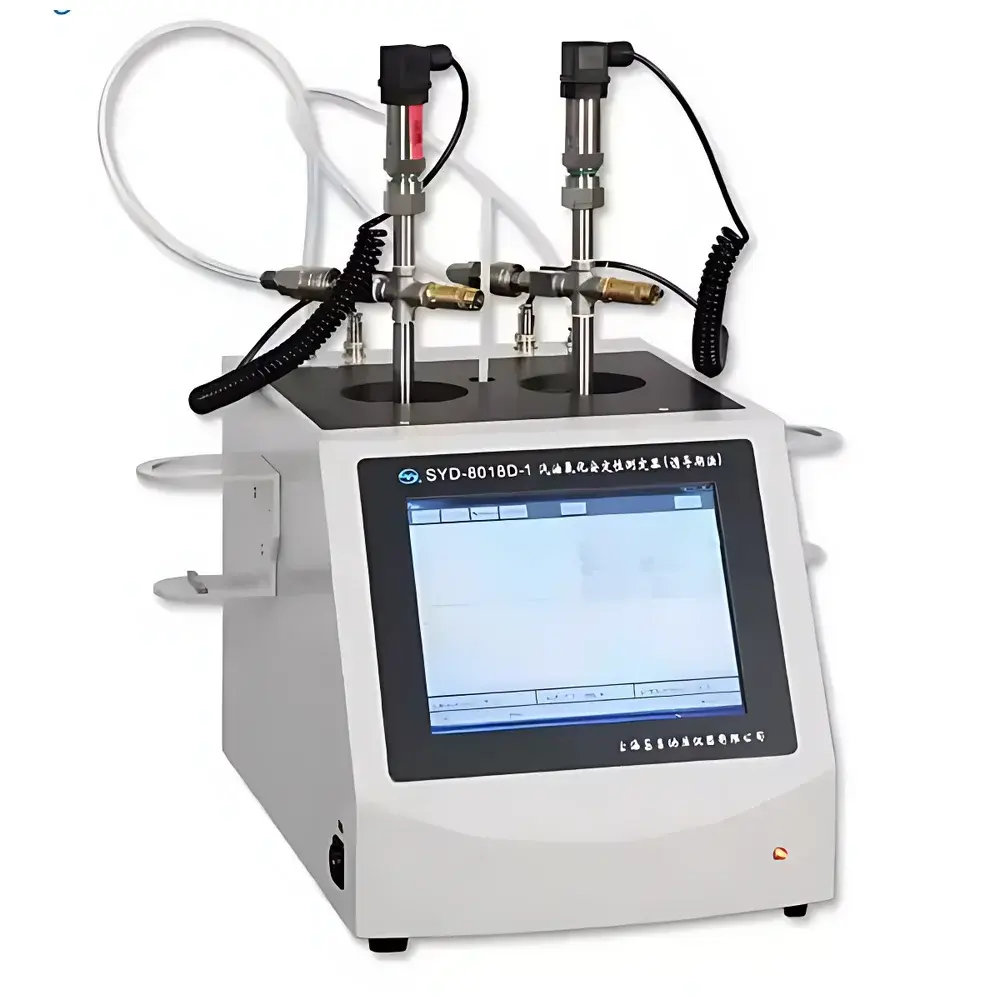
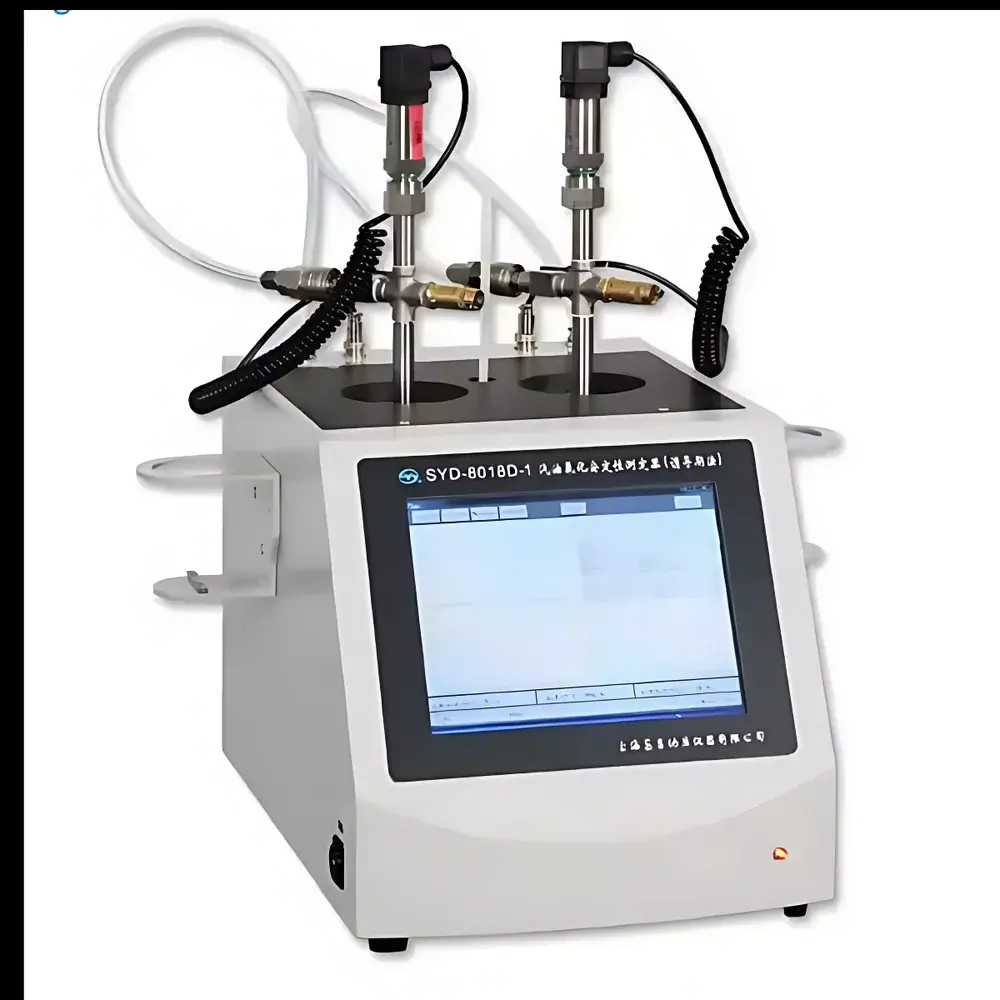
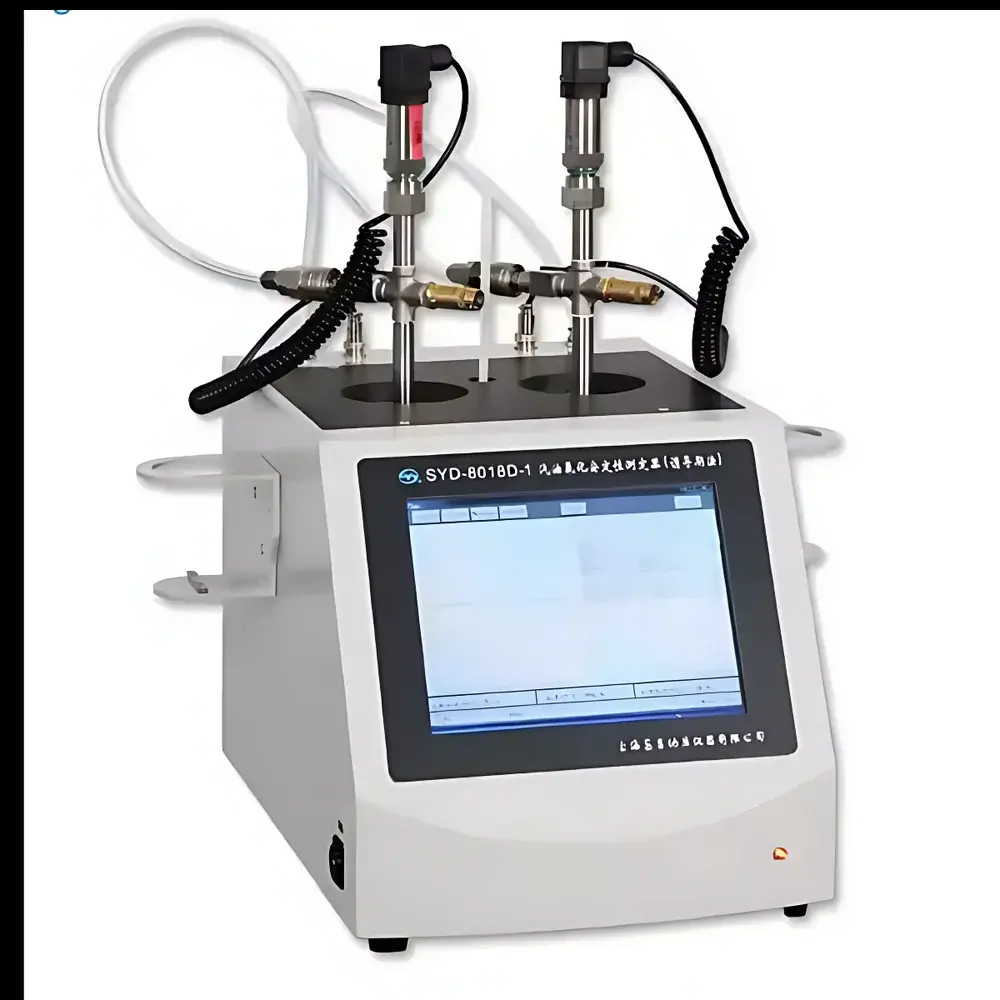
Changji Instruments SYD-8018D-1 Petroleum Oxidation Stability Tester (Induction Period Method)
| Brand | Changji Instruments |
|---|---|
| Origin | Shanghai, China |
| Manufacturer Type | Authorized Distributor |
| Country of Origin | China |
| Model | SYD-8018D-1 |
| Pricing | Upon Request |
| Temperature Setpoint | 100.0 °C |
| Temperature Control Accuracy | ±0.1 °C |
| Pressure Range | 0–1600 kPa |
| Pressure Sensor Accuracy | ±0.2% FS |
| Touchscreen | 10.1-inch Color LCD with Windows 7 OS |
| Power Supply | AC 220 V ±10%, 50 Hz ±1 Hz |
| Heating Power | 1400 W |
| Dimensions (W×D×H) | 630 mm × 280 mm × 380 mm |
| Net Weight | 50 kg |
Overview
The Changji Instruments SYD-8018D-1 Petroleum Oxidation Stability Tester is an automated benchtop instrument engineered for precise determination of gasoline oxidation stability under accelerated oxidative conditions, in strict compliance with the GB/T 8018–2015 standard (“Test Method for Oxidation Stability of Gasoline – Induction Period Method”) and aligned with the internationally recognized ASTM D525 specification. The instrument operates on the principle of sealed oxygen bomb oxidation: a weighed gasoline sample is placed in a stainless-steel oxygen bomb pressurized to 700 kPa with pure oxygen, then immersed in a precisely controlled metal bath at 100.0 °C. Oxidation progress is continuously monitored via real-time pressure decay, with the induction period defined as the time elapsed until a specified pressure drop (typically 14 kPa/min over a 15-minute interval) is observed—indicating the onset of rapid hydrocarbon oxidation and peroxide accumulation. This thermally accelerated test provides a reproducible, standardized metric for evaluating antioxidant effectiveness and predicting storage stability.
Key Features
- Integrated industrial PC architecture with embedded Windows 7 OS—no external computer, keyboard, or mouse required.
- 10.1-inch high-resolution color touchscreen interface with intuitive Chinese-language navigation and contextual operation guidance.
- Patented all-metal heating bath (replacing traditional water baths), eliminating evaporation, refilling, and microbial contamination risks while improving thermal uniformity and long-term stability.
- Dual independent oxygen bomb stations enable simultaneous testing of two samples—supporting replicate analysis, method validation, or comparative evaluation of formulations.
- Active overpressure safety system: each bomb incorporates a mechanical pressure-relief valve calibrated to activate automatically if internal pressure exceeds design limits, ensuring operator and equipment protection.
- Real-time dual-channel data visualization: synchronized pressure vs. time curves for both bombs; overlay comparison mode; dynamic time-axis scaling up to 3000 minutes; concurrent display of measured temperature and absolute pressure values.
- Thermally optimized enclosure with multi-layer insulation—minimizes energy consumption and surface temperatures (<45 °C at ambient conditions), meeting occupational safety requirements for prolonged laboratory use.
- Ergonomic dual-bomb positioning with precision alignment guides—facilitates rapid, repeatable bomb loading, sealing, and disassembly without tools or repositioning effort.
Sample Compatibility & Compliance
The SYD-8018D-1 is validated for use with unleaded and leaded gasoline, oxygenated blends (e.g., MTBE, ethanol), and reformulated fuels meeting ASTM D439, D4814, and GB 17930 specifications. It supports full traceability in regulated environments: audit trails, user access logs, and electronic signature capability align with GLP and GMP documentation practices. While not certified to 21 CFR Part 11 out-of-the-box, the system’s deterministic control logic, non-volatile parameter storage, and timestamped raw data export (CSV/Excel-compatible) provide foundational elements for Part 11 validation by end users. All pressure transducers are NIST-traceable upon calibration; temperature sensors are PT100-class with documented uncertainty budgets.
Software & Data Management
The onboard software executes fully automated test sequences—including oxygen pressurization, bath temperature ramp/stabilization, continuous pressure sampling (1 Hz resolution), induction period calculation per GB/T 8018–2015 Annex A, and pass/fail flagging against user-defined thresholds. Raw data files include metadata (operator ID, sample ID, date/time stamp, instrument serial number, calibration status). Export options include USB flash drive transfer and wireless Wi-Fi transmission to local network servers. Reports conform to ISO/IEC 17025–recommended structure: header information, instrument configuration summary, environmental conditions, raw pressure–time arrays, derivative curve plots, and final induction period with confidence interval estimation (based on duplicate run repeatability per standard).
Applications
- Quality control laboratories in refineries and fuel additive manufacturers verifying batch-to-batch consistency of antioxidant package performance.
- R&D departments screening novel stabilizer chemistries (e.g., hindered phenols, aromatic amines) under standardized oxidative stress.
- Regulatory testing labs conducting statutory compliance verification for national fuel specifications (e.g., China VI gasoline standards).
- Third-party certification bodies performing interlaboratory comparison studies under ISO 5725 guidelines.
- Educational institutions teaching petroleum product chemistry and analytical methodology in undergraduate and graduate curricula.
FAQ
What standards does the SYD-8018D-1 fully support?
It is designed and verified for GB/T 8018–2015 and ASTM D525, including all procedural requirements for sample preparation, oxygen purity, pressure measurement accuracy, temperature control stability, and induction period calculation.
Is the instrument suitable for diesel or jet fuel testing?
No—this model is specifically configured for gasoline-range volatility and oxidation kinetics. For distillate fuels, refer to the SYD-0175 (D2274) or SYD-0193 (D2272) series instruments.
Can test data be exported in machine-readable format for LIMS integration?
Yes—CSV-formatted datasets containing timestamps, pressure values, temperature readings, and calculated results are directly exportable via USB or Wi-Fi.
What maintenance is required for long-term reliability?
Annual recalibration of pressure transducers and temperature sensors is recommended; oxygen bomb seals should be inspected and replaced every 500 cycles or per manufacturer’s wear guidelines.
Does the system support remote monitoring or unattended operation?
The integrated Wi-Fi module enables network-based status polling and alarm notification; however, physical intervention is required for bomb loading/unloading and post-test cleaning—fully unattended multi-day runs are not supported.