
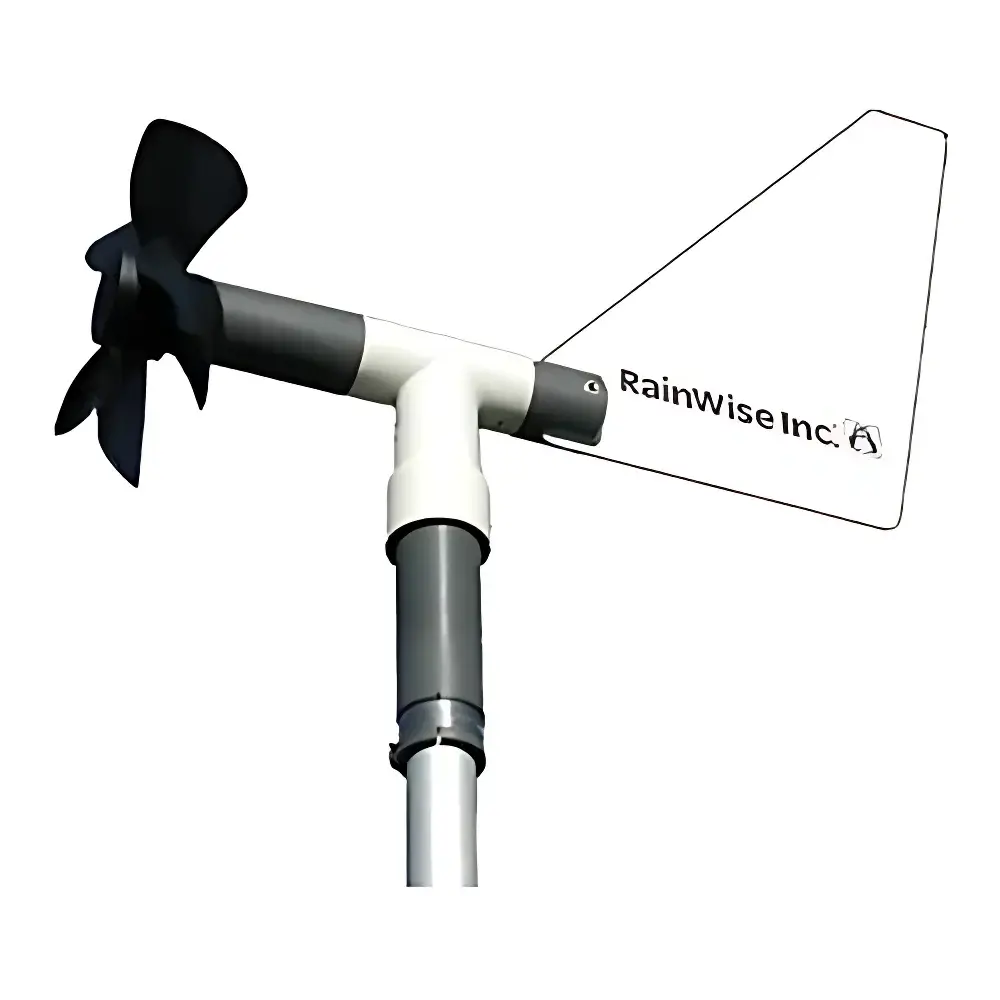
RainWise AerVane Wind Speed and Wind Direction Sensor
| Brand | RainWise |
|---|---|
| Origin | USA |
| Model | AerVane |
| Resolution | 0.1 m/s (wind speed), ±1° (wind direction) |
| Measurement Range | 0–60 m/s (sustained), up to 75 m/s (gust) |
| Accuracy | ±1.0% of reading (wind speed), ±1° (wind direction) |
| Operating Temperature | −55°C to +70°C |
| Relative Humidity Range | 0–100% RH |
| Startup Wind Speed | ≤0.36 m/s (anemometer), ≤0.5 m/s (vane) |
| Bearing Type | Stainless steel ball bearing |
| Output Options | RS-232 digital, 4–20 mA, 0–1 VDC, or custom analog |
| Housing Materials | Anodized aluminum, stainless steel, UV-stabilized PVC, Lexan® polycarbonate |
| Compliance | EPA-compliant, NIST-traceable calibration |
Overview
The RainWise AerVane is a high-reliability, dual-parameter meteorological sensor engineered for continuous, long-term wind speed and wind direction measurement in demanding environmental monitoring applications. It integrates a precision 5-blade propeller anemometer and a balanced wind vane into a single, compact housing—operating on proven electromechanical transduction principles. Wind speed is measured via optical interruption: rotation of the stainless steel–supported propeller drives a slotted disk past an infrared photointerrupter, generating frequency-proportional pulses. Wind direction is determined by a low-inertia, aerodynamically balanced vane that rotates a conductive wiper across a precision resistive potentiometer—delivering absolute angular position without mechanical dead zones. This architecture ensures true 0–360° coverage with no blind sectors, enabling unambiguous directional characterization critical for air quality modeling, emissions compliance reporting, and boundary-layer meteorology.
Key Features
- Full 360° wind direction sensing with zero dead zone and ±1° accuracy—validated against NIST-traceable reference standards
- Stainless steel ball-bearing assembly for the propeller ensures minimal friction, low hysteresis, and extended service life under icing, dust, and salt-laden conditions
- UV-resistant construction using anodized aluminum, marine-grade stainless steel, Lexan® polycarbonate, and UV-stabilized PVC—certified for outdoor deployment across arctic to tropical climates (−55°C to +70°C)
- Low startup threshold: ≤0.36 m/s for wind speed detection and ≤0.5 m/s for directional response—enabling sensitivity at near-calm conditions relevant to regulatory dispersion modeling
- Multi-protocol output flexibility: standard RS-232 serial interface with ASCII command set; optional 4–20 mA, 0–1 VDC, or user-defined analog outputs compatible with SCADA, PLC, and data loggers
- EPA Method EQOA-0010 compliant design—meets and exceeds U.S. Environmental Protection Agency requirements for ambient air monitoring networks and regulatory-grade meteorological support
Sample Compatibility & Compliance
The AerVane is designed for permanent outdoor installation on meteorological towers, EPA-certified air quality monitoring stations, industrial fence-line monitoring systems, and research-grade micrometeorological arrays. Its materials and sealing meet IP65 ingress protection requirements for rain, snow, and particulate resistance. Calibration is performed against NIST-traceable wind tunnel standards per ISO/IEC 17025-accredited procedures. The sensor supports GLP-aligned documentation packages—including calibration certificates with uncertainty budgets—and is suitable for deployments requiring adherence to 40 CFR Part 58 (Ambient Air Monitoring), ASTM D5485 (Standard Practice for Meteorological Measurements), and EU Directive 2008/50/EC Annex IX (Air Quality Assessment).
Software & Data Management
The AerVane operates as a standalone smart sensor with no embedded firmware dependencies. RS-232 output delivers ASCII-formatted data packets containing timestamped wind speed (m/s), wind direction (degrees), and diagnostic flags (e.g., sensor health, signal saturation). Integration with third-party platforms—including Campbell Scientific LoggerNet, CRBasic, and NOAA’s MADIS—is supported via documented command syntax and configurable polling intervals. For analog output configurations, linearity is maintained across full scale with <±0.1% FSO nonlinearity. All calibration coefficients are factory-programmed and retained through power cycles. Audit-ready data logs—including raw pulse counts and temperature-compensated outputs—can be archived in compliance with 21 CFR Part 11 when paired with validated acquisition software.
Applications
- Ambient air quality monitoring networks requiring co-located, EPA-compliant wind data for pollutant dispersion modeling and source attribution
- Industrial stack testing and fence-line monitoring per EPA Method 9 and 40 CFR Part 60 Subpart A
- Renewable energy site assessment—especially for small-wind feasibility studies where low-wind sensitivity and directional fidelity are essential
- Wildfire behavior prediction systems relying on real-time boundary-layer wind shear and gust detection
- University and government atmospheric science field campaigns requiring ruggedized, transportable instrumentation with traceable metrology
- Urban heat island and microclimate studies integrating multi-node wireless sensor networks
FAQ
Is the AerVane certified for regulatory use in U.S. EPA ambient monitoring programs?
Yes—the AerVane meets all performance criteria outlined in EPA Guidance Document EQOA-0010 and is routinely deployed in State and Local Air Monitoring Stations (SLAMS) and National Core Networks.
What is the recommended recalibration interval?
RainWise recommends annual verification against a traceable wind tunnel standard; however, field validation using co-located reference sensors may extend intervals per your QA/QC protocol.
Can the AerVane operate in freezing fog or rime ice conditions?
The sensor’s low-friction bearing system and hydrophobic housing surfaces mitigate ice accumulation, but for persistent icing environments, supplemental heating or passive anti-icing mounts are advised.
Does the RS-232 interface support Modbus RTU or SDI-12 protocols?
No—the native protocol is proprietary ASCII; however, protocol converters or middleware gateways can enable Modbus or SDI-12 translation upon request.
Is there a version with integrated temperature or humidity sensing?
The standalone AerVane does not include auxiliary sensors, but RainWise offers the MetStation series for fully integrated multi-parameter environmental nodes.
Related Products







