
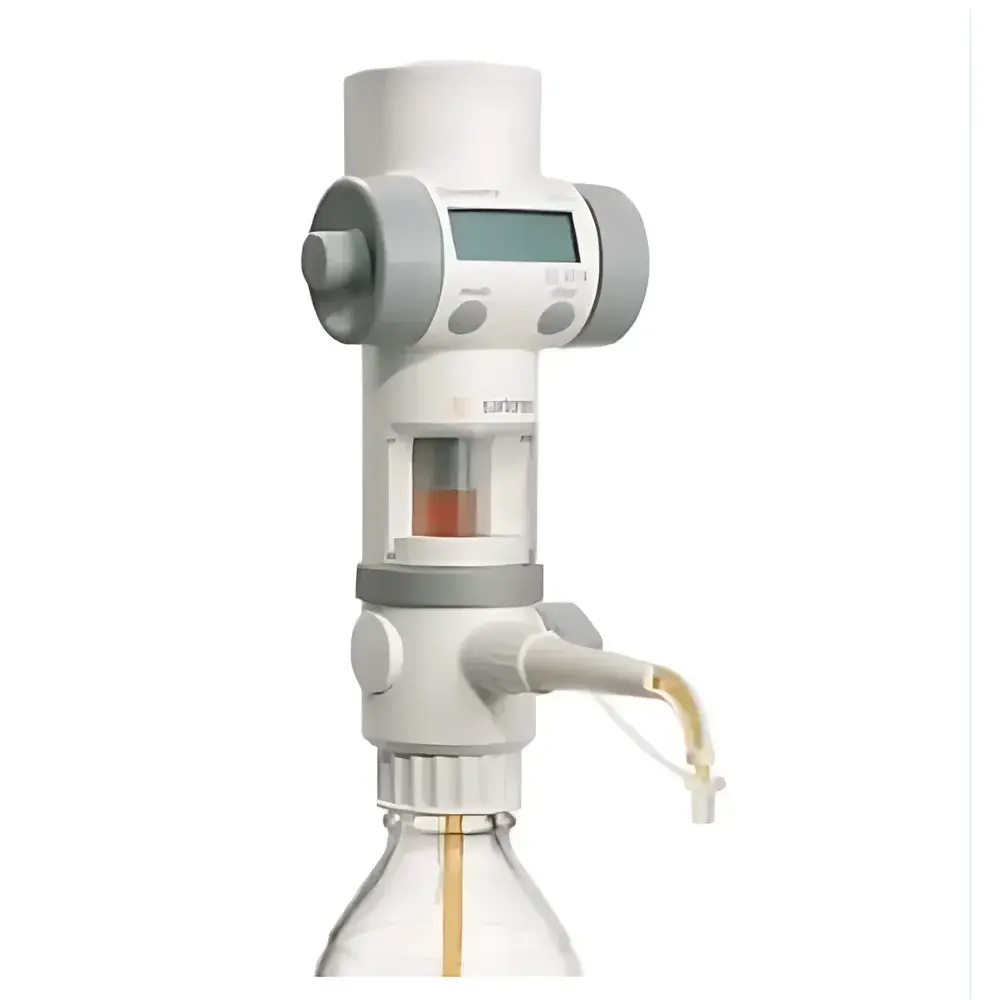
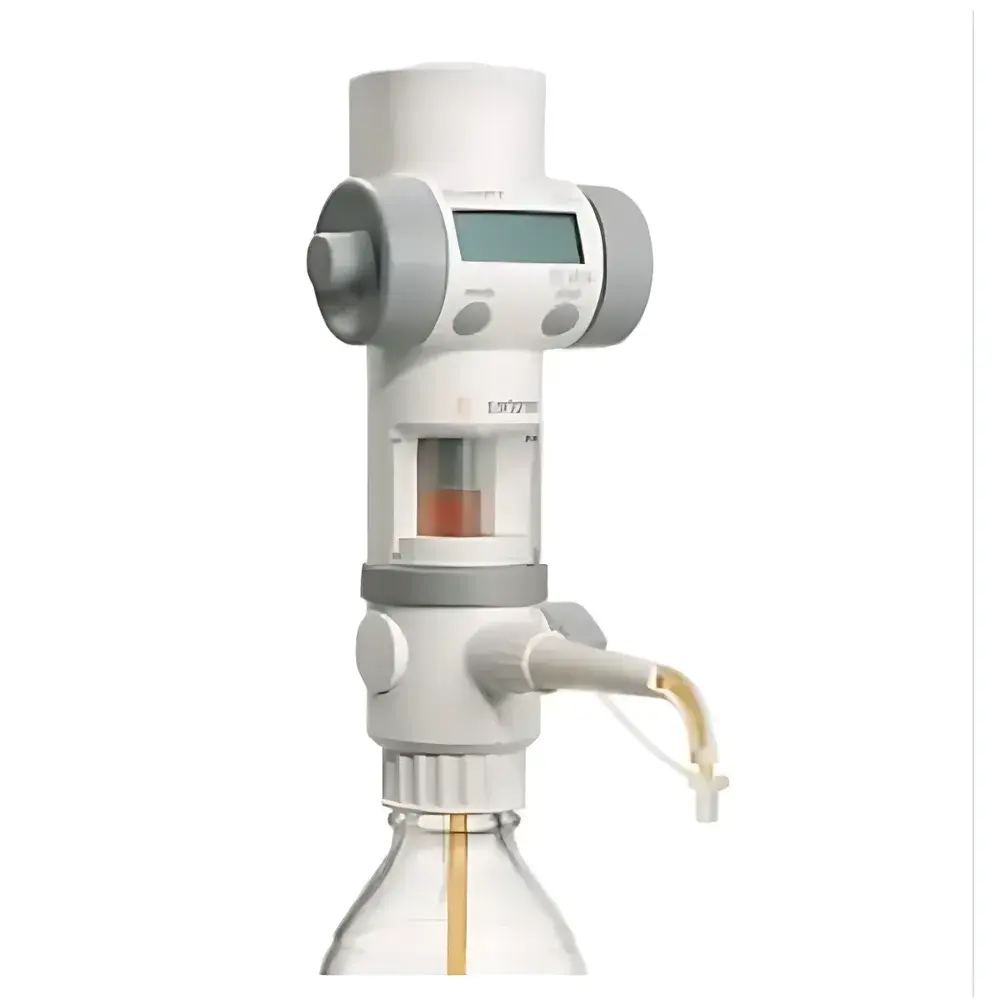
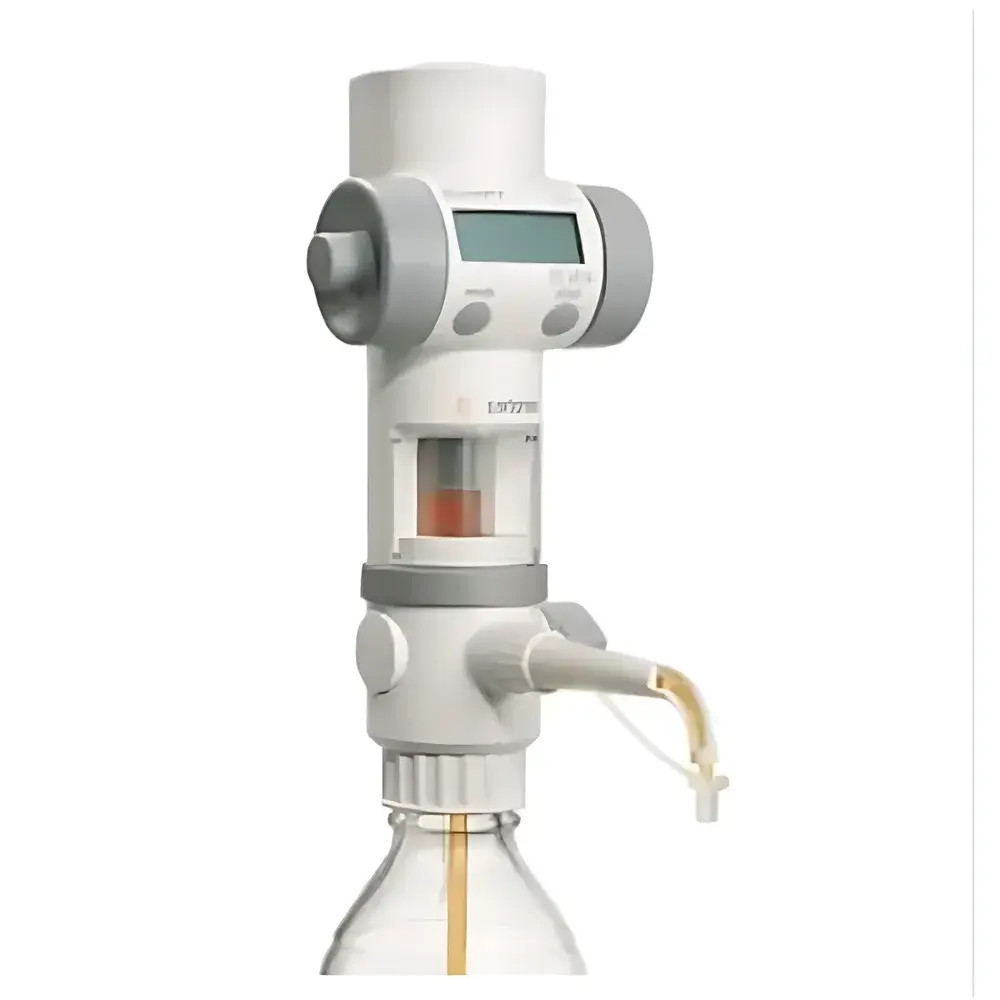
Sartorius Biotrate LH-723081 Bottle-Top Digital Buret
| Brand | Sartorius |
|---|---|
| Origin | Germany |
| Model | LH-723081 |
| Titration Range | 0.1–10 mL |
| Dispensing Accuracy | ≤ ±0.2% |
| Dispensing Resolution | 0.001 mL |
| Display Resolution | 0.001 mL |
| Display Accuracy | ±0.1% |
| Valve Type | Replaceable PTFE/FFKM |
| Sterilization | Autoclavable Fluid Path |
| Light Protection | Amber Window Option |
| Media Recirculation | Integrated |
Overview
The Sartorius Biotrate LH-723081 is a high-precision, bottle-top digital buret engineered for manual and semi-automated potentiometric titration workflows in regulated laboratory environments. Unlike conventional syringe-based or piston-driven dispensers, the Biotrate employs a precision-machined glass or PTFE-coated piston assembly coupled with an optical encoder system to deliver repeatable volumetric delivery across its full 0.1–10 mL range. Its design conforms to the functional requirements of automatic potentiometric titration systems—serving as a calibrated, operator-controlled dispensing module compatible with pH, redox, ion-selective, and conductometric sensors. The instrument operates on a closed-loop principle: volume displacement is continuously monitored via real-time encoder feedback, enabling traceable, GLP-compliant manual titrations without reliance on external software control. Its German-engineered construction ensures long-term dimensional stability under repeated chemical exposure and thermal cycling.
Key Features
- Precision optical encoder system providing 0.001 mL resolution and ≤ ±0.2% volumetric accuracy per ISO 8655-3 (burets) and ASTM E287 for volumetric dispensing devices
- 360° rotatable dispensing head with ergonomic locking mechanism—enabling unobstructed access to narrow-neck reagent bottles and multi-position flask alignment
- Autoclavable fluid path (121°C, 20 min, 1 bar), including piston, cylinder, and valve housing—validated for repeated sterilization without performance drift
- Integrated media recirculation channel returning unused titrant to the source bottle, minimizing waste and preventing air entrapment during low-volume additions
- Amber polycarbonate viewing window (replaceable) for photolabile reagents (e.g., iodine, silver nitrate, ceric sulfate), compliant with ICH Q5C light-stability guidelines
- Modular valve system with chemically resistant PTFE/FFKM seals—field-replaceable without tools; certified for use with acids (≤6 M HCl), bases (≤5 M NaOH), organic solvents (acetone, methanol, THF), and halogenated media
- Backlit LCD display with dual-unit readout (mL and % fill level); display accuracy ±0.1% of full scale, traceable to NIST-traceable calibrators
Sample Compatibility & Compliance
The Biotrate LH-723081 supports direct integration into ISO/IEC 17025-accredited QC laboratories performing titrimetric assays per USP , EP 2.2.20, and ASTM D974 (acid number), D664 (TAN), and D4739 (base number). Its materials of construction—borosilicate glass, FFKM elastomers, and PTFE-lined stainless steel—meet USP Class VI biocompatibility and FDA 21 CFR 177.2400 requirements for reagent contact surfaces. All calibration records, user-defined dispensing sequences, and maintenance logs are retained locally on-device memory (non-volatile EEPROM) and support audit trail generation when paired with Sartorius LabX software. Device firmware complies with IEC 61326-1 (EMC) and IEC 61010-1 (safety), with CE marking for EU laboratory use.
Software & Data Management
While the LH-723081 operates independently as a standalone buret, it is fully interoperable with Sartorius LabX Titration Software (v3.5+). LabX enables method-driven operation—including pre-programmed equivalence point detection algorithms (first/second derivative, fixed increment, pH-stat), automatic blank correction, and multi-step titration sequences. All dispensed volumes are timestamped and linked to user ID, sample ID, and sensor readings. Data export formats include PDF reports (21 CFR Part 11–compliant with electronic signatures), CSV for LIMS ingestion, and XML for ELN integration. Audit trails record all parameter changes, calibration events, and firmware updates with immutable hash verification.
Applications
- Standardization of titrants (e.g., NaOH, HCl, EDTA, AgNO₃) in pharmaceutical raw material release testing
- Determination of acid/base values in lubricants, biodiesel (ASTM D664/D974), and edible oils
- Chloride quantification in water and wastewater per APHA 3111B and ISO 9297
- Redox titrations for iron content (dichromate method) and dissolved oxygen (Winkler method)
- Non-aqueous titrations (e.g., perchloric acid in glacial acetic acid) requiring inert atmosphere compatibility
- Method development and validation studies where manual titration reproducibility must meet RSD ≤ 0.3% (n=10)
FAQ
Is the LH-723081 suitable for use with hydrofluoric acid (HF)?
No. HF attacks glass components and degrades FFKM seals; use only with HF-compatible alternatives (e.g., PFA-lined dispensers) per manufacturer’s chemical resistance guide.
Can the device be calibrated in-house using standard weight methods?
Yes. Calibration follows ISO 8655-6 gravimetric procedures using certified weights and Class A distilled water at 20°C; certificate templates are provided in LabX.
Does the media recirculation function affect titrant concentration over time?
No. Recirculation occurs only within the sealed dispensing head and does not introduce mixing or dilution; validated for ≥500 cycles without measurable concentration shift (per IC assay).
What is the maximum operating temperature for continuous use?
Ambient 15–30°C; short-term exposure up to 40°C permitted if humidity remains <60% RH to prevent encoder condensation.
How often must the valve assembly be replaced under routine QC use?
Every 12 months or after 5,000 dispensing cycles—whichever occurs first—as documented in the maintenance log and tracked by LabX.
Related Products






