
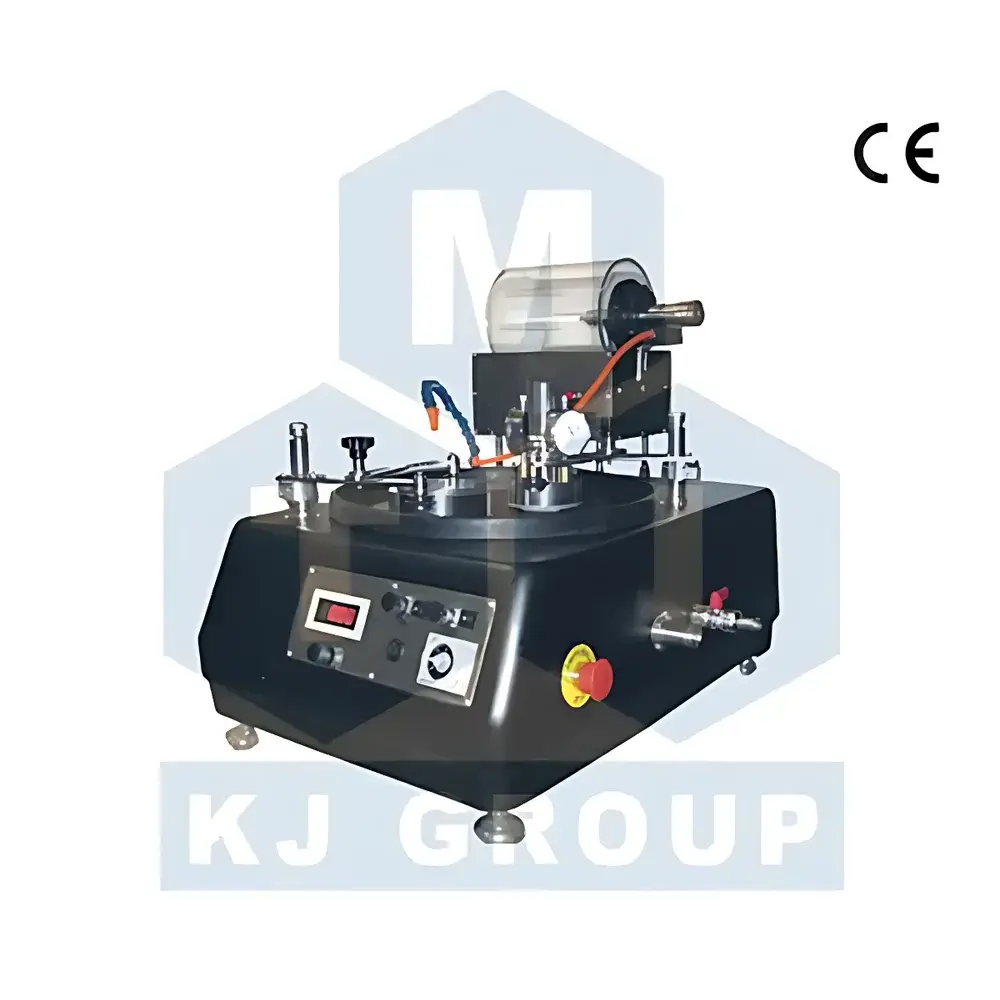
Unipol-1202 Automatic Precision Lapping and Polishing Machine
| Brand | Hefei Kejing |
|---|---|
| Origin | Anhui, China |
| Manufacturer Type | Authorized Distributor |
| Country of Origin | China |
| Model | Unipol-1202 |
| Price Range | USD 1,400–7,200 |
| Grinding Plate Diameter | 300 mm |
| Workstations | 2 |
| Platen Rotation Speed | 0–125 rpm |
| Oscillation Frequency | 9 cycles/min |
| Carrier Plate Diameter | 105 mm |
| Platen Flatness | <0.0025 mm per 25×25 mm area |
| Spindle Runout (at platen) | <0.010 mm |
| Power Supply | 110/220 V AC |
| Motor Power | 245 W |
| Dimensions (L×W×H) | 700 × 475 × 300 mm |
| Net Weight | 67 kg |
| Certifications | CE Certified |
| Warranty | 1 year standard, lifetime technical support |
Overview
The Unipol-1202 Automatic Precision Lapping and Polishing Machine is an engineered solution for high-accuracy planar surface preparation in materials science laboratories and quality control environments. Designed around the principles of controlled mechanical abrasion and hydrodynamic slurry delivery, the system enables reproducible removal of material from flat, brittle, or ductile specimens—including single crystals, sintered ceramics, optical glasses, metallic alloys, geological thin sections, PCB substrates, and fiber-reinforced composites. Its dual-station architecture supports parallel processing of two samples under identical kinematic conditions, minimizing inter-run variability. The machine operates on a co-rotational lapping principle: the specimen carrier rotates while oscillating radially across the stationary grinding plate—ensuring uniform wear distribution and eliminating edge rounding or center-thickness bias common in unidirectional systems. Critical metrological features—including sub-micron platen flatness and sub-10 µm spindle runout—are maintained via precision-ground cast-iron base construction and preloaded angular-contact bearings.
Key Features
- Dual independent workstations with synchronized motion control, enabling comparative studies or throughput optimization without cross-contamination.
- Digitally displayed infinitely variable speed regulation (0–125 rpm) for precise adaptation to material hardness, abrasive type, and desired removal rate.
- Programmable digital timer with auto-shutdown functionality ensures repeatability across batches and eliminates operator-dependent endpoint determination.
- High-flatness 300 mm diameter grinding plate (flatness ≤0.0025 mm over any 25×25 mm zone), certified via optical interferometry and traceable to national metrology standards.
- Low-runout rotational axis (<0.010 mm TIR at platen interface), achieved through dynamic balancing and precision-machined spindle housing, critical for achieving sub-µm thickness uniformity.
- Modular fluid delivery compatibility: supports SKZD-2 programmable dropper for timed reagent dosing or YJXZ-12 recirculating slurry pump for continuous abrasive suspension management.
Sample Compatibility & Compliance
The Unipol-1202 accommodates circular specimens up to Ø100 mm or rectangular samples with maximum dimensions of 100×100 mm. It is routinely deployed in ASTM E3–22 (Standard Guide for Preparation of Metallographic Specimens), ISO 14857 (Geological Thin Section Preparation), and IPC-TM-650 2.2.17 (PCB Laminate Planarization) workflows. All electrical components comply with CE Directive 2014/30/EU (EMC) and 2014/35/EU (LVD). Mechanical design adheres to ISO 12100:2010 (Safety of Machinery) principles, including guarded drive enclosures and emergency stop circuit integration. While not inherently GLP/GMP validated, the system’s programmable parameters, digital logging capability (when paired with GPC-50 controller), and repeatable endpoint control support audit-ready documentation in regulated QC labs.
Software & Data Management
The base Unipol-1202 operates via front-panel digital controls; however, optional integration with the GPC-50 Precision Lapping Control Unit adds RS-232/USB connectivity, parameter logging (speed, time, oscillation count), and user-defined recipe storage (up to 99 protocols). When used with the “00”-grade micrometer-based thickness gauge (GPC-50 compatible), real-time thickness deviation feedback can be correlated with process variables for statistical process control (SPC) charting. Data export is supported in CSV format for import into LIMS or Excel-based QA reporting frameworks. No proprietary cloud platform is required—data remains locally stored and fully exportable, satisfying FDA 21 CFR Part 11 requirements when combined with institutional electronic signature policies.
Applications
- Preparation of transmission electron microscopy (TEM) foils requiring nanometer-scale thickness uniformity and minimal subsurface damage.
- Final polishing of optical substrates (e.g., fused silica, CaF₂) prior to anti-reflective coating deposition.
- Thickness calibration of geological petrographic thin sections for quantitative mineralogical analysis.
- Planarization of sintered ceramic green bodies prior to dilatometric sintering studies.
- Surface conditioning of battery electrode coatings on Cu/Al foil substrates for adhesion testing per ASTM D4541.
- Routine QC of PCB laminate flatness per IPC-4101D specifications before drilling or metallization.
FAQ
What types of abrasives are compatible with the Unipol-1202?
Silicon carbide, aluminum oxide, diamond suspensions (0.25–30 µm), and colloidal silica slurries are routinely used. Slurry viscosity and pH must remain within manufacturer-specified limits for pump/dropper modules.
Can the machine be integrated into automated lab workflows?
Yes—via RS-232 or USB interface (with GPC-50 controller), it supports external trigger signals and accepts ASCII command sets for integration into centralized lab automation platforms.
Is the CE marking valid for use in North America?
CE certification confirms compliance with EU safety directives; for U.S./Canada deployment, users must verify local electrical codes (e.g., UL 61010-1) and may require third-party field evaluation.
How is platen flatness verified during routine maintenance?
Flatness should be checked quarterly using a calibrated optical flat (λ/20 grade) and monochromatic light source; deviations exceeding 0.003 mm/25×25 mm warrant professional resurfacing.
Does the warranty cover consumable parts such as grinding plates or carrier holders?
No—the 1-year warranty covers defects in materials and workmanship of the main unit only; plates, carriers, and drive belts are considered consumables and excluded unless failure results from manufacturing defect.



