
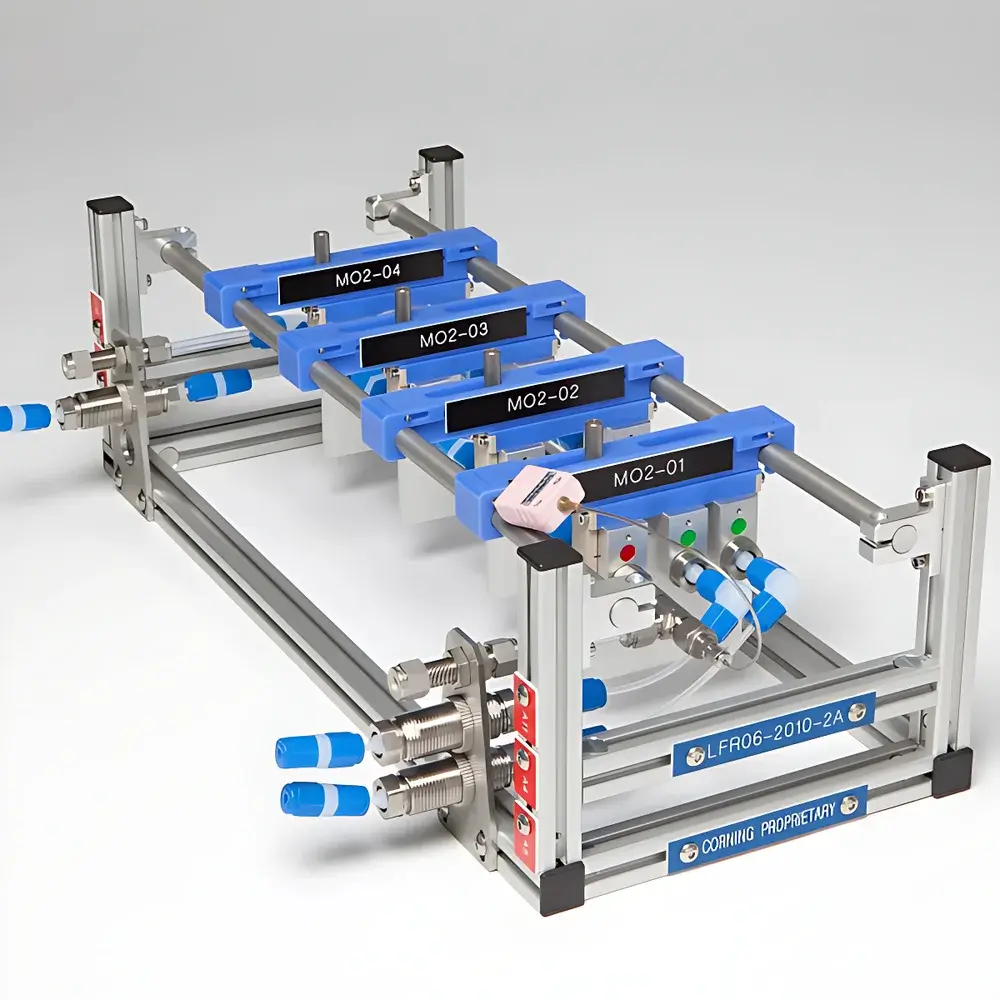
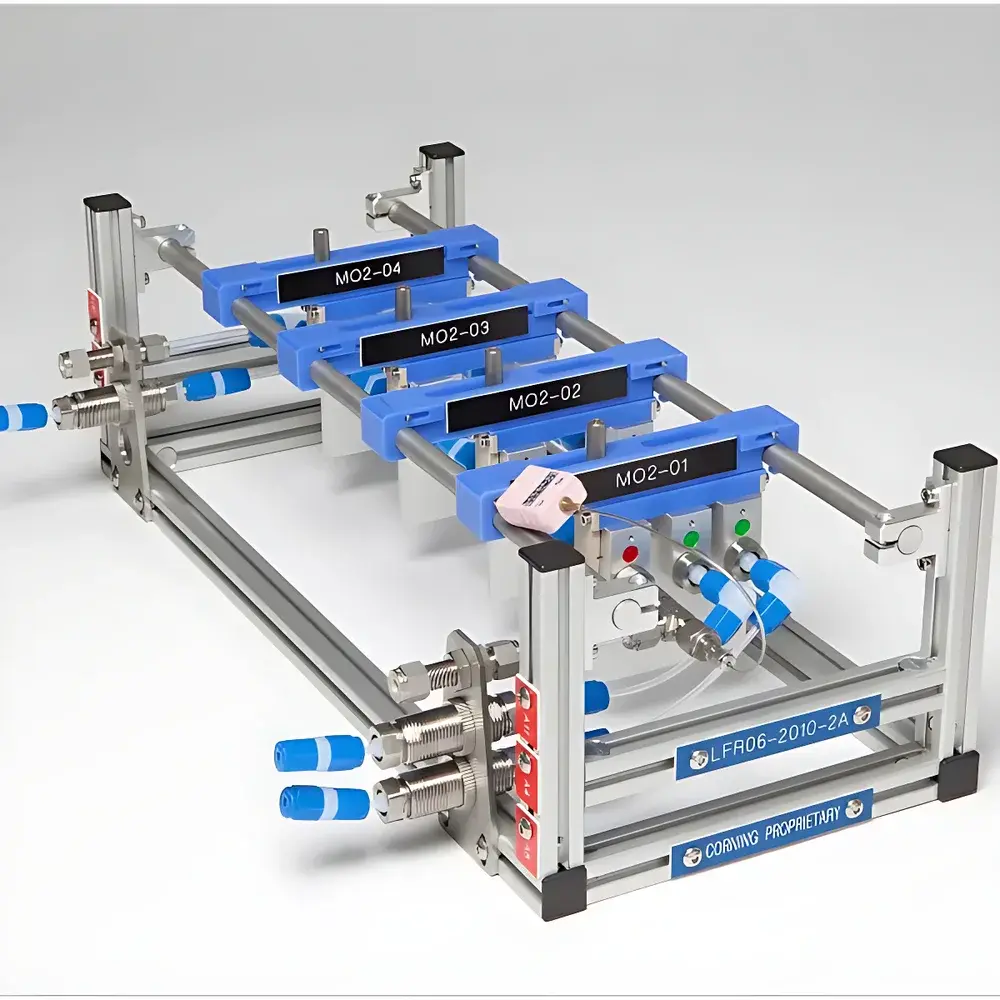
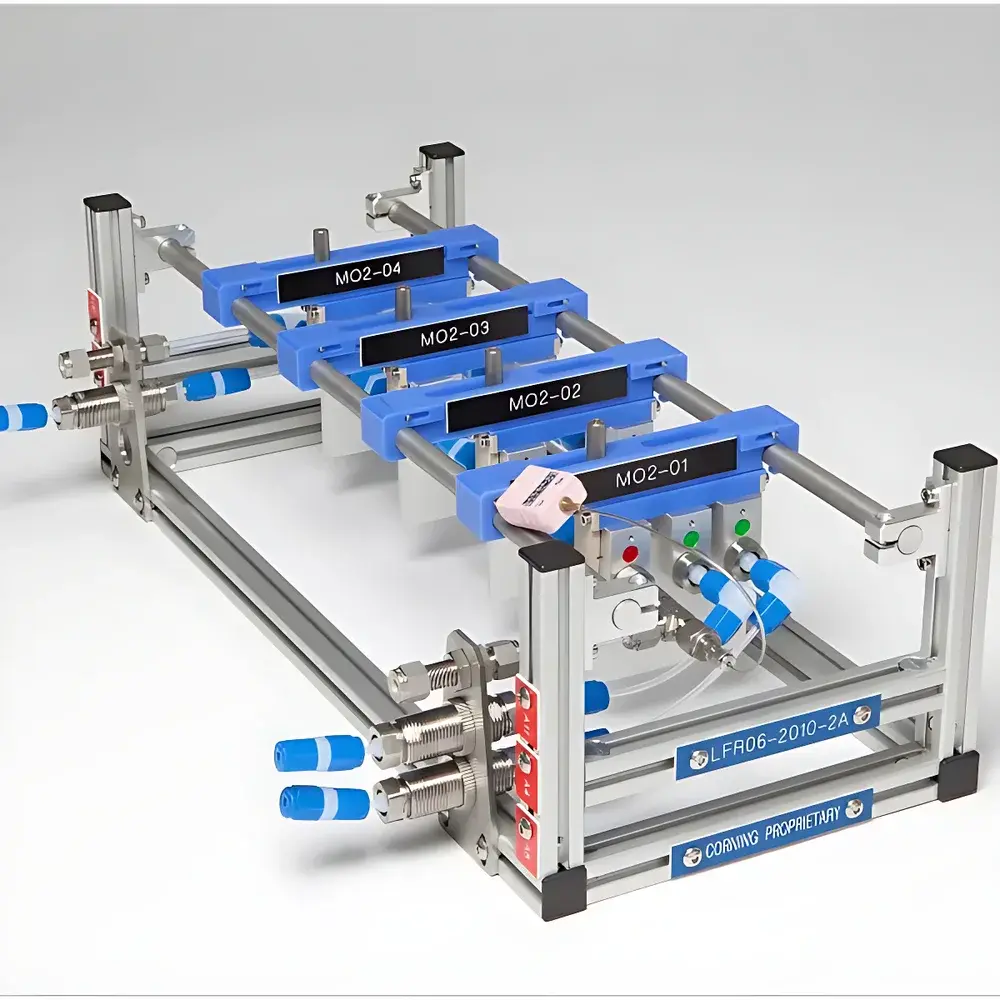
Corning G1 SiC Microchannel Continuous Flow Reactor
| Brand | Corning |
|---|---|
| Origin | USA |
| Manufacturer Status | Authorized Distributor |
| Product Category | Imported |
| Model | G1 SiC |
| Pricing | Upon Request |
| Instrument Type | Microchannel Reactor |
| Sample Volume Capacity | Trace (≤2.5 mL) |
| Construction Material | Silicon Carbide (SiC) |
| Operating Pressure Range | Medium Pressure (up to 18 bar) |
| Total Internal Volume | 1.7 mL (per reactor unit, configurable) |
Overview
The Corning G1 SiC Microchannel Continuous Flow Reactor is an engineered platform for precision-controlled, scalable continuous flow chemistry in laboratory-scale process development and kilogram-scale custom synthesis. Built on Corning’s proprietary silicon carbide (SiC) microstructured architecture, the system leverages laminar flow hydrodynamics and high surface-area-to-volume ratios to deliver exceptional heat transfer coefficients (>10,000 W/m²·K) and mass transfer rates—enabling rapid thermal equilibration and near-instantaneous mixing. Unlike traditional batch reactors, the G1 SiC operates under fully defined boundary conditions with negligible axial dispersion, ensuring reproducible residence time distributions (RTDs) and eliminating scale-up uncertainties associated with mixing or heat removal limitations. Its modular design comprises two independent reaction modules—Reactor-A and Reactor-B—each with a nominal internal volume of 1.7 mL, which can be operated in parallel, series, or as standalone units to accommodate sequential reactions, residence time tuning, or multi-step synthetic workflows.
Key Features
- Monolithic silicon carbide (SiC) fluidic architecture—chemically inert across pH 0–14, resistant to HF, strong oxidizers, and high-temperature organic solvents.
- Operating temperature range: –25 °C to +200 °C; maximum allowable working pressure: 18 bar (261 psi) at 200 °C.
- Low-flow operation capability: 0–10 mL/min per module, minimizing reagent consumption during reaction screening and kinetic profiling.
- No metallic wetted surfaces—eliminates catalytic leaching, metal contamination, and corrosion-related failure modes common in stainless-steel or Hastelloy-based systems.
- Modular configuration flexibility: Reactor-A and Reactor-B may be decoupled for independent parameter optimization or integrated into cascaded flow paths for multi-stage transformations.
- Integrated thermal management: Dual-path heat exchange channels surrounding each microchannel layer ensure uniform axial temperature profiles and suppress hot/cold spots.
Sample Compatibility & Compliance
The G1 SiC reactor accommodates a broad spectrum of chemistries—including highly exothermic nitrations, lithiations, halogenations, photoredox catalysis (when paired with external LED arrays), and enzymatic transformations—without degradation of structural integrity or performance drift. Its SiC construction complies with ASTM C651 (standard specification for reaction-bonded silicon carbide) and meets ISO 9001 manufacturing traceability requirements. For regulated environments, the system supports integration with validated control software compliant with FDA 21 CFR Part 11 for electronic records and signatures, and its deterministic flow behavior facilitates alignment with ICH Q5A (viral clearance modeling) and Q8(R2) (pharmaceutical development) frameworks where continuous processing is applied to API synthesis.
Software & Data Management
While the G1 SiC hardware operates as a stand-alone flow module, it is designed for seamless integration with third-party pumping systems (e.g., HPLC-grade syringe or diaphragm pumps), back-pressure regulators (BPRs), inline IR/UV-Vis spectrophotometers, and PLC-based supervisory control platforms. Process data—including flow rate, temperature setpoints, pressure readings, and real-time spectroscopic output—is aggregated via OPC UA or Modbus TCP protocols. When deployed within a validated digital lab infrastructure, audit trails, user access controls, and electronic batch records (EBRs) can be maintained in accordance with GLP and GMP documentation standards.
Applications
- Rapid screening of reaction parameters (residence time, stoichiometry, temperature) for route scouting and kinetic modeling.
- Safe execution of hazardous chemistries—e.g., diazotizations, azide couplings, and ozonolyses—via inherent thermal runaway mitigation.
- Continuous production of high-value intermediates for pharmaceuticals, agrochemicals, and specialty polymers at pilot scale (0.5–5 kg/batch equivalent).
- Development of continuous downstream processing trains, including inline quenching, liquid–liquid extraction, and crystallization modules.
- Education and training in flow chemistry principles, residence time distribution analysis, and process intensification strategies.
FAQ
What is the maximum operating temperature and pressure for the G1 SiC reactor?
The reactor is rated for continuous operation up to 200 °C and 18 bar, with full mechanical and chemical stability verified per Corning’s accelerated aging protocols.
Can the G1 SiC be used for photochemical reactions?
Yes—the SiC substrate is optically transparent in the UV-A to visible range (320–700 nm); when coupled with externally mounted collimated light sources, it supports homogeneous and heterogeneous photocatalytic transformations.
Is the internal volume truly fixed at 1.7 mL?
The nominal active volume per module is 1.7 mL; however, total system volume—including inter-module tubing and fittings—must be accounted for during residence time calculations and method transfer.
How does the G1 SiC compare to glass or fluoropolymer microreactors?
SiC offers superior thermal conductivity (~120 W/m·K vs. ~1.0 W/m·K for glass), higher pressure tolerance, and broader chemical resistance—particularly against strong bases and elevated-temperature halogenated solvents.
Does Corning provide application support for process development?
Yes—Corning’s Global Applications Lab offers collaborative feasibility studies, residence time modeling, and scale-up guidance aligned with Quality by Design (QbD) principles.



