
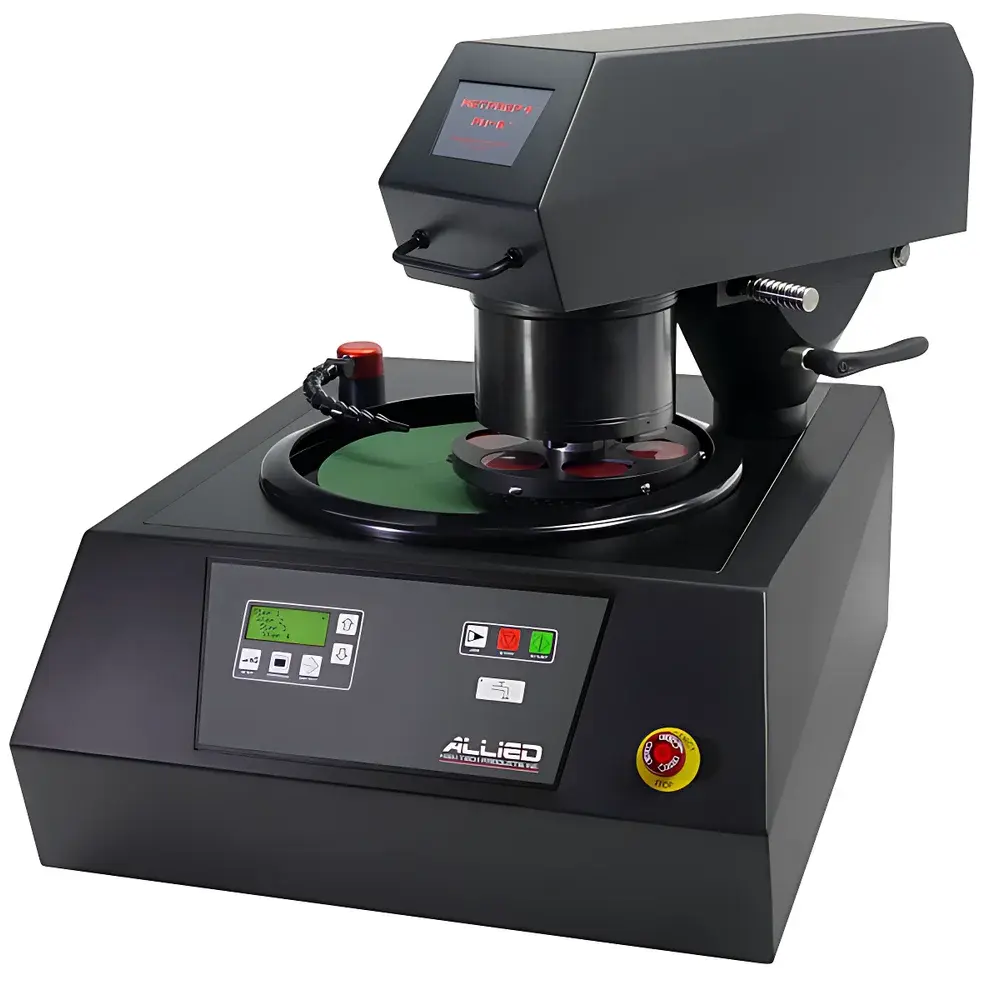
Allied MetPrep 4™ Automatic Grinding and Polishing System
| Brand | Allied |
|---|---|
| Origin | USA |
| Model | MetPrep 4™ |
| Dimensions (L×W×D) | 610 × 711 × 610 mm |
| Motor Power | 0.5 hp (375 W) |
| Control | Microprocessor-based with 25 programmable protocols |
| Grinding Head Options | PH-4™ (up to 9 samples) or PH-6™ (up to 12 samples) |
| Force Application | Pneumatic-electronic, ring-load or point-load mode |
| Sample Rotation Speed | 0–150 rpm (10 rpm increments) |
| Platen Rotation | Bidirectional, variable speed |
| Timing Range | 0–120 min (15-sec resolution) |
| Safety | Interlocked corrosion-resistant shield, emergency stop, LED-backlit LCD interface |
Overview
The Allied MetPrep 4™ Automatic Grinding and Polishing System is a precision-engineered, microprocessor-controlled specimen preparation platform designed for reproducible metallographic, geological, and ceramic sample preparation in industrial QA/QC laboratories and academic research facilities. Built upon the foundational principles of controlled mechanical abrasion and planar material removal, the system employs synchronized platen rotation, programmable head motion, and pneumatically regulated sample force to deliver consistent surface geometry, minimal edge rounding, and optimal subsurface integrity across diverse material classes—including ferrous and non-ferrous alloys, composites, sintered carbides, and brittle ceramics. Its architecture integrates deterministic kinematics (e.g., orbital, unidirectional, or oscillatory head motion) with real-time parameter feedback, enabling strict adherence to ASTM E3, ISO 13083, and ASTM E407 standards for microstructural evaluation. Designed and manufactured in the United States, the MetPrep 4™ serves as a core component in GLP-compliant workflows where traceability, repeatability, and audit-ready documentation are required.
Key Features
- Microprocessor-based control system supporting up to 25 fully customizable grinding and polishing protocols—each storing independent settings for start/stop logic, cycle duration, platen direction/speed, head oscillation rate, applied force profile, and fluid dispensing timing.
- Dual-mode pneumatic-electronic force delivery: selectable ring-load or point-load configuration via PH-4™ (9-sample capacity) or PH-6™ (12-sample capacity) grinding heads, ensuring uniform pressure distribution regardless of sample size or fixture geometry.
- Tilt-adjustable head assembly enables unobstructed access to platens and fixtures without repositioning during multi-step preparation sequences—reducing operator intervention and minimizing contamination risk.
- High-torque 0.5 hp (375 W) motor drives a corrosion-resistant anodized aluminum platen with rapid-swap capability; compatible with 8″, 10″, and 12″ diameter consumable discs.
- AD-5 optional automated fluid dispenser enables hands-free delivery of lubricants, coolants, or suspensions according to preprogrammed volume, timing, and flow rate—critical for unattended overnight runs and SOP-driven environments.
- Full-touch membrane keypad with backlit LCD display provides intuitive navigation, real-time parameter visualization, and error-code diagnostics—supporting multilingual UI localization per regional regulatory requirements.
- Integrated safety architecture includes interlocked polycarbonate shield, emergency stop circuit, thermal overload protection, and electronically monitored coolant valve regulation.
Sample Compatibility & Compliance
The MetPrep 4™ accommodates a broad spectrum of specimen geometries through a modular fixture ecosystem: center-force holders ensure planar alignment for balanced multi-sample runs (minimum three specimens); tear-drop fixtures provide adjustable clamping for irregular shapes; dual-chamber carriers enable concurrent processing of circular or asymmetric specimens; and single-point loading fixtures support precise cross-sectional preparation of small or geometrically constrained samples. All fixtures—available in 25 mm to 51 mm diameters and rectangular formats up to 53 × 94 mm—are engineered for compatibility with standard metallographic mounting resins (thermoset and thermoplastic), vacuum impregnation systems, and hot-press mounting presses. The platform conforms to IEC 61000-6-2 (EMC immunity) and UL 61010-1 safety standards. When operated with validated software configurations and audit-trail-enabled data logging (via optional AlliedVision™ software), it supports FDA 21 CFR Part 11 compliance for regulated pharmaceutical and medical device manufacturing environments.
Software & Data Management
While the base MetPrep 4™ operates via embedded firmware, integration with AlliedVision™ PC-based software unlocks advanced data governance capabilities—including electronic signature capture, protocol version control, user access tiering (admin/operator/auditor), and timestamped run logs exportable in CSV or PDF format. Each protocol execution generates a metadata-rich record containing force curves, rotational speed profiles, elapsed time stamps, fluid delivery events, and operator ID—enabling full forensic reconstruction of preparation history. Software-defined calibration routines permit periodic verification of pneumatic force accuracy against NIST-traceable load cells, satisfying ISO/IEC 17025 laboratory accreditation requirements. All data files are stored in encrypted, tamper-evident containers compliant with EU GDPR and HIPAA retention policies.
Applications
- Metallographic analysis of weld zones, heat-affected regions, and grain boundary networks in aerospace-grade superalloys and pipeline steels.
- Preparation of fracture surfaces for SEM-EDS phase mapping and FIB-SEM lamella extraction in failure analysis laboratories.
- Planar thinning of geological thin sections (e.g., igneous and metamorphic rock samples) for transmitted light microscopy and Raman spectroscopy.
- Surface conditioning of ceramic matrix composites (CMCs) and silicon carbide substrates prior to nanoindentation or scratch testing.
- Standardized polishing of coated biomedical implants (e.g., Ti-6Al-4V with HA coatings) to assess interfacial adhesion and coating homogeneity per ISO 13779-2.
FAQ
What voltage options are available for the MetPrep 4™ system?
The MetPrep 4™ is offered in both 115 VAC (50/60 Hz) and 230 VAC (50/60 Hz) configurations to meet regional electrical infrastructure requirements.
Can the system be integrated into a LIMS or MES environment?
Yes—via RS-232 or Ethernet (with AlliedVision™ software), the MetPrep 4™ supports bidirectional communication with laboratory information management systems using ASTM E1384 or HL7-compliant data exchange protocols.
Is validation documentation provided for GMP-regulated use?
Allied supplies IQ/OQ documentation templates, factory calibration certificates, and risk-based URS guidance documents to support equipment qualification under Annex 15 and ASTM E2500 principles.
How frequently does the pneumatic force system require recalibration?
Annual verification against certified reference loads is recommended; however, internal self-diagnostics perform continuous drift monitoring during each operational cycle.
Are consumables such as platens and abrasive discs supplied by Allied?
Allied offers a full portfolio of OEM-certified platens (including diamond-impregnated, resin-bonded, and cloth-backed variants) and proprietary abrasive suspension formulations optimized for specific material families and finish requirements.



