
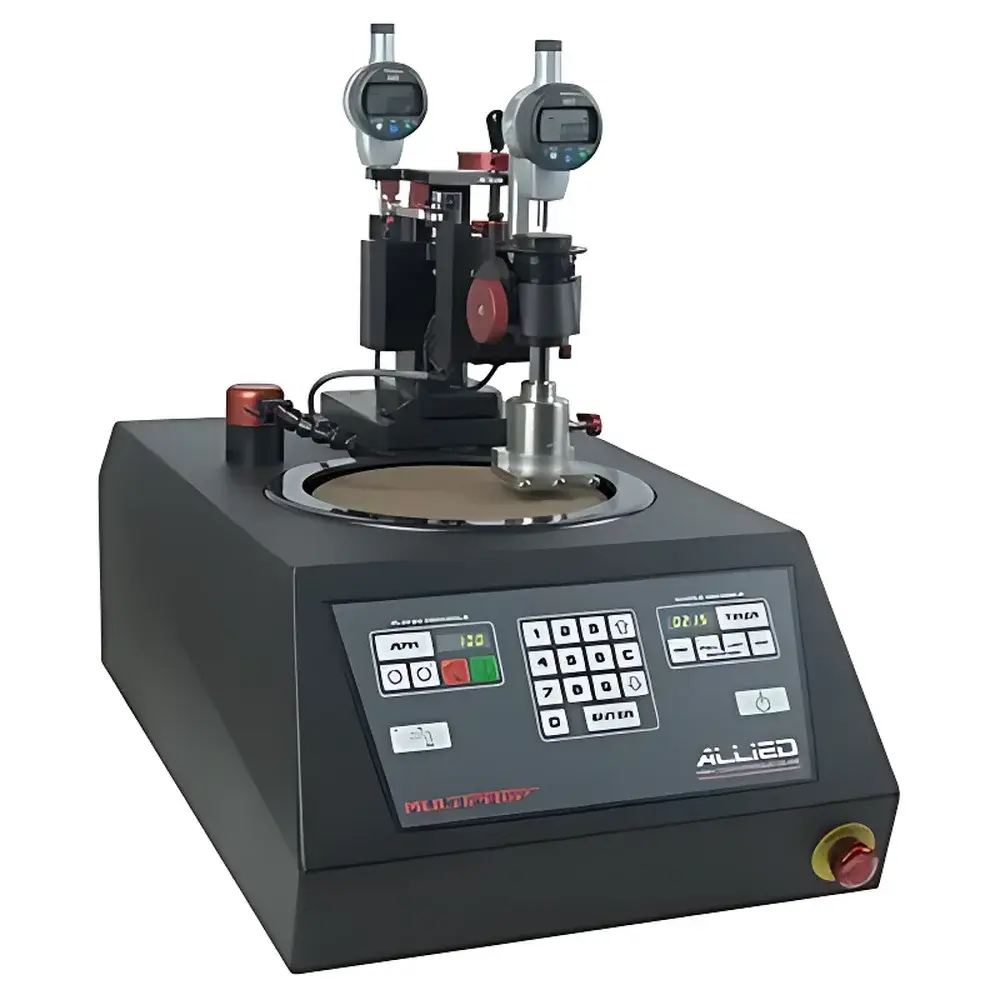
Allied OptiPrep™ Precision Optical Grinding and Polishing System
| Brand | Allied |
|---|---|
| Origin | USA |
| Model | OptiPrep™ |
| Platen Speed | 5–350 RPM (5-RPM increments) |
| Z-Axis Resolution | 1 µm |
| Platen Dimensions | Not specified |
| Number of Platens | Not specified |
| Motor | 0.25 HP (190 W) DC with gear-reduced high-torque output |
| Oscillation Sweep | Adjustable, 6 speeds |
| Sample Rotation Modes | Full or limited automatic, 8 speeds |
| Fixture Interface | Tool-less cam-lock |
| Compliance | CE |
| Warranty | 2 years |
| Dimensions (W×D×H) | 381 × 660 × 508 mm |
| Weight | 43 kg |
| Shipping Dimensions | 838 × 787 × 381 mm |
| Shipping Weight | 57 kg |
Overview
The Allied OptiPrep™ is a purpose-built precision grinding and polishing system engineered exclusively for optical component fabrication and metrology-grade sample preparation. Unlike general-purpose lapidary or metallurgical polishers, the OptiPrep™ employs a geometrically constrained kinematic architecture to maintain strict angular fidelity between the sample surface and platen plane—critical for achieving sub-micron flatness, controlled wedge angles, and repeatable surface figure in fused silica, BK7, CaF₂, sapphire, and other optically transparent substrates. Its core design principle centers on deterministic material removal via fixed-axis kinematics: the cam-lock fixture interface is rigidly referenced parallel to the platen plane, eliminating rotational drift and enabling precise angular orientation through mechanical fixture geometry—not software interpolation. This ensures traceable, reproducible bevel, chamfer, and facet generation required for laser cavity alignment, interferometric calibration standards, and AR/HR coating substrate prep.
Key Features
- Integrated OptiPrep Positioning Device with dual digital indicators: front display shows real-time material removal rate or sample advancement; rear indicator provides static vertical (Z-axis) positioning with 1-µm resolution and zeroing function
- High-torque 0.25 HP (190 W) DC motor coupled to a durable reduction gearbox—maintains consistent torque across full speed range (5–350 RPM in 5-RPM increments)
- Programmable rotation direction (clockwise/counterclockwise), variable oscillation sweep (6 discrete speeds), and selectable full or limited sample rotation (8 speeds) optimize abrasive utilization and edge uniformity
- Tool-less cam-lock fixture interface ensures repeatable, sub-arcsecond repositioning without torque tools—essential for multi-step processes requiring fixture interchangeability
- Quick-change anodized aluminum platen design resists wear and corrosion; bowl-flush housing minimizes abrasive slurry accumulation and simplifies cleaning
- Electronic coolant delivery system with adjustable valve enables precise flow control for diamond, cerium oxide, and colloidal silica slurries—reducing thermal distortion and improving surface finish
- Onboard digital timer and tachometer support unattended operation; touch-pad interface controls all motion and sequencing functions
Sample Compatibility & Compliance
The OptiPrep™ accommodates optical components ranging from <5 mm micro-lenses to 150 mm diameter flats and prisms, provided custom fixtures are employed. Fixture design is integral to process validation—Allied offers engineering consultation for ISO 10110-compliant surface specification alignment (e.g., λ/20 flatness, scratch-dig 10-5). The system complies with CE marking requirements for machinery safety (2006/42/EC) and electromagnetic compatibility (2014/30/EU). While not certified to ISO/IEC 17025 or GLP out-of-the-box, its digital motion logs, repeatable Z-indexing, and programmable sequence execution support audit-ready documentation when integrated into validated laboratory workflows per ISO 9001 or FDA 21 CFR Part 11–aligned data management systems.
Software & Data Management
The OptiPrep™ operates via embedded firmware with no external PC dependency—ensuring deterministic timing and immunity to OS-level latency. All motion parameters (speed, oscillation amplitude, rotation angle, dwell time, Z-step increment) are stored in non-volatile memory and recalled via numeric keypad input. Real-time position feedback from both digital indicators is logged internally with timestamped entries (accessible via USB export). For laboratories requiring electronic records, Allied provides optional API integration kits compatible with LabVantage, Thermo Fisher SampleManager, and custom LIMS deployments—supporting metadata tagging, user authentication, and change-controlled parameter history per ALCOA+ principles.
Applications
- Preparation of interferometric reference flats and transmission spheres per ISO 10110-7
- Beveling and edge-polishing of laser crystals (Nd:YAG, Ti:sapphire) prior to HR coating
- Faceting of nonlinear optical crystals (BBO, LBO, KTP) with angular tolerance ≤ ±5 arcseconds
- Flatness correction of UV-grade fused silica windows for synchrotron beamline optics
- Sub-aperture correction of aspheric mold inserts used in precision glass molding
- Reconditioning of damaged optical contact standards (e.g., gauge blocks, master flats)
FAQ
Does the OptiPrep™ support automated recipe-based processing?
Yes—up to 99 user-defined protocols can be stored, each containing speed, oscillation, rotation mode, Z-step, and dwell time parameters. Recipes execute deterministically without host PC intervention.
Can existing optical fixtures be retrofitted to the OptiPrep™ cam-lock interface?
In most cases, yes. Allied’s Applications Engineering team performs mechanical interface audits and provides CAD-based adapter redesigns—including stress analysis for vacuum-compatible or cryogenic fixtures.
Is coolant flow rate calibrated and traceable?
Coolant valve position is digitally encoded and reproducible within ±2% volumetric error. For GMP environments, optional gravimetric flow verification kits (NIST-traceable) are available.
What maintenance intervals are recommended for the reduction gearbox?
The sealed planetary gearbox requires no scheduled lubrication over its rated service life of 20,000 operational hours. A diagnostic self-test runs at power-up to verify encoder synchronization and motor commutation integrity.
How is process repeatability verified during IQ/OQ qualification?
Allied supplies a Validation Support Package including test fixtures, NIST-traceable step gauges, and protocol templates aligned with ASTM E2921 and ISO 14644-1 cleanroom particulate monitoring requirements for optical fabrication environments.



