
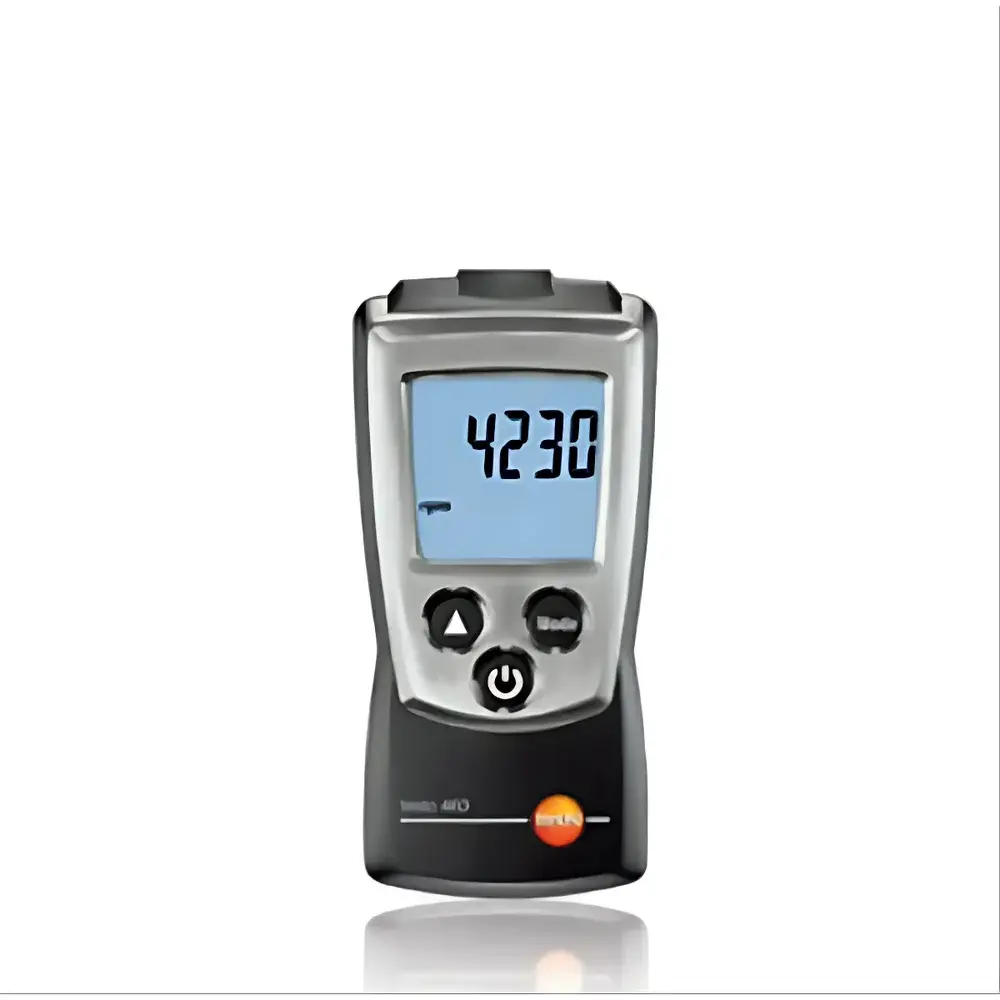
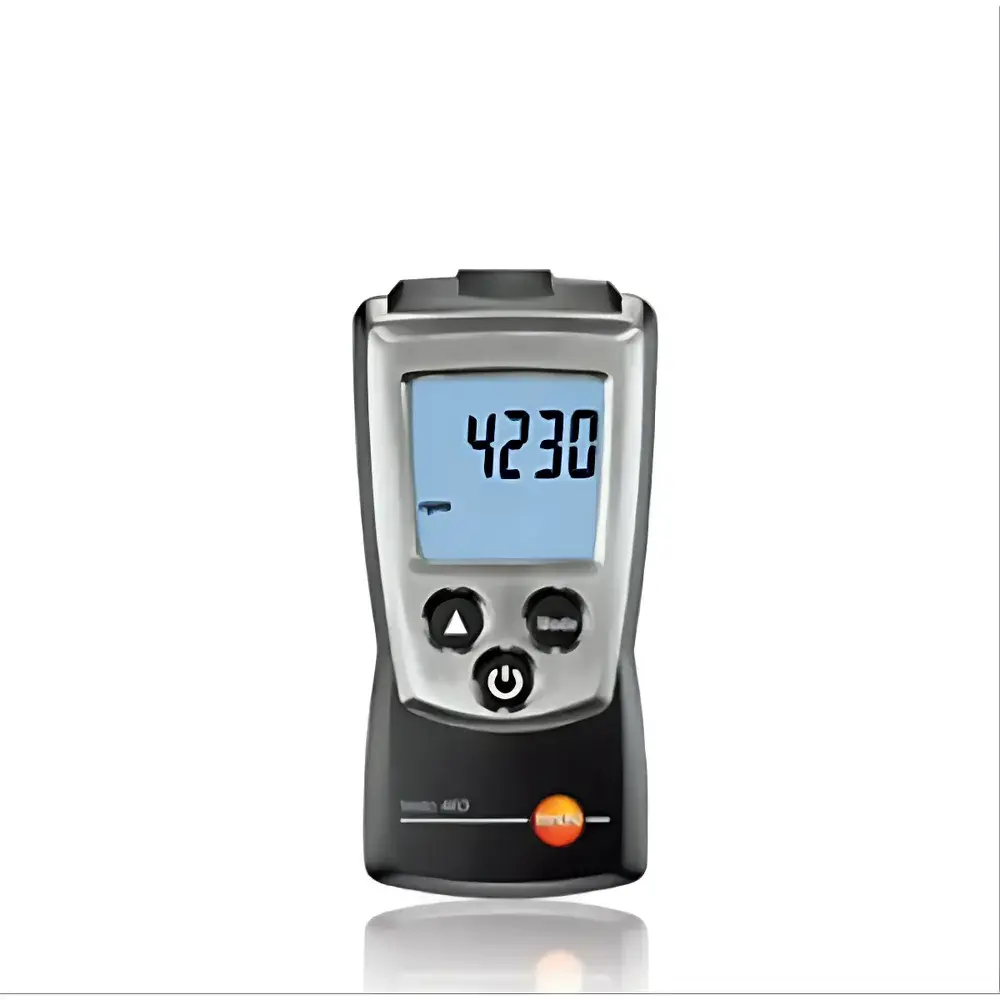
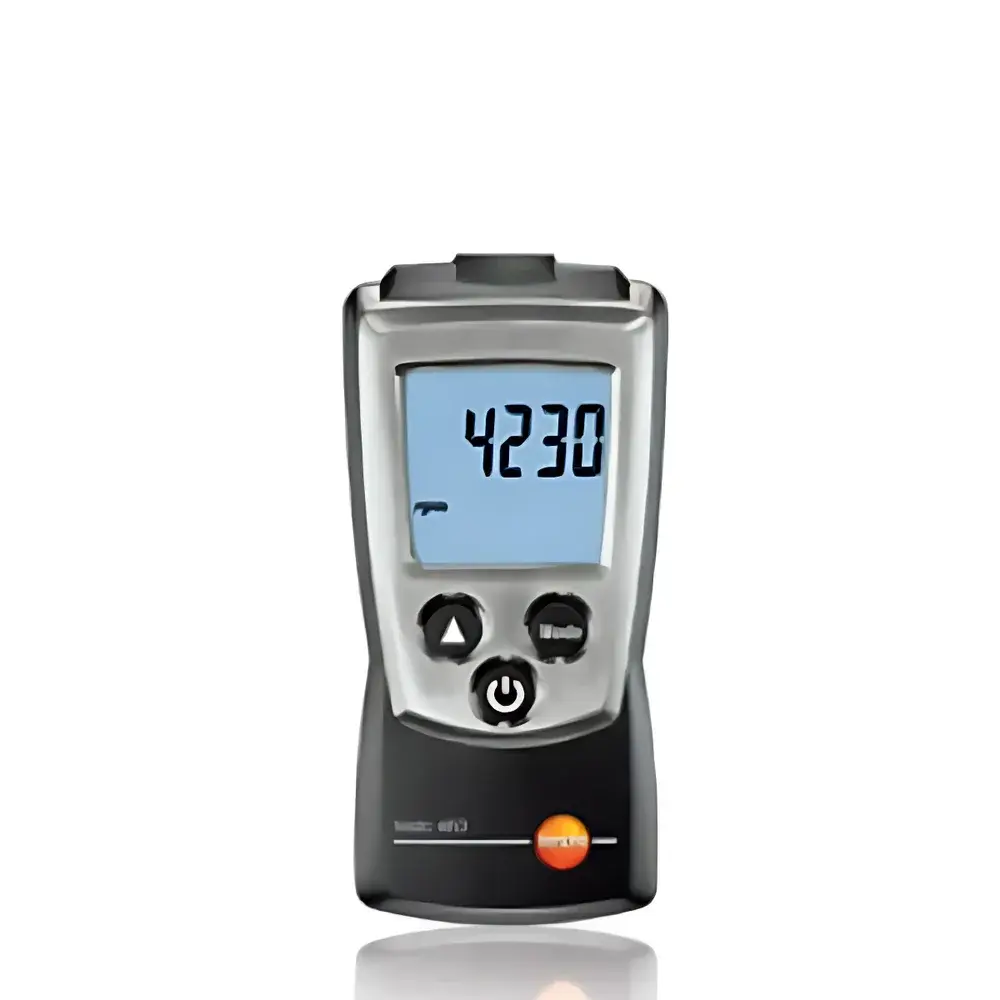
testo 460 Optical Tachometer
| Brand | testo |
|---|---|
| Origin | Germany |
| Model | 460 |
| Weight | ~150 g |
| Operating Temperature | 0–50 °C |
| Power Supply | 3 V (CR2032 battery) |
| Repeatability | ±0.05 % |
| Response Time | ≤0.5 s |
| Measurement Accuracy | ±0.05 % of reading |
| Measurement Range (Optical) | 100–29,999 rpm |
| Resolution | 0.1 rpm (100–999.9 rpm), 1 rpm (1000–29,999 rpm) |
| Measurement Distance | 10–40 cm |
| Units | rpm or rps |
| Hold Function | Yes |
| Backlit Display | Yes |
| Included Accessories | Reflective tape, protective cap, wrist strap, CR2032 battery, calibration certificate |
Overview
The testo 460 Optical Tachometer is a handheld, non-contact rotational speed measurement instrument engineered for precision, portability, and operational continuity in industrial maintenance, HVAC commissioning, laboratory validation, and quality assurance environments. Based on reflective optical sensing technology, the device emits a focused LED beam that detects periodic reflections from a retro-reflective tape affixed to a rotating surface—enabling real-time RPM acquisition without mechanical coupling, physical contact, or process interruption. Its core principle relies on time-of-flight pulse detection and digital frequency counting, delivering high reproducibility across diverse rotating components including fan blades, motor shafts, pump impellers, conveyor pulleys, and gear-driven assemblies. Designed and manufactured in Germany, the testo 460 adheres to stringent CE and RoHS compliance requirements, ensuring electromagnetic compatibility (EMC) and environmental safety in regulated production settings.
Key Features
- Non-invasive optical measurement: Eliminates need for shutdowns, slip rings, or magnetic pickups—ideal for live-line diagnostics and preventive maintenance workflows.
- Precision LED targeting system: Integrated visual indicator precisely centers the measurement beam on the reflective tape, minimizing alignment error and maximizing signal-to-noise ratio.
- Wide dynamic range: Measures rotational speeds from 100 to 29,999 rpm with resolution of 0.1 rpm below 1000 rpm and 1 rpm above—supporting both low-speed precision calibration and high-speed turbine verification.
- Robust ergonomic design: Weighing only ~150 g with an integrated wrist strap and protective cap, it ensures secure handling during field inspections and reduces operator fatigue during extended use.
- Backlit LCD display with HOLD function: Enables clear readability under low-light conditions (e.g., inside equipment enclosures or dimly lit mechanical rooms) and allows stable recording of transient values for documentation or reporting.
- Fast response time (≤0.5 s) and repeatability of ±0.05 %: Meets technical requirements for routine performance verification per ISO 5347 (vibration and shock transducer calibration) and supports traceable speed validation in GLP-compliant labs.
Sample Compatibility & Compliance
The testo 460 is compatible with any rotating surface where a standard self-adhesive reflective tape can be temporarily applied—including metal, plastic, rubber, and painted substrates. The tape’s high-contrast reflectivity ensures reliable signal capture even at oblique angles or moderate ambient light interference. No surface preparation beyond cleaning is required. The instrument operates within an optimal working distance of 10–40 cm, accommodating confined-space applications such as duct-mounted fans or enclosed gearbox housings. It conforms to EN 61326-1 (electromagnetic immunity for measuring equipment) and EN 61000-6-3 (emission limits), making it suitable for use in electrically noisy industrial facilities. While not intrinsically safe, its low-power 3 V operation and absence of spark-prone components permit deployment in non-hazardous classified areas per ATEX Category 3G.
Software & Data Management
The testo 460 operates as a standalone, battery-powered instrument with no embedded data logging or PC connectivity. All measurements are displayed and retained locally via the HOLD function; values are not stored internally nor exportable. This architecture prioritizes simplicity, reliability, and regulatory transparency—particularly relevant in environments governed by FDA 21 CFR Part 11 or EU Annex 11, where uncontrolled electronic records may introduce audit complexity. For traceability, each unit ships with a factory-issued calibration certificate referencing DIN EN ISO/IEC 17025-accredited procedures. Users are advised to perform periodic functional checks using certified reference tachometers and maintain calibration logs in accordance with internal QA protocols or ISO 9001:2015 Clause 7.1.5.
Applications
- HVAC system commissioning: Verifying airflow fan speeds against design specifications and energy efficiency benchmarks (ASHRAE Standard 111).
- Manufacturing line validation: Confirming conveyor belt drive motor RPM consistency across shifts and production batches.
- Preventive maintenance: Trending rotational drift in pumps and compressors to anticipate bearing wear or belt slippage.
- Academic and vocational training: Demonstrating rotational dynamics principles with immediate, repeatable quantitative feedback.
- Pharmaceutical equipment qualification: Supporting IQ/OQ documentation for mixing vessels, tablet press drives, and lyophilizer vacuum pumps where speed stability is critical to process parameters.
FAQ
What type of reflective tape is supplied with the testo 460?
A standard pressure-sensitive retro-reflective tape is included—designed for single-use or short-term application on smooth, non-porous surfaces. It complies with ISO 22877 for optical tachometer targets.
Can the testo 460 measure through transparent barriers such as glass or acrylic?
No—optical path obstruction (e.g., windows, guards, or dust covers) will interfere with beam transmission and reflection. Direct line-of-sight to the taped surface is required.
Is the testo 460 suitable for measuring very low speeds (<100 rpm)?
It is not specified for reliable operation below 100 rpm. For sub-100 rpm applications, contact testo support for alternative solutions such as contact-type tachometers or encoder-based systems.
How often should the testo 460 be recalibrated?
Annual recalibration is recommended under normal usage conditions. Frequency may increase based on environmental exposure, mechanical shock, or criticality of measurement in your quality management system.
Does the testo 460 meet NIST-traceable calibration requirements?
Yes—the supplied calibration certificate references traceability to national standards via an ISO/IEC 17025-accredited laboratory, fulfilling most regulatory and accreditation requirements for metrological validity.
Related Products







