
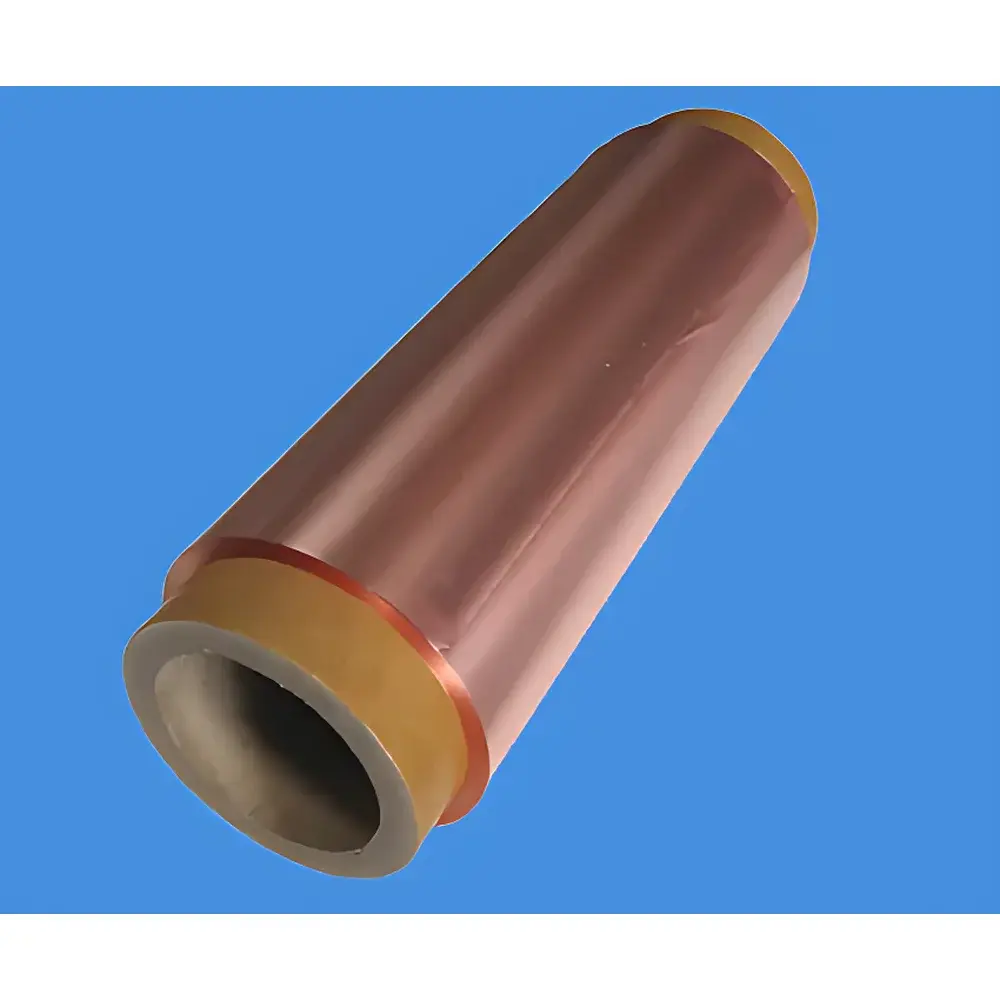
Copper (Cu) Foil for Quartz Crystal Microbalance (QCM) Electrode Applications
| Brand | Hefei Kejing |
|---|---|
| Origin | Anhui, China |
| Manufacturer Type | Authorized Distributor |
| Country of Origin | China |
| Model | Cu Foil |
| Price Range | USD 0.15 – 1,500 (per piece, depending on dimensions and purity grade) |
| Color | Metallic copper-red |
| Electrical Conductivity | 97% IACS at 20 °C |
| Thickness | 25 µm (standard), customizable from 10–100 µm |
| Density | 8.94 g·cm⁻³ |
| Vickers Hardness | 80 HV |
| Tensile Strength (Longitudinal) | 280 MPa |
| Elongation | 3–8% |
| Resistivity | ≤0.017165 Ω·mm²/m |
| Net Weight (150 mm × 150 mm × 25 µm) | ~5 kg per pack |
| Dimensions (Standard) | 150 mm × 150 mm × 25 µm |
| Packaging | Vacuum-sealed in Class 100 cleanroom bags, shipped in Class 1000 cleanroom environment |
Overview
Copper (Cu) Foil is a high-purity, precision-thickness metallic substrate engineered for use as an electrode material in Quartz Crystal Microbalance (QCM) systems and electrochemical sensing platforms. As a fundamental component in QCM-based mass-sensitive detection, the foil serves as both a conductive working electrode and a functionalized surface for thin-film deposition, corrosion studies, or real-time monitoring of interfacial processes—including metal electrodeposition, polymer film growth, and biomolecular binding events. Its well-characterized physical and electrical properties—particularly its high conductivity (97% IACS), low resistivity (≤0.017165 Ω·mm²/m), and reproducible mechanical behavior—ensure stable frequency response and minimal energy dissipation during QCM oscillation under AT-cut quartz crystals (typically operating at 5–10 MHz). The foil’s uniform 25 µm thickness and smooth surface morphology (<0.1 µm Ra) support consistent acoustic coupling and reduce spurious mode excitation, enabling reliable Δf and ΔD measurements per Sauerbrey and Voigt modeling frameworks.
Key Features
- High-purity electrolytic copper (≥99.95% Cu) with controlled oxygen content (<10 ppm), minimizing oxide-induced impedance drift during long-term electrochemical cycling.
- Precision cold-rolled thickness tolerance: ±1.5 µm across 150 mm × 150 mm sheet area, verified by laser micrometry and XRF thickness mapping.
- Surface finish optimized for vacuum evaporation, sputtering, or drop-cast functionalization—no residual rolling lubricants or chloride contaminants (certified via ion chromatography).
- Mechanically robust with tensile strength of 280 MPa and elongation of 3–8%, supporting repeated handling in glovebox and dry-room environments without microcracking.
- Class 100 cleanroom vacuum packaging ensures surface integrity—free from airborne particulates (>0.3 µm), hydrocarbons, and moisture adsorption prior to electrode mounting.
Sample Compatibility & Compliance
This Cu foil is compatible with standard QCM sensor holders (e.g., Inficon, Stanford Research Systems, and custom-built electrochemical QCM cells) featuring 3-electrode configurations (working, counter, reference). It adheres to ASTM B152/B152M (Standard Specification for Copper Sheet, Strip, and Plate) and meets ISO 9001-certified manufacturing traceability requirements. For regulated applications—including GLP-compliant corrosion inhibitor screening or USP analytical instrument qualification—the foil lot documentation includes CoA (Certificate of Analysis) with certified thickness, resistivity, and surface cleanliness data. While not inherently FDA-listed, it satisfies material eligibility criteria under FDA 21 CFR Part 11 for electronic record integrity when used within validated QCM data acquisition workflows.
Software & Data Management
The foil itself does not include embedded firmware or software; however, its performance is fully interoperable with industry-standard QCM data acquisition platforms such as QCM-I software (Biolin Scientific), NOVA (Metrohm Autolab), and custom LabVIEW-based acquisition modules. When integrated into electrochemical QCM (EQCM) experiments, the foil enables synchronized acquisition of frequency shift (Δf), dissipation (ΔD), current (I), and potential (E) datasets—supporting time-resolved mass/charge correlation analysis. Raw data exports comply with ASTM E1447 (Standard Practice for Computerized Data Acquisition in Analytical Chemistry) and are compatible with MATLAB, Python (via pandas/h5py), and OriginLab for advanced modeling (e.g., viscoelastic parameter extraction using QCM-D fitting algorithms).
Applications
- In-situ monitoring of copper electrodeposition/dissolution kinetics in battery electrolytes (e.g., Li-ion anode SEI formation studies).
- Real-time quantification of protein adsorption, DNA hybridization, or antibody-antigen binding on thiol-modified Cu surfaces.
- Corrosion rate assessment in simulated cooling water or marine environments using electrochemical noise analysis coupled with QCM mass tracking.
- Thin-film polymerization control (e.g., polyaniline, PEDOT) via potentiostatic EQCM, where mass change correlates directly with charge insertion.
- Reference-grade calibration substrate for QCM sensitivity factor (Cf) validation across multiple harmonics (n = 3, 5, 7).
FAQ
Is this Cu foil suitable for high-vacuum thermal evaporation?
Yes—its low outgassing rate (<1×10⁻⁹ Torr·L/s·cm² at 25 °C, measured per ASTM E595) and absence of volatile organics make it compatible with e-beam and resistive thermal evaporation systems.
Can I order custom thicknesses or annealed variants?
Yes—custom orders are available for thicknesses between 10–100 µm and optional recrystallization annealing (300–400 °C, N₂ atmosphere) to adjust grain size and hardness profile.
What is the shelf life under recommended storage conditions?
When stored unopened in original vacuum packaging at 20–25 °C and <30% RH, shelf life is 24 months. Post-opening, use within 72 hours in inert atmosphere to prevent native oxide growth.
Does the foil require surface activation before functionalization?
For thiol-based SAMs or electrografting, mild electrochemical pre-treatment (e.g., −0.2 V vs. Ag/AgCl for 60 s in 0.1 M H₂SO₄) is recommended to remove adventitious oxides and expose atomically clean Cu(111) domains.





